In October 1968, at the Summer Olympics in Mexico City, the American sprinters Tommie Smith and John Carlos stood on the medal podium after the 200 meters. As the national anthem played, each man raised a black gloved fist into the air and bowed his head. The gesture lasted under two minutes. It was meant to draw attention to racial injustice in the United States, at a time when the civil rights movement was met with violence and the Olympic Committee insisted that politics had no place in sport.
The International Olympic Committee disagreed with that interpretation only when the politics pointed in a direction it did not like.
Smith and Carlos were stripped of their accreditation and sent home within 48 hours. Both men faced years of threats and professional exclusion once they returned to ordinary life. The photograph of that podium has outlasted every official statement written about it since.

It is now taught in schools as a symbol of a wider truth that when large institutions try to wall sport off from the world around it, athletes sometimes refuse to stay on their side of that wall.
Fifty eight years later, a different team is testing the same wall, over a different conflict.
The Bus That Cannot Stop
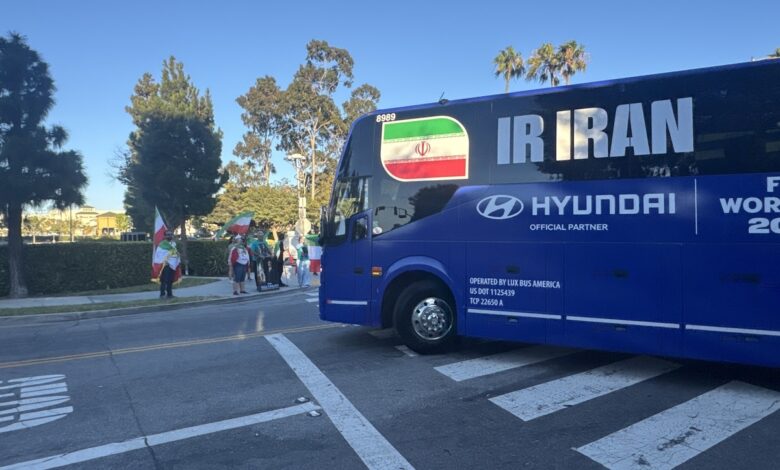
The Iran national football team is participating in the 2026 World Cup without ever spending a single night in the United States. Following the end of each of their group games held in Los Angeles, the players return through transportation back to Tijuana, Mexico, where they are stationed for training, and only return to the U.S. the day of their next game. The arrangement exists because Washington declined to host the team for the length of the tournament, even though Iran was drawn to play three of its group games on U.S. soil.
The backdrop is a war. The United States and Israel struck Iranian targets earlier this year, and a ceasefire process has been underway in parallel with the tournament itself. Andrew Giuliani, who heads the White House’s FIFA task force, confirmed that Iran’s delegation would be required to leave the country the evening of each match. U.S. officials have pointed to restrictions on individuals with ties to Iran’s Revolutionary Guard as the reasoning behind denying entry to several members of Iran’s support staff, an explanation that has not been applied to other federations at the tournament.
Iran’s coach, Amir Ghalenoei, told reporters after the team’s opening 2-2 draw with New Zealand at SoFi Stadium that the squad had been told to leave immediately rather than rest overnight as planned.
“I think our team is perhaps the most oppressed in the World Cup,” he said. Captain Mehdi Taremi credited the crowd, much of it drawn from the roughly 230,000 Iranian Americans living around Los Angeles, with making the match feel like a home game despite everything surrounding it. FIFA president Gianni Infantino visited Iran’s locker room after the match. Taremi later said he believed Infantino wanted to help, but added that other forces were also at work, a comment he did not elaborate on further.
READ: FIFA reportedly proposes Israel-Palestine match to open youth football festival
Iran has said it intends to file a formal complaint with FIFA over the travel arrangement, arguing it violates the principle of equal conditions for participating teams. FIFA has not yet issued a public response.
A Pattern Beyond One Team
Iran’s situation is the most visible example of something larger that has run through this tournament and the months leading up to it. Several separate incidents, unconnected to each other in any organized sense, have placed the same underlying tension on display as athletes, fans and ordinary citizens increasingly unwilling to treat sport as a politics free zone, even as the institutions that govern sport keep insisting it should be one.
During April, the under 21 side from Bosnia and Herzegovina prepared to play a qualifying game for the UEFA European Championship against the team from Israel. The game was scheduled to take place at neutral venue in Hungary. Most of the players from Bosnia did not shake hands with the Israeli team members before the game started. The match itself ended 0-0 and drew little lasting attention. The unshaken hands did not fade as quickly. Bosnian media connected the gesture with military actions of Israel in Gaza and Iran. It must be noted that Bosnia is a state where its contemporary image was created as a result of the Srebrenica genocide in 1995, where more than eight thousand Bosnian Muslims, both males and young boys, died while international community could do nothing to stop it. This background cannot give answers to all motivations for making this gesture but it is one of them.
Two months later, in Toronto, just hours before the World Cup match between Canada and Bosnia and Herzegovina, a group of protesters scaled up the embankment next to the Gardiner Expressway and put a cover on top of the official Toronto FIFA World Cup logo with a slogan, “Kick Israel Out of FIFA.” They were wearing t-shirts showing their organization’s name as Jews for a Free Palestine. According to Faisal Ibrahim who was acting as a spokesperson for them, “FIFA broadcasted Israeli league matches held in the territories which we believe belong to Palestinians and therefore is complicit in the act rather than remaining neutral.”
Then in May, Barcelona’s eighteen year old forward Lamine Yamal waved a Palestinian flag from an open top bus during the club’s La Liga title parade through Barcelona, an event that drew an estimated 750,000 people into the streets.
Yamal, whose father is Moroccan, posted photos of the moment to his Instagram account, where he has more than 42 million followers. Israel’s defense minister Israel Katz accused him of inciting hatred. FC Barcelona issued a statement to its Israeli fan club clarifying that the gesture did not reflect the club’s official position and was not planned in advance. Spain’s Prime Minister Pedro Sánchez took the opposite view, writing that anyone who considers waving a national flag to be incitement has lost perspective, and that Yamal had simply expressed solidarity that many Spaniards feel.
Similarly, at Stanford University’s commencement this June, somewhere between one hundred and two hundred of the roughly six thousand graduating students walked out of the stadium as Google chief executive Sundar Pichai began his address. Organizers from Stanford’s chapter of Students for Justice in Palestine cited Project Nimbus, a 1.2 billion dollar cloud computing and AI contract that Google and Amazon signed with the Israeli government in 2021, along with broader objections to Google’s work with U.S. immigration enforcement. The protesting students held a separate gathering nearby, calling it the People’s Commencement. Pichai, for his part, told reporters he was glad students felt able to express their views peacefully. Venture capitalist Vinod Khosla criticized the walkout publicly, calling it short sighted and arguing that opposition to AI contracts ignored the technology’s potential benefits for people elsewhere in the world.
READ: Iraqi football player questioned for 7 hours after arriving in US: Reports
A War Without a Handshake
Apart from football and ceremonies of graduation, another and far more serious dispute took place in 2025 between two neighboring nations, each possessing nuclear arms, raising the same question about the ability of sport to remain independent of politics.
In April 2025, a provocative incident took place in Kashmir, which is under the control of India. The incident was considered by Indian authorities to be the worst attack against India after 2008. India alleged Pakistan of the attack. Pakistan refuted any connection to it, saying that it was baseless. It also called for an independent international inquiry into the killings. Within two weeks, India had already canceled the Indus Water Treaty, which had been existing between the two nations since 1960 even after surviving two earlier wars between the two nations, and it also carried out a number of air and missile attacks on sites located in Pakistani controlled territories. The Pakistani government said that it was an illegal action taken against Pakistan, since there is nothing in the treaty about its suspension. Pakistan’s air force responded to the strikes by shooting down several Indian aircraft. A ceasefire was reached after four days of exchanges, on May 10, 2025.
Cricket between the two nations, a fixture that had continued through earlier crises, did not survive this one. The Indian team has refused to shake hands with the Pakistan team at numerous tournaments ever since, including Asia Cup and T20 World Cup in 2026, an act mirroring the same decision of bringing politics into the world of sports in another part of the world and another game altogether.
What the Gesture Is Actually Saying
None of these moments started a war, and none of them will end one. A banner on a highway overpass does not change a FIFA bylaw. A flag waved from a parade bus does not move a ceasefire negotiation forward. What these gestures share is smaller and, in a way, more telling that each one is a refusal to separate politics from daily life.
FIFA has spent years describing itself as neutral on political matters. This line of thinking becomes difficult to uphold immediately when an organization needs to determine which flags to confiscate and which to leave alone, or which federations to suspend and which to let off.
Tommie Smith and John Carlos were immediately ostracized from the Olympic hierarchy after making their gesture in 1968. Many years have passed since then, but the photograph is much more widely known than many of the official decisions made in response to it. Whether the gestures made across this World Cup, in Toronto, in Barcelona, in Bilbao, at Stanford, and on the road between Tijuana and Los Angeles, are remembered the same way will depend on what happens after the cameras move elsewhere. Iran’s team will board the bus again this week, cross the border once more in the dark, and return to play. That, at minimum, is an event that will still be true regardless of who wins the tournament.
OPINION: Sheikh Jarrah: How ceasefires enable Israel’s quiet annexation
The views expressed in this article belong to the author and do not necessarily reflect the editorial policy of Middle East Monitor.