Unfolding catastrophe: Israel cuts off Gaza again, deepens humanitarian crisis in devastated enclave

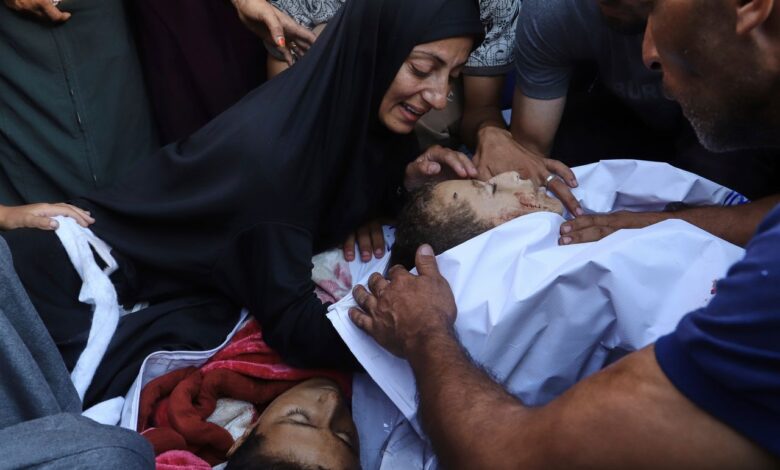
Israel has once again cut off Gaza from the rest of the world, closing off the only two entry points into the devastated Palestinian enclave and deepening a humanitarian crisis for millions of people struggling to find food and shelter.
This week, Israel closed the Kerem Shalom crossing, the only cargo entry point into Gaza operational for the last two weeks, after the latest round in its aerial battle against Iran.
Israel also sealed the Rafah crossing – Gaza’s only international border checkpoint that connects it to Egypt – completely cutting off the enclave from the rest of the world.
The latest blockade has stopped the flow of all essential humanitarian aid, commercial goods, food, medicine, and fuel into a territory of 2.4 million ravaged by a nearly three-year war that has forced 90 percent of the population out of their homes and hearths.
Israeli officials routinely claim that up to 800 aid trucks enter Gaza every day. But independent aid groups put the number of trucks entering Gaza at approximately 110 per day, which is barely sufficient to meet the population’s daily nutritional needs.
Experts say Israel’s actions are part of a broader pattern of “collective punishment” rather than any legitimate security measures, as cited in the official announcement.
Hamdullah Baycar, professor of international relations at Karadeniz Technical University in Türkiye, tells TRT World that the timing of the crossing closure is directly linked to Israel’s ongoing military engagements elsewhere in the region.
“Restrictions on the movement of people and goods have been a feature of Gaza for many years and have intensified significantly since 2023. However, the timing of the latest closure appears closely linked to the current Israeli-US war against Iran,” he says.
Baycar says that while Israel is framing the decision as a response to Iranian missiles, the crossings have long served a dual purpose – security and political – for Israel.
“By restricting the flow of humanitarian aid and commercial goods, Israel exerts pressure on the Palestinian population. The crossings provide Israel with a source of diplomatic leverage, as the opening or closure of aid routes can become a bargaining chip in negotiations involving mediators, humanitarian organisations, and international actors,” he says.
Related
London-based Palestinian filmmaker Yousef Alhelou tells TRT World that the move is part of Israel’s effort to further solidify its longstanding control over Gaza.
“Israel’s closure of Gaza commercial crossings is not new. Israel has been maintaining full control of Gaza’s airspace, territorial waters, and border crossings. Actually, Israel still occupies Gaza,” he says.
“Whenever Israel wants to collectively punish Palestinians, it takes measures to show that it has that power. It suffocates the people of Gaza under the pretext of security,” he says.
Alhelou adds that Israel justifies such closures “in the name of Iranian missiles into occupied Palestinian territories,” even though the restricted movement of humanitarian aid into the besieged enclave serves only to “strengthen (Israel’s) grip on Gaza and seek revenge”.
In his view, Palestinians constitute the “weakest link” in any chain of events where Israel encounters a setback.
“Anything (bad) happens to Israel, Palestinians have to suffer,” he says.
According to the UN Office for the Coordination of Humanitarian Affairs (OCHA), people in Gaza have no choice but to rely on a steady flow of humanitarian and commercial goods from outside the besieged territory.
The UN and its partner organisations “work hard to maintain a sustained and predictable flow” of humanitarian aid into Gaza despite Israeli restrictions, it noted in a recent note.
“Such efforts cannot be sustained if crossings remain closed,” it said.
The latest blockade exacerbates an already dire situation in Gaza, where years of war have destroyed 88 percent of infrastructure, including homes, vital facilities, and public services.
Baycar warns of severe consequences of the Israeli blockade for Gaza’s residents.
“The territory remains heavily dependent on external supplies of food, medicine, fuel, and other essentials, while years of war have devastated livelihoods and infrastructure. Any prolonged closure will further worsen shortages and deepen civilian suffering,” he says.