The devastation from two massive earthquakes that struck Venezuela on Wednesday offers a stark warning for California and other seismically vulnerable areas of the toll catastrophic shaking can bring to urban areas.
It will take days to assess the full scope of the damage; at least 32 were dead and more than 700 were injured, with both numbers expected to climb, the Associated Press reported early Thursday, with dozens of buildings collapsing in the state of La Guaira, about 20 miles north of the capital. Videos show horrifying, but now predictable, images of entire blocks flattened and basic infrastructure in shambles.
The first images of the most severe damage in Venezuela appear to involve the collapse of “non-ductile concrete buildings,” a type of building construction that also exists in California, according to Maria Mohammed, president of the Structural Engineers Assn. of Southern California.
“Looking through the photos that have been coming through the news, it looks like most of the buildings that we’re seeing that have collapsed are non-ductile concrete buildings,” Mohammed said. This type of concrete building lacks enough steel to keep the brittle concrete in the columns from exploding when shaken in an earthquake.


The U.S. Geological Survey has said that non-ductile concrete buildings are one of the building types “most likely to kill people during an earthquake.”
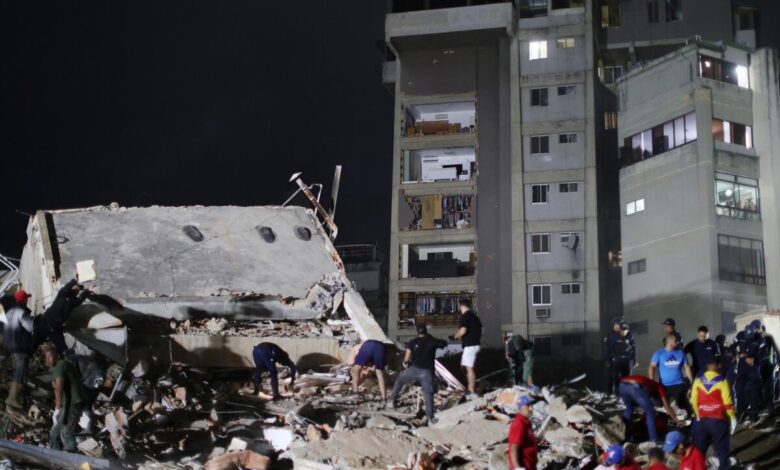
People climb among rubble on Wednesday night in Caracas following two devastating quakes.
(Jesus Vargas / Getty Images)
The discovery of the fatal flaw behind non-ductile concrete buildings came during the magnitude 6.6 Sylmar earthquake of 1971. Concrete buildings that collapsed in that earthquake included a 46-year-old Veterans Administration hospital in San Fernando, where 49 people died.
More concrete buildings came tumbling down during the magnitude 6.7 Northridge earthquake of 1994, causing the partial collapse of a Kaiser Permanente building and a Bullock’s department store.
Minimum building requirements have changed in the U.S. since the 1970s to ban construction of non-ductile concrete buildings and to require a better configuration of steel reinforcement to resist shaking. In the last decade, a few local governments, such as those of Los Angeles, Torrance, Santa Monica and West Hollywood have required seismic retrofits of vulnerable non-ductile concrete buildings, although the deadline to get them retrofitted remains years away. L.A. County also recently ordered retrofits of high-rise concrete buildings that are either owned by the county or in the unincorporated area.
But many other cities across California have not imposed such retrofit rules, including San Francisco, which has so far only required the owners of concrete buildings to submit an online screening form with information about their building’s design.
Meanwhile, vulnerable concrete buildings continue to tumble down in earthquakes all around the world, including in Taiwan in 1999, New Zealand in 2011, Mexico in 2017, Turkey and Syria in 2023 and, earlier this month, in the Philippines, where a viral video showed workers fleeing a wobbling building containing a Jollibee fast food restaurant before it collapses catastrophically.
It will take time to assess the building codes and practices in the Venezuelan cities devastated on Wednesday. One study, published in 2020, discussed how experts might recommend retrofitting riskier buildings. Another report, published in 2023, suggested updates be incorporated into the Venezuelan seismic code “to improve the safety” of buildings.
Some of the deadliest quake-triggered building collapses in other countries around the world were influenced by corruption, uneven enforcement of building rules and shoddy construction. In New Zealand, a government investigation found that one of the engineers who designed one of the buildings that collapsed, which resulted in 115 deaths, had been working well beyond his level of experience.
California has progressively increased quake safety codes for new construction in the last century after major temblors such as those in Long Beach in 1933, Sylmar in 1971, Loma Prieta in 1989 and Northridge in 1994.
But there remains concern about older construction. Although many older brick buildings have been retrofitted in L.A., other types of buildings have not.

Rescue workers in Caracas search a collapsed building for survivors after Wednesday’s quakes.
(Javier Campos / Associated Press)
Engineers have warned that a major vulnerability for California is concrete buildings built to codes that existed in the 1970s or before and that haven’t been retrofitted and are capable of collapsing. A key example was the partial collapse of the then-brand-new Olive View Medical Center in Sylmar, which had opened just months before the 1971 Sylmar earthquake to higher building standards; three people died.
The USGS said in 2008 that it was plausible that about 50 low- and midrise older concrete buildings could collapse in a magnitude 7.8 earthquake in Southern California. There could be 800 people in completely collapsed concrete buildings, and 7,000 in partially collapsed structures, the USGS said in its ShakeOut scenario.
The massive earthquakes that hit Venezuela on Wednesday came as a one-two punch. Temblors of magnitude 7.2 and 7.5 struck within 39 seconds of each other at 6:05 p.m. local time, according to the U.S. Geological Survey, causing the collapse of buildings in the nation’s capital of Caracas. An estimated 20,000 people probably experienced “violent” shaking, as defined by the Modified Mercalli Intensity Scale, enough to throw buildings off of foundations and cause great damage in substantial buildings.
The epicenter, or starting point, of the largest quake Wednesday occurred about 100 miles west of Caracas, in the state of Yaracuy, but then the temblor ruptured down a lengthy stretch of fault to the east, sending shaking energy toward Caracas. According to crowdsourcing data sent to the USGS, “very strong” or “severe” shaking was felt in Caracas.
“This is one of the very damaging earthquakes, because you combined a very large event with residences of a lot of people,” seismologist Lucy Jones, a Caltech research associate, said at a briefing Wednesday.
Wednesday’s largest quake appeared to be the biggest Venezuela had experienced in 125 years, possibly eclipsed only by an earthquake with an estimated magnitude of 7.7 that hit in 1900 off the country’s coast, killing 21 people, according to a USGS database of historic quakes. The closest quake of magnitude 6 or above to strike close to Caracas in recent memory was a 6.6 quake in 1967, which killed 240 people and highlighted the seismic vulnerability of the city.

The interiors of buildings were visible after walls tumbled during the disaster.
(Adrian Naranjo / Associated Press)
Computerized calculations by the USGS, based on the area shaken and its intensity, suggest there’s a 40% chance that fatalities could range from 10,000 to 100,000, with a 36% chance that fatalities could range from 1,000 to 10,000.
“Overall, the population in this region resides in structures that are vulnerable to earthquake shaking,” the USGS said.
Some areas in Venezuela may have perceived the two quakes as just one very long shaking event. One seismic station in Venezuela observed what seemed to be “a fairly continuous event” between the two quakes, said Caltech geophysics professor Zhongwen Zhan, the director of the Caltech Seismological Laboratory, at Wednesday’s briefing.
“It’s not surprising. A 7.2 earthquake can last half a minute, so the two earthquakes basically get merged together, so we can expect potentially there is a reclassification later — it might not be a separate foreshock,” Zhan said.
Caracas’ seismic risk is similar to the risk Los Angeles and San Francisco face, as each of the three cities sits near a tectonic plate boundary “and therefore historically have had bigger earthquakes,” Jones said. “To a geologist, this is not at all surprising.”
The rate at which tectonic plates are moving past one another in Venezuela is similar to how fast seismic strain is accumulating on the San Andreas fault in California, Jones said.
“This is the sort of earthquake we’ve been talking about when we talk about the San Andreas risk for California,” Jones said. The similarities are striking — this earthquake was just outside of Caracas, and the San Andreas fault is about 20 miles away from the edges of the city of Los Angeles and “runs right through the Inland Empire.”
California will likely fare better than Venezuela did on Wednesday, but a magnitude 7.8 quake in this state would still be devastating. A USGS simulation of a hypothetical magnitude 7.8 earthquake on the San Andreas fault shows a death toll of 1,800 people is plausible, and there could be hundreds of billions of dollars in losses, with huge fires — perhaps 10 times the size as those that burned through Altadena and Pacific Palisades — sweeping through the region due to a lack of water.

A car was smashed beneath a building that collapsed in the shaking in Caracas.
(Adrian Naranjo / Associated Press)
“So we are very concerned,” Jones said.
The Venezuela earthquake occurred about seven hours after a magnitude 5.6 earthquake hit Mendocino County in Northern California. It was a much smaller earthquake, perhaps one-thousandth the size of the Venezuela earthquake, Jones said.
About 25 minutes after the Venezuela quake, a magnitude 6.9 earthquake hit off the east coast of Japan, about 20 miles from the town of Kuji in Iwate prefecture, where “strong” shaking was felt. However, the USGS estimated that it was unlikely there would be fatalities or significant economic damage, as structures there are generally resistant to earthquake shaking. The area was hit hard by the 2011 magnitude 9.1 earthquake and tsunami that began off of Japan’s east coast, leaving more than 20,000 dead or injured.
Wednesday’s quake “was offshore, and therefore the shaking that people received — the earthquake is coming at them from farther away — they receive lower levels of shaking,” Jones said. Also, “the construction in Japan has been designed to take that strong earthquake shaking, and therefore it doesn’t look like there’s any significant damage there.”
There’s no scientific basis that the quakes in Venezuela, California and near Japan are related, Jones said.
California residents can prepare for an earthquake in a number of ways including property owners assessing whether a retrofit is needed, even if it isn’t required by a city ordinance. Jones noted that the state offers grants through the Earthquake Brace+Bolt program to partially cover the cost of retrofitting older single-family homes that can slide off their foundation in an earthquake.
Many apartment buildings have a flimsy first floor, propped up by skinny supports to accommodate carports, garages or storefronts. A number of cities across California have required that these “soft-story” buildings be retrofitted, but most cities have not followed suit. There are also a number of cities, especially in the Inland Empire, with older brick construction that can collapse in an earthquake, yet the buildings aren’t required to be strengthened or demolished.
Structural engineers have also warned about the potential vulnerability of certain older steel-frame skyscrapers. Torrance, Santa Monica and West Hollywood all require steel-moment-frame buildings to be evaluated and, if necessary, retrofitted, but the city of Los Angeles does not.
People can also take steps to secure their furniture, such as fastening televisions to walls, strapping bookcases to walls, installing quake-safety latches on kitchen cabinets and using quake-resistant or anti-theft picture frame hooks, which can be purchased at a hardware store and can help prevent glass frames from shattering on the floor. Officials recommend storing one gallon of water per day per person for at least three days and, ideally, for two weeks.
“The other thing I would strongly say is, talk to your neighbor. Do you have a family plan? Do you have a neighborhood plan?” Jones said. “That’s what gets you through a disaster, and the best earthquake plans would be ones that you do with your neighborhood, with your church, with your school.”