“You get cold at least once every few years, right? But if I pick a random day of your life and sample you for a cold virus, I probably won’t find it, right? Even if I look for antibodies, depending on what strains you have been infected with, how long ago, and what antibody test I use, I still might not find it,” says Stephens.
“So consider issues like that with wild mammal species we barely know anything about, and you will see what a tough problem it is.”
The viral needle points nowhere

In the past five decades, multiple outbreaks in DRC, Gabon, Liberia, Sierra Leone, Sudan, Uganda, and other countries have killed thousands of people.
Yet not enough has been done to search for the animal or animals primarily responsible for Ebola spillover into humans.
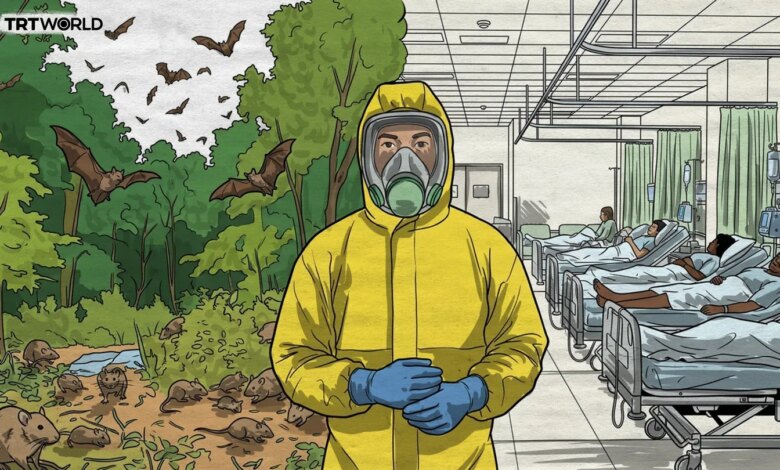
Based on where the past Ebola outbreaks have occurred and tracking of infectious cases, scientists are convinced that the Ebola source lives in the wild. They also believe it’s a mammal.
Stephens says that of the 900 known species of mammals in Africa, only about 350 have been sampled. Even fewer have been infected with a live virus in a laboratory, which allows researchers to see where the virus hides inside an animal and how long after the infection it becomes detectable.
“The virus is also likely pretty rare in the species that it does infect. For example, in most species where we have found it, only two or three individuals have ever tested positive out of however many samples, sometimes hundreds.”
What Stephens is talking about is finding antibodies.
Most of the past outbreaks, such as the deadly spillover in 2014 that killed more than 11,000 people in Sierra Leone, Liberia and Guinea, have been traced back to wild animals.
In the 2014 outbreak, virologists found that the first infection was a two-year-old boy who may have come in contact with bats in Guinea. Other outbreaks have been linked to the consumption of meat from dead chimpanzees and other primates.
Even considering that the search for the Ebola virus has been limited to a small percentage of wild animals, it is mind-boggling that no trace of live virus has been found despite hundreds of samples that have been meticulously collected from jungles of DRC and other places and then shipped to high-tech labs of institutions like America’s CDC.
Maybe that’s because remnants of the virus hide in some tissue of an animal after the outbreak has run its course, Stephens and his colleagues argued in a paper titled ‘Where is the elusive primary ebolavirus reservoir and how do we find it?’
The immune system of animals, like that of humans, fights and flushes out pathogens. But a tiny bit of the infection might still remain in the body, lingering in a tissue, eluding virologists.
The paper argued that once the animals experience any stress, such as food shortages, it triggers the virus to resurface.
Even if scientists narrow their search to bats, collecting samples from thousands of bats across different species is a daunting and expensive proposition.
“Add on top of that the fact that if you sample at the wrong time of year or sample the wrong tissue, you still won’t find it, and you have a really tough task in front of you. So few species have been studied in detail in the lab that it’s really hard for us to narrow any of that stuff down,” says Stephens.
“Of course, ultimately the main reason we haven’t found it more often is because there just isn’t money available to look for it. Certainly not the kind of money you would need to thoroughly sample hundreds of species.”