69
The growing dependence on spiritual products among young Nigerians is not happening in a vacuum. It is emerging at the intersection of economic hardship, unemployment, social uncertainty, and a deeply religious culture. While many observers view the trend as purely religious, the facts suggest it is also a response to structural challenges facing Nigeria’s youth.
Nigeria is one of the youngest countries in the world. More than 60 percent of the population is under the age of 30, creating immense pressure on the economy to generate jobs and opportunities. Yet millions of young people continue to struggle with unemployment and underemployment. According to ActionAid Nigeria, nearly 80 million young Nigerians are unemployed, representing about 53 percent of the country’s youth population.
For many young people, this reality creates a sense of frustration and uncertainty. Graduates leave school with high expectations only to face a difficult labour market. As a result, many begin searching for alternative explanations and solutions to their challenges. Religion often becomes one of those avenues.

Researchers have found that religious engagement plays a significant role in helping unemployed youth maintain hope and emotional resilience. A recent study on youth unemployment and religion in Nigeria concluded that religious participation often functions as an emotional buffer, helping young people interpret hardship as temporary and purposeful rather than permanent failure.
Nigeria’s religious landscape also helps explain why spiritual products enjoy widespread acceptance. The country remains one of the most religious societies in the world. According to data analyzed by the Pew Research Center, roughly 7 in 10 Nigerian adults believe that spells, curses, or other forms of spiritual influence can affect people’s lives. Such beliefs make spiritual interventions seem practical rather than extraordinary.
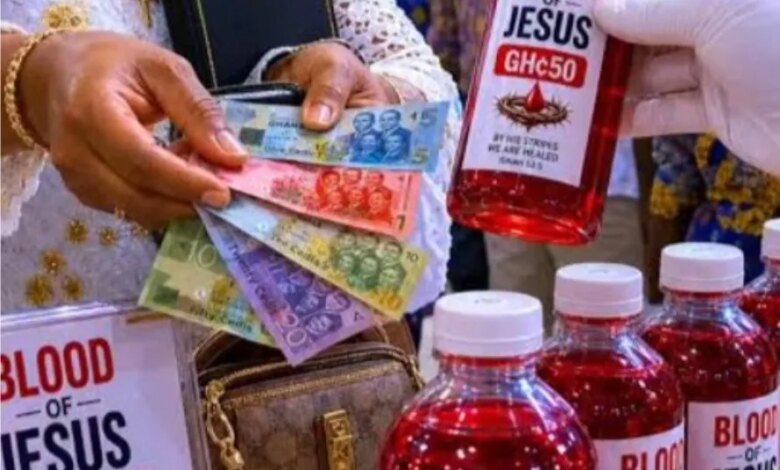
This cultural environment has created fertile ground for a booming market in spiritual products and services. Anointing oils, miracle waters, prophetic consultations, prayer seeds, deliverance materials, and breakthrough programmes are often marketed as pathways to divine favour, protection, prosperity, or success.
The popularity of these products is closely linked to the rise of prosperity-oriented religious teachings. Scholars studying Nigerian Pentecostalism argue that prosperity messages resonate strongly in societies marked by inequality and limited economic opportunities. These teachings often present wealth and success as visible signs of divine blessing, encouraging believers to seek spiritual solutions to material problems.
The attraction is understandable. In a country where hard work does not always guarantee success, spiritual products can offer something many young people desperately need: hope. They promise that a breakthrough is possible even when economic realities suggest otherwise.
Social media has amplified this trend. Testimonies of miraculous jobs, visa approvals, business success, healing, and financial breakthroughs circulate daily across digital platforms. These stories create powerful narratives that reinforce the belief that spiritual intervention can change one’s circumstances.
However, critics argue that excessive dependence on spiritual products can sometimes divert attention from structural issues such as unemployment, poor governance, inadequate education, and economic inequality. Some scholars warn that while religion can provide comfort and resilience, it may also encourage people to personalize problems that are fundamentally social and economic.
Ultimately, the rise of spiritual products among Nigerian youth is not simply a story about faith. It is a story about survival. It reflects the struggles of a generation navigating economic uncertainty while searching for meaning, hope, and control in an increasingly difficult environment. In many cases, spiritual products have become less about religion alone and more about managing the anxieties of everyday life in contemporary Nigeria.
KEY FACTS AT A GLANCE
- More than 60% of Nigerians are under 30 years old.
- Nearly 80 million Nigerian youths are reported to be unemployed.
- About seven in 10 Nigerian adults believe spiritual forces such as spells or curses can influence people’s lives.
- Studies show religious engagement helps many unemployed youths maintain hope and psychological well-being.
- Scholars link the popularity of prosperity teachings to widespread inequality, corruption, and economic hardship.
This combination of economic pressure, cultural beliefs, and the search for hope helps explain why spiritual products have become increasingly attractive to many young Nigerians. Spiritual products now are seen not merely as religious items but as tools of reassurance. For a graduate unable to find work, a trader struggling with inflation, or a young entrepreneur facing repeated setbacks, a young lady looking for serious relationship, man or woman who wants to break free from curses, these products can represent hope, protection, and the belief that a breakthrough is possible.
Religion also occupies a central place in Nigerian society. Spiritual explanations for life’s challenges remain influential, and many people believe that unseen forces can affect health, finances, relationships, and career prospects. This cultural foundation makes spiritual solutions feel natural rather than unusual.
Another factor is the commercialization of faith. Over the years, some religious organizations and spiritual entrepreneurs have increasingly packaged faith into products and services marketed as pathways to prosperity, protection, or success. Researchers have linked the growth of such practices to broader social challenges, including poverty, insecurity, and public frustration with existing institutions.
Social media has amplified the trend. Testimonies of miraculous financial breakthroughs, instant healing, and supernatural success now circulate daily on TikTok, Facebook, Instagram, and YouTube. For young people navigating uncertainty, these stories can be highly persuasive.
Yet the rise of spiritual products also reveals a deeper issue: a crisis of confidence in traditional systems. When education does not guarantee employment, when hard work appears disconnected from reward, and when public institutions struggle to meet expectations, many people begin looking elsewhere for solutions. Some turn to politics, others to migration, and many to spirituality.
Ultimately, the growing reliance on spiritual products among Nigerian youth says less about religion itself and more about the realities of life in a society where hope has become a valuable commodity. In times of uncertainty, people naturally search for something to hold on to. For many young Nigerians, that search has taken a spiritual form.
–SUNDAY ADIGUN
08029516271
What do you think about this?
Drop your opinion in the comment section.
FOLLOW US & Share this with someone who needs to see this.