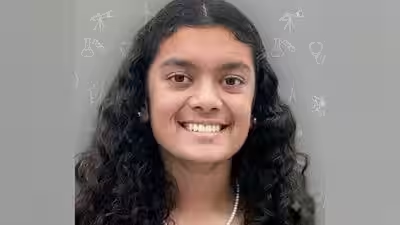
Sharvi Mahajan, a 14-year-old Indian-American student from California, has been named among the 10 finalists of the 2026 3M Young Scientist Challenge. Mahajan has developed a system to predict driver fatigue before it leads to accidents.Sharvi, an eighth-grade student at Bernardo Heights Middle School, created NeuroDrive Alert, an electroencephalogram (EEG)-based machine learning system designed to monitor changes in brain activity over time, Young Scientist Lab reported. The system helps identify signs of fatigue early enough to warn drivers before they fall asleep.She is one of five Indian-American students to reach the final round of this year’s competition. The other finalists of Indian origin are Aaisha Asif from Florida, Raji Doshi from Connecticut, Arika Kundu from Minnesota and Naboshree Santra from Florida.
Brain signals predict fatigue
Sharvi’s project combines two technologieswidely used in science and engineering. The first is electroencephalography (EEG), a method that records electrical activity produced by the brain. Small sensors, called electrodes, are placed on the scalp to measure tiny electrical signals generated by brain cells. EEG is commonly used by doctors and researchers to study sleep, epilepsy and other neurological conditions because it can track changes in brain activity in real time.The second technology is machine learning, a form of artificial intelligence in which computer models learn to recognise patterns from data. Machine learning systems improve the ability of the computer models to identify specific patterns after being trained on examples.Sharvi’s NeuroDrive Alert combines these two approaches to detect microsleep. Microsleep refers to very short periods of sleep, often lasting only a few seconds, during which a person may briefly lose awareness. Even though these episodes are short, they can be dangerous if they occur while driving or operating machinery.According to Sharvi, the system is designed not only for drivers but also for other situations where staying alert is important.
Taking project further


Sharvi said she entered the 3M Young Scientist Challenge because she wanted to learn new skills and strengthen the practical impact of her project. “I entered the challenge to learn new skills and be exposed to innovative ideas that could significantly refine the real-world impact my project has,” she said.Sharvi also said science, technology, engineering and mathematics (STEM) has always been an important part of her life.”I have been deeply passionate about STEM my whole life, and I believe that the 3M Young Scientist Challenge is an amazing opportunity to both pursue my interests further and make a difference in others’ lives.”
EEG inspires her
When asked about her favourite invention of the last 100 years, Sharvi chose the EEG machine because of its ability to record brain activity without surgery or other invasive procedures.”My favorite invention of the last 100 years is the Electroencephalogram (EEG) machine,” she said.She explains how EEG can capture very small changes in brain activity over time. “I find it absolutely amazing how an EEG can reflect even the tiniest of dynamic brainwave movement into a scan, showcasing its exceptional temporal resolution.”“The sheer amount of data that one can obtain from a singular EEG has the potential to shed light on the neural fingerprints of numerous neurological conditions, and it has the power to present a wide range of information about a subject, from sleep quality to attention span,” she added.According to Shravi, one of the most exciting uses of EEG is in the development of Brain-Computer Interfaces (BCIs) as these systems allow computers or other devices to receive signals directly from the brain.“BCIs restore independence, mobility, and communication for individuals experiencing physical disabilities and the EEG machine’s key role in the process of building a BCI truly intrigues me.”
A future in neuroscience and AI
Sharvi hopes to continue working in fields related to the brain and artificial intelligence in the future. Looking ahead 15 years, she said she hopes to become a computational neuroscientist or founder of a tech startup.Sharvi said she has long been fascinated by the brain and enjoys developing artificial intelligence models. “I have always been mesmerized by the brain and the mysteries that are hidden within it, with neuroscience always being the field in science that intrigues me the most.”She added, “Artificial intelligence also captures my attention, and I love the process of building different models and testing different features or techniques to improve model performance.”According to Sharvi, combining these interests would allow her to build technology she is passionate about. “Becoming a computational neuroscientist or founding a tech startup centered around these topics would allow me to combine my interests and build something I am truly passionate about.”The 3M Young Scientist Challenge, organised by 3M and Discovery Education, is now in its 19th year. The competition invites students in grades five to eight to develop science-based solutions for everyday problems.During the summer, each finalist will work with a 3M scientist to further develop their project. The competition will conclude on October 12 and 13 at the 3M Innovation Center in St. Paul, Minnesota, where the finalists will take part in live challenges, present their projects and answer questions from the judging panel. The winner will get $25,000 prize.


