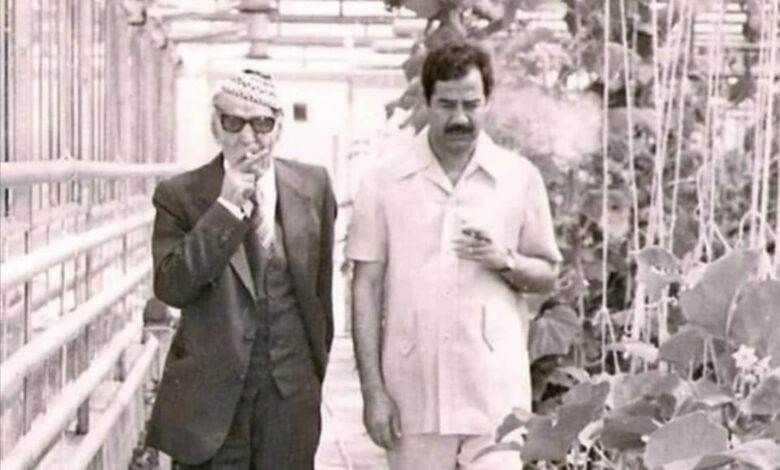
Because I belong to a generation that never lived through the era of Muhammad Mahdi al-Jawahiri when he was truly Iraqi, I knew him as many others did: from books, from poems, and from the echo of his voice as it traversed decades of controversy and compromise. Yet, I was close to his son, Furat (Abu Ban)—that writer who used to carry his weekly column to me when I supervised the back page of Al-Jumhuriya newspaper more than thirty years ago. As if carrying a fragment of his father’s soul, he would hand over his article like a precious gift to be handled with exaggerated care. He grew fond of me for some reason, perhaps because of how I treated his column, publishing it on the back page as if it were a historical document to be shielded from the very air.
I remember a winter day in Baghdad when Abu Ban walked in unannounced and said, “Come on, Karam, come with me.” I didn’t ask where, nor could I refuse. On the road, as he drove, he told me: “You are the closest person to the doyen of Iraqi music, Abbas Jamil. I am taking you to him; I have something he must hear.” Abbas Jamil’s house was just minutes away from the Al-Jumhuriya building. His wife, Um Faisal, received her guests as if the house itself were a living piece of Baghdad’s memory.
Furat pulled out a cassette tape and asked Abu Tariq to listen. Muhammad Mahdi al-Jawahiri’s poem praising King Hussein bin Talal, “O Most August King,” had been composed by Gamal Salama and performed brilliantly by the Tunisian singer Soufia Sadok. Abbas Jamil sat analysing the melody for Furat, while I prepared to write a journalistic piece about the encounter. But Furat told me he would write his weekly column on the subject, and that was that.


The Green Zone’s anti‑corruption purge: Justice or a new round of spoils?
My distant yet close relationship with Al-Jawahiri did not end there. When rumours spread that he would return to Baghdad and newspapers prepared to celebrate him, my late friend Mohamed Al-Jazairi wrote an article titled “Welcome, Al-Jawahiri,” placing his full portrait on the cover of Al-Rafidain magazine. But Al-Jawahiri never returned.
I remember four years before Al-Jawahiri’s passing, standing inquisitively before verses of his poem praising Muammar Gaddafi, hung in the corridor of the “Qouz Al-Teek” hotel in the city of Misrata. My friend, the Libyan writer Abdul Karim Al-Danna, told me that Al-Jawahiri was highly celebrated in Libya during the 1980s and had recited his famous poem there dedicated to the “Brother Leader.” Thus, the chain of leaders upon whom Al-Jawahiri bestowed his fluid, heart-touching poetry was complete in my mind.
I recalled all these scenes from memory—about a poet around whom controversy never ceases, both as an artist and a human being—as I watched photos of the new statue of Al-Jawahiri in Baghdad. It is a statue that offends artistic taste. It is not just that the refined sensibilities of the Iraqi architect Ihsan Fethi reject such mediocrity; it is that the graveyard mentality ruling today’s distorted Iraq is inherently incapable of producing art, immortalising a poet, or even comprehending the meaning of beauty.
Therefore, it was hardly surprising that Fethi denounced that wretched statue—a monument born under the weight of cheap political necessity and blatant authoritarian showmanship, bearing no relation to Al-Jawahiri or the Baghdad we once knew.
Here, a question creeps in that cannot be ignored: How can a government that has lost its aesthetic sense claim the ability to immortalise a poet? What kind of mind believes that a statue can compensate for the absence of taste, or that sculpture can repair what has been shattered in the soul? Mediocrity here is no accident; it is the natural consequence of an authority that views art as nothing more than a photo opportunity.
“This is not how Al-Jawahiri should be immortalised! I see an urgent need to replace the statue of Al-Jawahiri in Abu Nuwas with another that befits the greatest poet of the Arabs.” — Dr. Ihsan Fethi
Fethi was shocked when he saw a frail statue assembled in haste—without a competition, without a committee, without a vision. A statue where everything is distorted: the proportions, the posture, the clothes, the head, the hands tied behind the back, the feet, and an unbelievably poor execution. Then came the ultimate scandal: another head of Al-Jawahiri placed in front of the base… meaningless, without reason, devoid of any shred of understanding.
Fethi notes that this work is flimsy and unacceptable by all standards. He does not blame the artist who executed the work, the sculptor Nada Kazim—adding that “perhaps the work was executed under force majeure while he is in the autumn of his artistic life”—as much as he blames those who approved this absurdity: the former Prime Minister, Muhammad shia al-Sudani, who granted the direct commission without legitimacy or fairness, after praise was heaped in his presence upon a work lacking the simplest elements of quality. Even Artificial Intelligence—as Fethi points out—is capable today of proposing dozens of statues for Al-Jawahiri that are incomparably better than this regrettable work.
Massad Boulos: Like a man calling Libyans to prayer from Malta
Here lies the irony: how can an authority that refuses to know Al-Jawahiri except through the lens of its own desires, rather than his loud, contradictory reality, fashion a statue for him? What ignorance assumes that sculpture is merely a shape, that poetry is just a name, and that Al-Jawahiri can be summarised in a piece of stone? The statue here is not merely an artistic failure; it is an announcement of a total rupture with the meaning of culture itself.
These are not just artistic errors; it is a cultural scandal that exposes how the selectivity of symbols is managed in a country where taste has been hijacked, talent suppressed, and mediocrity turned into state policy.
A country where statues are erected just as offices are distributed: through cronyism, ostentation, and a mindset that sees art only as an official photo op in front of a work unworthy of a glance.
Therefore, Fethi concludes with an explicit call: do not unveil this shameful work; instead, remove it immediately and replace it with a monument worthy of the greatest poet of the Arabs. This call is not merely artistic, but political as well, because it says what everyone fears to utter: that mediocrity is no longer a passing incident in Iraq, but has become a methodology, with the ruling authority acting as the official patron of ugliness.
Perhaps the most painful irony is that Muhammad Mahdi al-Jawahiri, who spent his life chasing meaning, is chased today by a statue that does not recognise him. It is as if mediocrity decided to take revenge on poetry itself.
This is not a statue of Al-Jawahiri; it is a statue of the regime confessing, unintentionally, that it has lost the ability to create beauty… and with it, the ability to know who Al-Jawahiri truly was.
The views expressed in this article belong to the author and do not necessarily reflect the editorial policy of Middle East Monitor.


