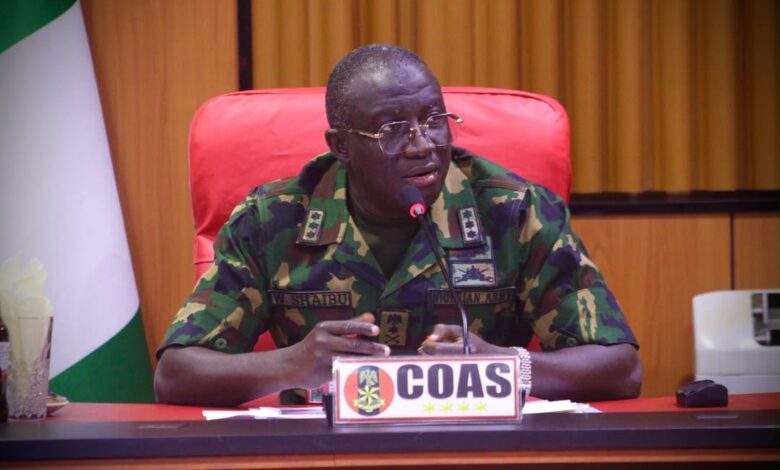
The Nigerian Army has ordered stronger security along humanitarian supply routes in the North East after identifying continued threats from terrorist remnants, with the Chief of Army Staff, Lieutenant General Waidi Shaibu, directing the Theatre Commander to reinforce protection on the Dikwa to Gamboru Ngala corridor.
He gave the directive on Friday at the Army Headquarters in Abuja while receiving the Head of Office of the United Nations Office for the Coordination of Humanitarian Affairs (UN OCHA), Miss Danielle Parry.
The action is meant to keep aid workers, relief materials and displaced people safe as humanitarian operations and resettlement activities continue in conflict affected parts of Borno State.
READ RELATED NEWS
Army, EFCC deepen partnership to tighten fight against cybercrime, insecurity
Tinubu approves four new Army divisions to speed security response
Nigerian army warns public against fake social media linked to COAS
Humanitarian operations in the North East still face security and funding difficulties even though military operations have recorded gains.

Aid agencies continue to support millions of people, making secure access to affected areas important for relief delivery and the return of displaced families to their homes and livelihoods.
Army orders stronger protection for aid deliveries
Lieutenant General Shaibu reaffirmed the Nigerian Army’s commitment to strengthening civil military cooperation to support humanitarian work, protect civilians and promote stability in areas affected by conflict.
He said safe and unhindered access for humanitarian workers is an important part of the Army’s strategy to build on operational achievements and support the safe and dignified return of displaced persons.
The Army chief congratulated Miss Parry on her appointment and said cooperation between the Nigerian Army and United Nations humanitarian agencies has continued to improve humanitarian assistance, strengthen civilian protection and support stabilisation efforts in the North East.
He assured the UN delegation that the Army would continue to provide security for humanitarian personnel, relief materials and other essential supplies, particularly along operational routes where movement remains difficult.
Lieutenant General Shaibu also acknowledged the security issues connected with the ongoing decongestion of Internally Displaced Persons camps and the resettlement of affected people in Borno State.
He said the Army would continue working closely with humanitarian organisations so that the process takes place in a secure and properly coordinated manner.
To support that objective, he instructed the Theatre Commander to strengthen security on vulnerable humanitarian corridors, especially the Dikwa to Gamboru Ngala route where terrorist remnants still threaten relief operations.
He also directed that force protection measures should be improved, convoy escort arrangements strengthened and operational coordination between the military and humanitarian organisations increased.
UN says millions still depend on humanitarian assistance
The Army chief also encouraged UN OCHA to make better use of available resources through improved forward logistics planning.
He pointed to local warehousing and wider implementation of the Humanitarian Reset Initiative as practical steps that could help maintain uninterrupted humanitarian assistance even with declining financial support.
Miss Parry said the military’s assistance has helped humanitarian organisations reach people affected by conflict.
She noted that nearly six million people still rely on humanitarian assistance while international humanitarian funding continues to decline. That situation, she said, makes effective coordination between security agencies and humanitarian organisations even more important.
Miss Parry identified Gwoza, Bama, Damboa, Dikwa and Monguno as locations where security problems continue to limit humanitarian access. She appealed for continued military support so displaced people can safely return to farming and other livelihood activities.
The meeting reaffirmed cooperation between the Nigerian Army and UN OCHA as both sides discussed practical measures to improve humanitarian access in conflict affected areas.
For More News Details, Visit the New Daily Prime.