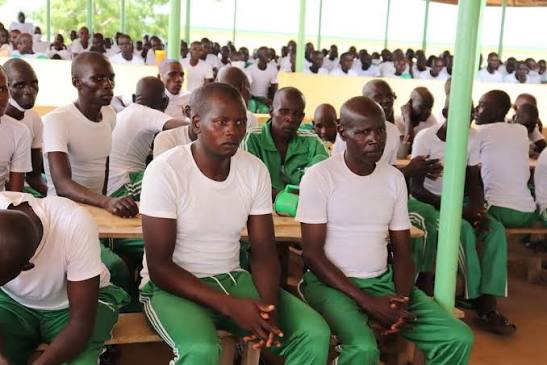
Security experts have recommended that the federal government transfer the rehabilitation and reintegration of repentant terrorists from the military to civilian institutions, saying the current military-led model should evolve to reflect international best practices and improve long-term peacebuilding.
The recommendation is contained in a new policy report by Nextier, which reviewed a decade of Operation Safe Corridor (OSC), Nigeria’s flagship deradicalisation, rehabilitation and reintegration programme for former Boko Haram and Islamic State West Africa Province (ISWAP) associates.
The policy report was authored by Dr Chibuike Njoku, Associate Consultant at Nextier, and Dr Ndu Nwokolo, Managing Partner at Nextier.
According to the report, “The federal government should progressively transfer responsibility for rehabilitation and reintegration from the military to a civilian-led framework coordinated by the National Counter Terrorism Centre (NCTC) and relevant ministries.”
The report added that “while the military should retain responsibility for security screening and risk assessment, rehabilitation, psychosocial support, education, livelihood assistance and post-reintegration monitoring should be managed by civilian institutions with appropriate technical expertise.”
Operation Safe Corridor was established in 2016 as a non-kinetic component of Nigeria’s counterterrorism strategy to encourage defections from insurgent groups, reduce recidivism and facilitate the reintegration of eligible former fighters into civilian life.
The report said the programme has processed 2,615 former combatants over the past decade, with 2,016 successfully completing rehabilitation.
Despite these achievements, the researchers argued that the programme’s institutional development has lagged behind its operational expansion.
“A decade after its establishment, Operation Safe Corridor has evolved from a pilot military initiative into Nigeria’s principal non-kinetic counterterrorism programme,” the report stated.
It, however, noted that “the programme’s evolution has been uneven. Governance remains largely military-led, with limited civilian participation, weak transparency and inadequate independent oversight.”
The report reviewed the programme’s development across three phases. Between 2016 and 2018, Operation Safe Corridor was established as a military-led initiative offering religious reorientation, psychosocial counselling, civic education, literacy and vocational training.
From 2019 to 2022, the programme expanded significantly following increased military operations against Boko Haram and rising voluntary defections, while collaboration improved among the Defence Headquarters, the National Counter Terrorism Centre, government ministries and development partners.
The report said the period from 2023 to 2026 witnessed unprecedented numbers of defectors entering the programme, alongside growing public debate over its transparency, accountability and long-term effectiveness.
According to the researchers, community acceptance remains one of the programme’s biggest challenges.
The report observed that “community reintegration continues to face resistance, as many affected communities perceive that former combatants receive greater support than victims of insurgency.”
It further argued that rehabilitation and reintegration are fundamentally civilian responsibilities requiring broader stakeholder participation.
“While the military was appropriately positioned to establish and manage OSC during active counterinsurgency operations… the rehabilitation and reintegration phases are fundamentally civilian responsibilities,” the report stated.
It added that these phases require leadership from civilian institutions with expertise in education, psychosocial support, vocational training and social welfare, alongside active participation by state governments, local authorities, traditional and religious leaders, civil society organisations and host communities.
Beyond recommending a civilian-led framework, the report urged the Federal Government to adopt a National Reintegration Policy that clearly defines institutional mandates, eligibility criteria, funding arrangements and accountability mechanisms.
It also recommended a results-based monitoring and evaluation framework to assess employment outcomes, educational attainment, psychosocial recovery, community acceptance and recidivism, while calling for greater support for victims of terrorism through psychosocial care, livelihood restoration and community reconciliation initiatives.