Divers once believed the Great Blue Hole was bottomless; then explorers discovered human remains deep inside

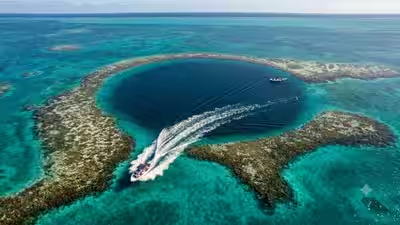
From above, the Great Blue Hole is breathtaking. A near-perfect circle of deep blue sits in the middle of the turquoise waters of the Belize Barrier Reef, attracting divers from around the world with the promise of giant stalactites, reef sharks and one of the planet’s most iconic underwater landscapes. Yet beneath its postcard-perfect surface lies a far more unforgiving environment. As divers descend, sunlight fades, oxygen disappears, and the risks multiply. Once rumoured to be bottomless, the giant marine sinkhole has instead revealed a darker reality: expeditions have recovered the remains of divers who never returned, serving as a stark reminder that one of Earth’s most beautiful dive sites is also among its most hazardous.
Why Belize’s famous underwater sinkhole is one of the world’s most spectacular dive sites
The Great Blue Hole lies around 70 kilometres off the coast of Belize within the UNESCO-listed Belize Barrier Reef Reserve System. Measuring approximately 318 metres across and 124 metres deep, it formed during the last Ice Age when the area was a dry limestone cave system. As sea levels rose following the end of the glacial period, the cave roof collapsed, leaving behind the enormous circular sinkhole seen today.According to Nasa, the site is famous for its towering limestone stalactites and stalagmites, some of which formed before the cave was submerged. These geological features provide evidence of dramatic sea-level changes over thousands of years and make the Blue Hole one of the world’s most significant underwater geological landmarks.
Why the deeper water becomes increasingly dangerous


Although the surface waters are calm and inviting, conditions change dramatically with depth. Divers descend through increasingly dark water, where buoyancy shifts rapidly due to pressure changes, making precise control essential.Below around 30 metres, many divers begin entering depths where nitrogen narcosis becomes a significant concern. Sometimes referred to as the “rapture of the deep”, the condition can impair judgement, slow reaction times and create a false sense of confidence – precisely the opposite of what is needed in a technically demanding dive.Navigation also becomes more difficult. Fine sediment resting on ledges can be stirred into dense silt clouds by a single misplaced fin kick, reducing visibility to almost nothing. Combined with cavern-like formations and limited natural light, disorientation can occur quickly, especially for divers without advanced deep-diving experience.Nasa notes that dives at the Great Blue Hole are intended for experienced divers because of the site’s depth, environmental conditions and technical demands.
The mysterious anoxic layer beneath the surface
One of the remarkable things about the Blue Hole is the anoxic layer, which is essentially a depth that lacks oxygen completely. This layer is characterised by a hazy boundary layer of hydrogen sulfide gas, which is a poisonous gas that is formed through the decomposition of organic materials by bacteria in the absence of oxygen.Not much life can exist past this layer. What one gets to experience is an eerie underwater world where there is no visibility and very little biological activity.
Human remains ended the myth of a “bottomless” hole
For decades, stories circulated that the Great Blue Hole had no bottom. Modern exploration eventually disproved that belief, mapping the sinkhole’s true depth while revealing a sobering reality.As reported by the Jerusalem Post, two divers have lost their lives in the Blue Hole over the years. During deep exploration missions, human remains were discovered inside the sinkhole, including bodies that could not be safely recovered because disturbing them would have posed unacceptable risks to recovery teams. The discoveries reinforced what experienced dive operators have long emphasised: the greatest danger is rarely wildlife, but the extreme conditions created by depth itself.While Caribbean reef sharks and nurse sharks are commonly seen around the site, they are generally not considered the primary hazard. Instead, depth, decompression requirements, impaired judgement, limited visibility and technical errors account for the overwhelming majority of serious incidents.
A natural wonder that demands respect
The Great Blue Hole continues to be among the most highly desired destinations for scuba divers, luring many into this geological formation under the Caribbean waters, which is yet to lose its charm among the scientific and adventurous community.Nonetheless, the past of this great geological structure is also a perfect example of how great nature may hide even greater dangers within itself. Every additional meter of this dive alters the physics, chemistry, and biology of diving in this place.


