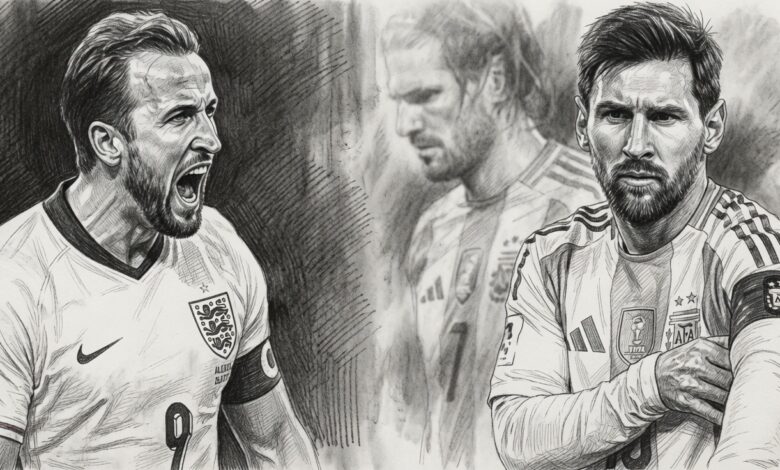
England face defending champions Argentina in Atlanta on Wednesday, 15 July, with a place in the 2026 World Cup final at stake. The historic rivalry has been given an extra edge by questions on social media about referee Ismail Elfath, although there is no verified evidence that FIFA has tried to favour Lionel Messi or Argentina.
The semi-final is scheduled to kick off at 8pm UK time at Mercedes-Benz Stadium. England reached the last four after beating Norway 2-1 in extra time, while Argentina defeated Switzerland 3-1 after extra time in their quarter-final.
The winner will advance to Sunday’s final in New York. For England, victory would offer another chance to win the country’s first men’s World Cup since 1966. Argentina are attempting to retain the trophy they won in Qatar in 2022.
Why Ismail Elfath’s appointment has caused debate
FIFA appointed Moroccan-born American referee Ismail Elfath to take charge of the semi-final, assisted by Corey Parker and Kyle Atkins. Italian official Maurizio Mariani will serve as the fourth official.

Some supporters have questioned the decision because Elfath was the fourth official when Argentina beat France in the 2022 World Cup final. He has also refereed matches involving Messi’s Inter Miami, with Messi’s teams winning those games.
Read related news:
England fans demand Quansah red card review after Fifa Balogun row
10-man England beat Mexico to reach world cup quarter-finals
Those links have been described as a “lucky omen” for Argentina, but they do not prove bias or improper conduct. A fourth official does not make the main refereeing decisions, while a team’s previous victories under a particular referee are not evidence that future matches will be unfair.
FIFA refereeing chief Pierluigi Collina has defended the independence and integrity of officials amid claims of possible favouritism. The accusations circulating online remain unsubstantiated, and there is no confirmed evidence that the tournament has been “rigged” for Messi.
Elfath has significant international experience. He became a FIFA-listed referee in 2016, worked at the 2022 World Cup and has already handled three matches at the 2026 tournament. His appointment suggests FIFA considers him capable of managing one of the competition’s most sensitive fixtures.
A rivalry built on unforgettable World Cup moments
England and Argentina have met five times at the World Cup, producing several of the tournament’s most controversial and memorable matches.
England won their 1966 quarter-final at Wembley after Argentina captain Antonio Rattín was sent off. The confusion surrounding that dismissal later contributed to the development of football’s yellow and red card system.
Argentina gained revenge in the 1986 quarter-final, when Diego Maradona scored both the “Hand of God” goal and a second effort widely regarded as one of the greatest goals in World Cup history.
Their 1998 meeting brought more drama. David Beckham was sent off before Argentina won a penalty shoot-out. Four years later, Beckham scored from the penalty spot as England secured a 1-0 victory in the 2002 group stage.
Wednesday’s match will be the countries’ first competitive meeting in 24 years. The long gap, combined with the political history surrounding the Falkland Islands, means the fixture carries an intensity beyond an ordinary semi-final.
Can England stop Messi and Argentina?
England’s challenge will be to control Argentina without allowing the occasion to dictate their approach. Thomas Tuchel’s side must remain disciplined, particularly around the penalty area, where one mistimed challenge could change the match.
Argentina’s threat extends beyond Messi. Alexis Mac Allister, Julián Álvarez and Lautaro Martínez all played important roles in the quarter-final victory over Switzerland, with Álvarez and Martínez scoring during extra time.
England will look to Jude Bellingham after his two goals against Norway helped secure their semi-final place. His ability to carry the ball through midfield and arrive late in attacking positions could be central to England’s plan.
The match may be decided by small details: midfield control, defensive concentration, substitutions and how both teams respond to pressure. Extra time and penalties remain possible if the scores are level after 90 minutes.
Authorities have also strengthened security in Atlanta because of the rivalry’s history. Police are working with federal agencies, while officials have warned supporters against provocative political or discriminatory banners.
Argentina’s security minister said separate entrances would be used for supporters, although FIFA’s ticketing arrangements make full segregation inside the stadium difficult. Fans have been urged to behave respectfully and avoid turning political tensions into confrontation.
For viewers, the key point is that the referee debate should not overshadow the football. Elfath’s decisions will face intense scrutiny, but claims of a conspiracy require evidence, not statistics about previous matches or online suspicion.
England and Argentina now have the opportunity to settle their rivalry on the pitch. The winner will reach the World Cup final, while the losing side will be left to debate another chapter in one of international football’s most enduring contests.