FG Convenes Validation Meeting To Align National, State Budgets With Agrifood Strategy

0
Chibuzor Emejor
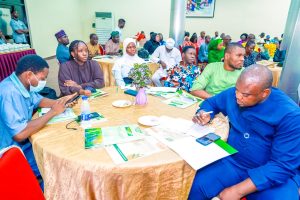
The Federal Government has convened a national validation meeting to align national and state budgets with Nigeria’s National Agrifood System Strategy and Action Plan to implement the CAADP Kampala Declaration (2026–2035), aimed at strengthening food systems, enhancing food sovereignty, and revolutionizing the agricultural ecosystem
Speaking at the National Validation Meeting held in Abuja on Wednesday, the Minister of Agriculture and Food Security, Senator Abubakar Kyari, called on all Ministries, Departments and Agencies(MDAs) and State Governments to align their annual budgets with the new blueprint to ensure effective domestication of the CAADP Kampala Declaration and end fragmentation in agricultural spending.


Kyari explained that the Strategy was developed to build on the gains of the Maputo 2003 and Malabo 2014 Declarations, while adopting a more holistic, agrifood systems-based approach.
He stated that “This validation meeting is essential, as it is where the zero draft becomes stronger, more representative, and more actionable, we must ensure that every budget line, every programme, and every intervention across government is aligned with the priorities of this Strategy.”
He noted that the document reflects inputs gathered from extensive consultations from all six geopolitical zones and a national workshop, making it responsive to Nigeria’s diversity.
He added that “We wanted a plan that reflects the diversity of Nigeria’s agricultural landscape, from the livestock corridors of the North to the aquaculture belts of the South, from the cassava and yam zones of the East to the cocoa and oil palm plantations of the West,”.
According to the Minister, the Strategy provides a harmonised implementation framework with clear roles, responsibilities, timelines, and accountability mechanisms.
“It also integrates CAADP Biennial Review indicators into national planning, budgeting, and reporting systems.
Kyari highlighted that the Strategy directly addresses key implementation challenges facing Nigeria’s agrifood systems, including climate adaptation, disaster risk reduction, post-harvest loss reduction, and market volatility.
He pointed out ‘’these issues have undermined productivity in the past and must be tackled alongside production targets.
The Minister further said the blueprint prioritises blended financing from public, private and donor sources, as well as risk-management instruments like agricultural insurance and affordable credit to support farmers.
He emphasised that the plan specifically targets smallholder farmers, youth, women, and marginalised groups.
“The Kampala Declaration is not just a continental commitment. It is a roadmap for transforming Nigeria’s agrifood system into one that is resilient, inclusive, productive, and industrialised,” Kyari stated.
He urged all stakeholders to champion the harmonisation and operationalisation of the plan into their respective annual budget preparation processes, stressing that the Strategy must not become “another document on the shelf.”
Kyari revealed that ‘’A unified Strategy and Action Plan aligned with CAADP will reduce duplication, strengthen policy coherence, harmonise indicators and targets, and provide a single framework to attract and align investments across the public and private sectors’’.
In his welcome remarks, the Permanent Secretary, Federal Ministry of Agriculture and Food Security, Dr. Marcus Ogunbiyi, commended the Agricultural Sector Working Group and Technical Committee for driving the nationwide consultations that produced the zero draft.
According to him, the Strategy aligns Nigeria’s priorities with Agenda 2063, the Sustainable Development Goals and the CAADP Kampala Declaration, and builds on ongoing government efforts in mechanisation, irrigation, value chain development, digitalisation of agricultural services and private sector investment.
Dr. Ogunbiyi stated that the validation aims to critically examine proposed interventions, identify gaps and strengthen implementation frameworks, noting that the Strategy must promote policy coherence, reduce duplication, strengthen accountability and create stronger links among all actors in the agrifood system.
He added that the success of the Strategy will depend on effective implementation, adequate financing, robust monitoring and evaluation, strong institutional coordination and sustained political will.
“Our vision is to build an agrifood system that is productive, competitive, climate-smart, nutrition-sensitive, digitally enabled, market-oriented and attractive to our young people.
“Our objective is to ensure that no Nigerian goes hungry and that agriculture remains profitable for our farmers and agribusinesses,” he said.
In his remarks, Commissioner for Agriculture in Osun State, Mr Tola Fasseru, assured that the State Governments would work assiduously towards implementing the Kampala Declaration which is in line with the Agricultural transformation agenda of the present government.
He stressed the need to involve women and youth in agrifood systems to enhance food production and generate more revenue.
The validation meeting had in attendance representatives of state governments, development partners, the private sector, civil society organisations, and farmer groups.
End.