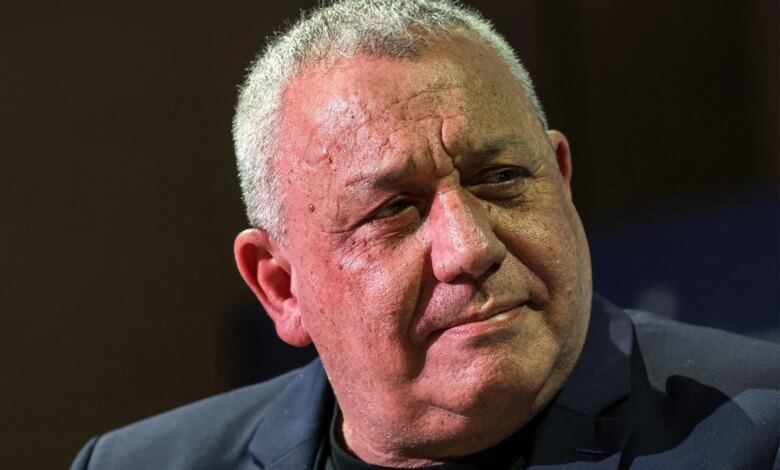
Gadi Eisenkot, the former Israeli military chief of staff, is now polling ahead of Benjamin Netanyahu.
A Channel 12 survey in July put his new party, Yashar, at 23 seats to Likud’s 22 in the 120-member Knesset, and named him the more suitable prime minister by 43 percent to 34.
Eisenkot’s pitch rests on accusing Netanyahu of failing the hostages of October 7, 2023. He has said Netanyahu approved and then sabotaged an early deal with Hamas, and that forty-six captives who should have come home did not, some of whom could have been brought back.


Beyond that, Yashar promises to restore what Eisenkot calls Israel’s security, unity and democratic institutions, prioritise the conscription of ultra-Orthodox men into military or national service, and repeal legislation he says has let Netanyahu’s government exempt them.
None of it touches the terms Israel offers Palestinians. His record does that instead, starting with the Dahiya Doctrine, the military blueprint he wrote for using massive, disproportionate force against civilian areas.
As head of the Israeli military’s Northern Command, Eisenkot formulated the doctrine and laid it out himself in 2008: villages that fire on Israel become military targets regardless of who lives there, and the response will be disproportionate by design.
It takes its name from the Beirut suburb that the Israeli military flattened during the 2006 war on Lebanon, a campaign that killed nearly 1,000 civilians, a third of them children, and gutted the country’s power plants, sewage systems, bridges and ports.
“We will apply disproportionate force on it (village) and cause great damage and destruction there. From our standpoint, these are not civilian villages, they are military bases,” Eisenkot was quoted as saying by the Yedioth Ahronoth newspaper.
“This is not a recommendation. This is a plan. And it has been approved,” he added.
Since then, Israel has repeatedly applied the doctrine in Gaza, Lebanon and elsewhere.
In the assault on Gaza that began in December 2008, about 1,400 Palestinians were killed. A UN inquiry concluded that the offensive was deliberately disproportionate and intended to punish, humiliate and terrorise the civilian population.
In 2014, another Israeli assault on Gaza killed more than 1,500 civilians over 50 days and flattened residential buildings.
Since October 2023, Israel has again employed overwhelming force in Gaza, in a genocide campaign that has killed at least 73,000 people, and wounded tens of thousands of others.
Eisenkot later became Israel’s chief of the general staff before retiring in 2019. As recently as March, he called for the Dahiya Doctrine to be applied again in Lebanon, saying it had “never been more relevant.”
His four years as chief of staff, from 2015 to 2019, span the Great March of Return, when Israeli snipers killed at least 189 unarmed Palestinian protesters, among them 35 children, three paramedics and two journalists, and wounded more than 6,000 others, per UN figures.


