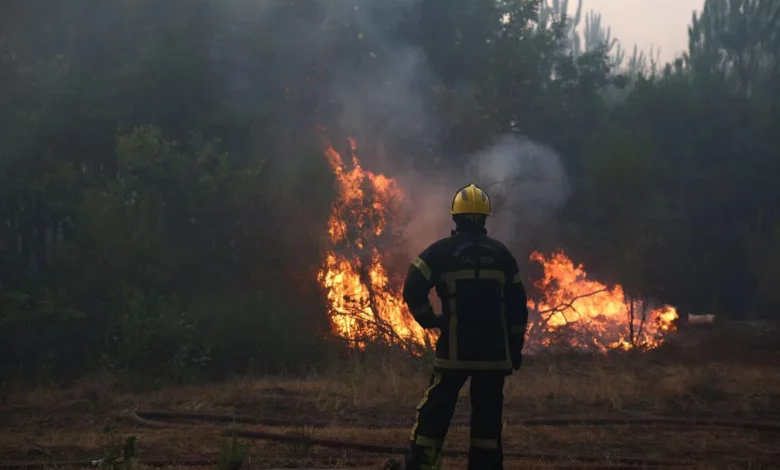
BORDEAUX/ATHENS/MADRID – France, Spain and Greece battled major wildfires on July 30 as soaring temperatures, parched vegetation and powerful winds extended a summer of deadly fires, mass evacuations and mounting disruption across Europe.
France arrested two people on suspicion of arson as crews contained a vast fire near Bordeaux, Spain fought a blaze in the eastern province of Castellon, and Greece battled fires on two fronts that killed three firefighters and forced tourists and residents to flee parts of Crete.
“The wind is unbelievable – you can’t stand, sometimes. The flames were huge; it was really scary,” resident Chrissa Gioukaki told Reuters at Agia Galini, a coastal resort on Crete’s southern coast, where a number of tourists and locals found shelter for the night in an indoor gym.
Europe is world’s fastest-warming continent
Emergency crews have faced barely a pause between heatwaves and fire fronts this summer across an increasingly tinder-dry Europe, the world’s fastest-warming continent.


European Union (EU) countries are having an above-average season for wildfires, already overtaking 2025’s record-breaking year.
The temperatures on July 30 showed Europe was the continent furthest from its historic norm, according to the Reuters Climate Monitor. The average high is forecast to be 25.3 deg C, which is 3.6 deg C above what was typical from 1961 to 1990.
In south-western France, the authorities said the fires near Bordeaux had not spread overnight, with the area burned holding at 42,000ha. Two people were arrested on suspicion of starting fires, the local administration said, without providing further details.
The French fires have torn through pine forests and forced about 220,000 residents and holidaymakers to evacuate, although some 60,000 have been allowed to return. Thousands of businesses that briefly suspended operations were gradually reopening, officials said.
Conditions were expected to ease around Bordeaux on July 30, with the possibility of thunderstorms, greater humidity and temperatures below recent peaks. But an extreme heat warning remained in force in Gironde, the department of which Bordeaux is the main city, and the authorities cautioned that the fires were not over.
Meteo France warned in its latest bulletin on the afternoon of July 29 that the highest danger of wildfires was now centred on south-eastern France and the Mediterranean arc.
Wildfires in France have now burned more land than in any year since 2006.
Gale-force winds fan flames in Greece
Two firefighters died after becoming trapped in a fire that erupted in central Crete on July 29 while they were driving between fire fronts. Another died in a separate fire in the Peloponnese region.
Hundreds of residents and tourists were evacuated from the area by sea and by land around the community of Krya Vrysi and surrounding villages, as high winds pushed the fire out of control near popular holiday spots.
“The situation is desperate. The tragic part is that we lost two fellow firefighters,” said Yiannis Tartarakis, mayor of Agios Vasilios, a municipality that includes several affected villages in its district.
Firefighting aircraft could not be deployed because of the strong winds, he added.
Intense heat from wildfires is known to create its own microclimate, which can occasionally lead to more extreme weather phenomena; wind is one.
New fires as Spain faces ‘extreme’ crisis
Spanish Prime Minister Pedro Sanchez said the crisis facing the country was “extreme”, with at least 10 active wildfires causing concern.
“We’re in a critical, highly complex situation,” Sanchez said on the evening of July 29, referring to the combination of high temperatures, low humidity and strong wind gusts fuelling the flames.
Speaking from Mallorca, he added that he had asked European Commission president Ursula von der Leyen by letter to base a new EU wildfire-fighting centre for the western Mediterranean region on the Balearic island.
New wildfires have erupted in the north-western Spanish provinces of Zamora and Leon amid the fourth heatwave of the summer, while the blaze in eastern Castellon province continued to spread, the authorities said on July 30.
More than 1,000 people have been evacuated in the area of Zamora’s Arribes del Duero natural park, while three separate fires in the north of Leon forced more than 300 people to leave their homes.
In Castellon, the head of the firefighting mission, Antonio Rodrigo, told reporters late on July 29 that the fire’s 82km perimeter had been established but not secured after flames ravaged more than 9,300ha.
The overnight operation involving 400 firefighters was “critical” to determine whether it would be stabilised within 48 hours, Rodrigo added, as weather conditions remained optimal before the heat on July 30 was expected to hamper efforts. REUTERS


