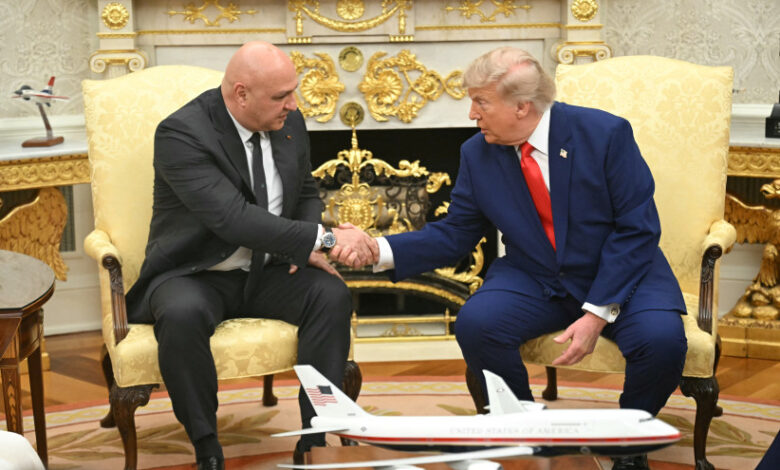
The meeting between US President Donald Trump and Lebanese President Joseph Aoun in Washington on July 21 is part of a new strategy that the White House is pursuing. Trump has met with Syrian leader Ahmed al Shara’a and also Iraq’s Prime Minister Ali al Zaidi in recent weeks. This shows how the US is now cementing its ties to key countries in the historic Levant.
Lebanon, Syria, and Iraq are all part of the heartland of the Arab world. Damascus and Baghdad are historic cities around which the whole of the region’s civilization has revolved over the last 1,000 years.
Lebanon is now key to US policy. Trump wants to see movement toward peace and also wants to help Lebanon move forward with deploying its armed forces into pilot zones. Trump has pledged to help Lebanon “a lot.”
“It’s been a very badly treated place and country, and we’re going to have it properly treated and treated with the respect it deserves,” Trump told Aoun. “We’re gonna help it a lot.”


The US has been involved in 11 nights of strikes on Iran as of July 22, meaning that while Iran is on the defensive, Washington is moving to shore up Syria, Iraq and Lebanon. This is a key frontier. All of these states have common interests against Iranian influence and Iranian attempts to destabilize them.
Trump shows devotion to Israel-Lebanon talks
The US has also helped broker rounds of talks between Lebanon and Israel, signaling historic levels of engagement. A US president has never been so devoted to Israel and Lebanon and trying to make things actually work. Aoun is the first Lebanese leader to visit the White House in almost 20 years. Previous US administrations essentially sat on the sidelines and let things percolate in the wrong direction in Lebanon.
“Lebanon hopes the talks result in Israeli troops withdrawing from large swaths of southern Lebanon that they currently occupy, and the Lebanese military receiving support to assert full control in areas where Hezbollah had held sway,” the London-based Asharq al-Awsat noted.
Speaking about Israel and the IDF redeploying, Trump said, “they’re in the process of doing that. They’re in the process of redeploying.” Israel is clear that it won’t withdraw from everything it has taken. Aoun said to the American president, “your vision is peace,” calling it Trump’s “legacy.”
The goal now is for the Framework Agreement announced on June 26 to move forward. The agreement is supposed to see Lebanon deploy in pilot zones and remove Hezbollah, and, eventually, there could be normalization with Israel. Trump has suggested he might even speak to Hezbollah. This shows the deep US commitment.
Direct flights to Beirut on the table in US-Lebanon relationship
As part of the new US-Lebanon relationship, there could be direct flights to Beirut. There will likely need to be some reforms at Beirut International Airport. This means making sure Hezbollah is not present at or near the airport. This will be complex because Hezbollah has long sought to use the airport.
Sebastian Gorka, Deputy Assistant to the President and Senior Director for Counter Terrorism on the National Security Council, wrote on X/Twitter that “eighteen years ago, Colonel Joseph Aoun was my student at National Defense University as a Department of War Counterterrorism Fellow.”
He noted that Aoun was “an exceptional student at that. It was, therefore, a deeply personal moment to see him represent Lebanon as their President today in the Oval Office with President Donald Trump.” He added that these are “two true leaders fearlessly committed to their people and to Peace in the Middle East.”


