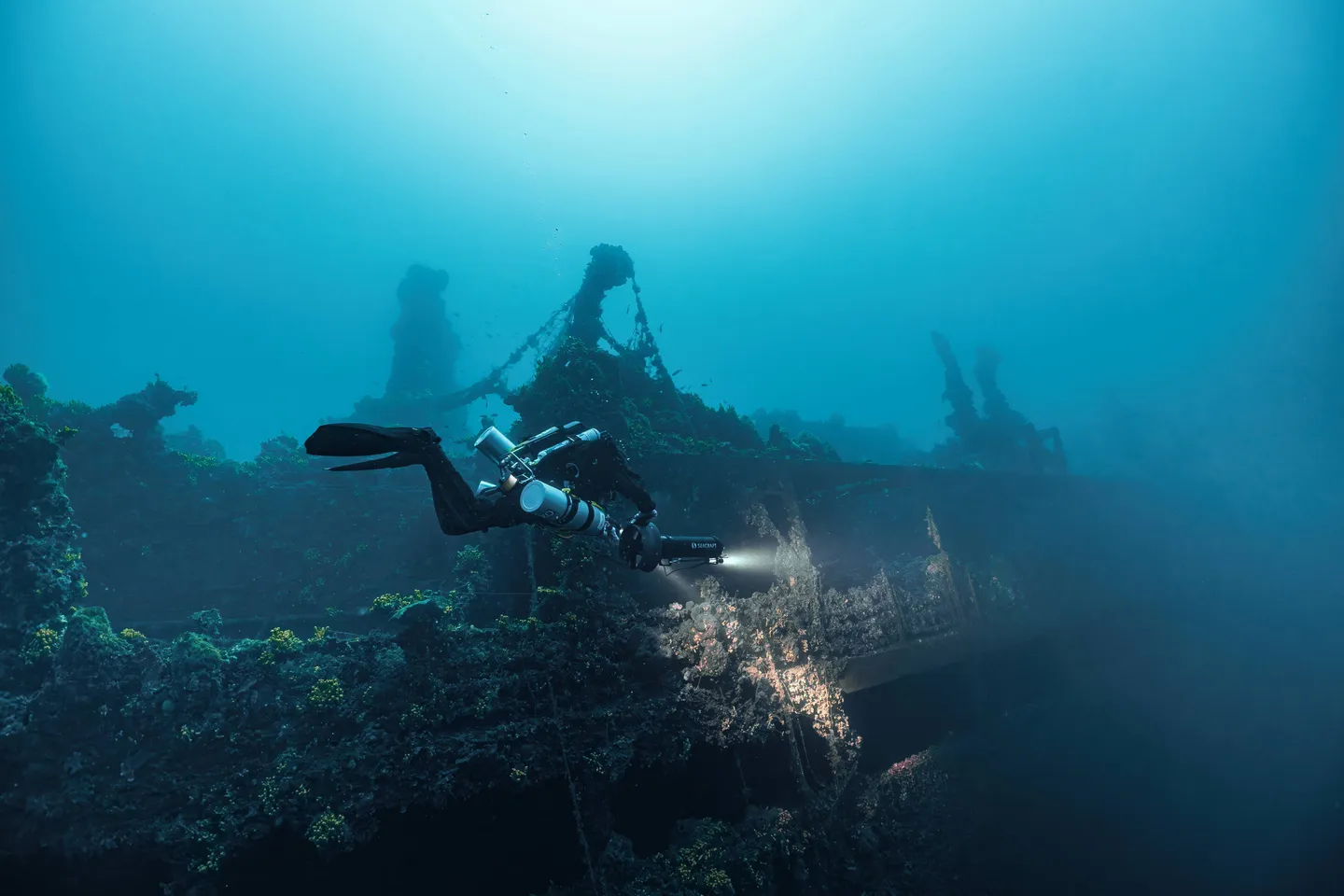
Yusuf Kartal, head of the Planning and Projects Group, says that the strait is home to more than a hundred shipwrecks, 29 of which are already open to controlled diving.
Among them is the HMS Majestic, a British flagship of great historical significance.
Also resting there is the HMS Ocean, the first to sink on March 18 after striking a mine, and collectors’ items such as the Australian submarine AE2 and the British E14, sunk by the Ottoman torpedo boat Sultanhisar.


Added to this list is the colossal SS Carthage, 121 meters long, which was sunk in battle by two torpedoes from the German submarine.
“The most extraordinary thing about these ships,” Kartal tells TRT Espanol, “is that, the moment you dive alongside them, they instantly convey the stories of the people who lived through the most ferocious moment of the war.”
Preservation against all odds
But this project isn’t solely about the nostalgia of war or the allure of exploration; it’s also about how these former instruments of mass destruction have been given a second life.
According to experts, sunken ships fulfil a vital ecological function today. Anchored to the seabed, they act as large-scale artificial reefs. Marine flora has colonised the steel, and thousands of fish, algae, and coral species have found a safe haven within these structures.
Furthermore, these metal giants act as an unexpected but highly effective shield against illegal fishing.
Riza Birkan, a technical diving instructor for the project, tells TRT Espanol that the wrecks act as veritable barriers against the commercial trawling nets that typically devastate the seabed.
By snagging the heavy nets on the steel of the warships, fishermen have avoided the area.
To reinforce this protection, the administration has installed five-ton concrete blocks with large mooring buoys for tourist boats, preventing the dropping of anchors that could damage biodiversity or the structures of the monuments.
“Today, thanks to this protection, the ecosystem has burst into color,” Birkan says.
“The warships now function as a true underwater oasis of biodiversity.”
To ensure these monuments survive for centuries to come, the scientific team has used an advanced engineering technique, simply put: cathodic conservation.
Saltwater accelerates corrosion and oxidation of iron. Without intervention, the ships will eventually collapse.
To prevent this, engineers have placed blocks of metals such as zinc, aluminium, or copper near each wreck, which act as “sacrificial anodes.” Instead of the ship losing its own electrons and disintegrating, the metal blocks corrode in the water, protecting the site.
Birkan says this very clearly by showing his own underwater camera, which has a small piece of zinc attached to prevent corrosion of the camera body.
In the underwater park, this same scientific principle is applied on a monumental scale, calculating the metallic surface of entire destroyers down to the millimetre to guarantee their eternal existence beneath the sea.
The HMS Louis was chosen to be the first vessel to use the Deep Legacy project’s pioneering cathodic protection system.
To mark this milestone, renowned Swedish photographer Alex Dawson (winner of the 2024 Underwater Photographer of the Year award) dove to capture the first images of the wreck and the installed anodes.
It wasn’t the only remarkable descent: Turkish freediver Bilge Cingigiray, famous for her Guinness World Record for weighted underwater walk, free-dived to a depth of 13 meters to commemorate the initiative. Proof that these rusting giants continue to exert an irresistible magnetism on the world’s best explorers.
Uniting past and future
The Deep Legacy project demonstrates that current technology can make underwater archaeology accessible.
Yusuf Kartal says, this initiative seeks to highlight a memory that, ultimately, belongs to all of humanity: “Canakkale is a place that holds the stories of hundreds of thousands of people from all over the world: from Australia and Canada to Senegal, France, and Ireland. That is why it is so necessary to raise awareness about the suffering that took place in this sea”.
What was a century ago a scene of global pain and division now stands as a space for historical reconciliation and cutting-edge science.
Protecting these metal sanctuaries and the souls they hold is not just a technical challenge or a tourist attraction; it is a universal responsibility that shows us that even in the darkest depths of the past, a legacy for the future can be cultivated.
It is down there where oblivion stops and the famous message of peace that Mustafa Kemal Atatürk, founder of the Republic of Türkiye, dedicated to the families of the foreign soldiers who fell in the battle of Gallipoli takes on its full meaning:
“They, having lost their lives on this land, have also become our children.”
This article was first published on TRT Espanol


