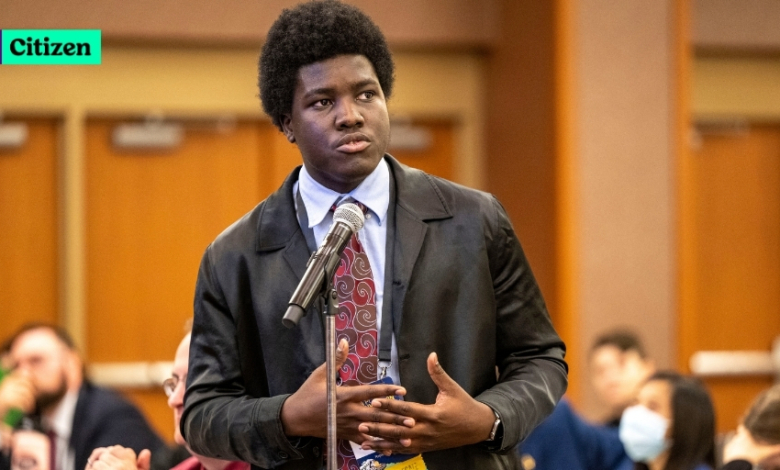
Oriekaose Agholor was barely nine years old when he got his first taste of the Nigeria Police’s incompetence. Years later, in his adulthood, he saw that things hadn’t changed, so he decided to do something about it. This is his story as told to Orame.
When you grow up in Nigeria, you learn very early that you are your own government. If there’s a fire, you fetch water. If there’s a security threat, you lock your gate and pray. I learned that lesson at eight or nine years old, when my school bus was involved in an accident on the expressway. We waited, but no police or road safety personnel came.
Eventually, the teachers with us flagged down a Keke, and we went home. If we’d been bleeding instead of just stranded, that delay could have killed us. In Nigeria, it can feel as if nobody knows who you are or where you came from; help will not get to you, no matter how bad the situation is.
Years later, during the 2020 lockdown, I started actively watching the news with my dad. I would watch news stations like Arise TV, Channels, and sometimes CNN. I kept hearing the same two words, week after week, month after month: “unknown gunmen.


What shocked me the most was that it wasn’t just ordinary people saying it. It was the police and the military. Our very own security forces, telling the country that the people terrorising us were simply unknown. That never sat right with me. That was when the idea for the Wahala app entered my head
When I started telling people about the idea, the reaction split right down the middle. Some got it instantly, no convincing was needed, but a lot of people, including people very close to me, asked the same question first: don’t we already have Twitter and Instagram for this?
I had to explain, over and over, that those platforms weren’t built for real-time reporting. If you’re an average person and you film an ongoing robbery and post it, it has to go viral before enough people see it and actually respond — and by then, whoever did it would be long gone.
Social media rewards what’s trending, not what’s happening ten minutes from your house, and these days it’s obvious that it wasn’t built for the kind of misinformation-proofing a safety tool actually needs.
What hurt even more, honestly, was realising the loudest support wasn’t coming from my own circle. I had a few hundred followers, so when we put out the call for beta testers and asked for general feedback, I assumed at least 20% of my own people would respond, but that wasn’t the case.
It was strangers, people I’d never met, who actually showed up first.
I started commenting under security stories on Arise TV and Channels TV’s Instagram pages, one person at a time, pitching the app to people already venting about insecurity in the comments. Those strangers became our first real users, long before anyone in my network did.
The idea itself didn’t come from me alone. I met my co-founders, Tunji, in 2015 from secondary school, and Kosi around 2022. What brought us together on this project was a shared frustration with the state of security in Nigeria.
Kosi had survived a “one-chance” robbery: he had gotten into the wrong bus and jumped out just in time before anything worse could happen. Tunji remembers a night where he lay awake listening to gunshots coming from outside his own compound, wondering if anyone else could hear them, wondering who, if anyone, was coming to control the situation.
We were young, still in school, and we kept telling ourselves we’d build something “when we had more experience, more time, and more money.” At some point, we just asked each other, “What can we build now?” And that question solidified what the Wahala App is today.
What followed was three years of failure. We didn’t have the skills yet. My undergrad was in robotics and mechatronics, and I’m currently doing a master’s in mechanical engineering at the University of Michigan. None of that involves the software you use to build an app.
The first attempt at building the app was a Figma file and a friend who tried to flesh it out, but their interests never really aligned, so it died. A second attempt with someone else went the same way: a good idea but no follow-through.
I remember my mentor once telling me that nobody hands you money or belief just because you have a good idea; if you have to build the first version out of toothpicks and paper, build it out of toothpicks and paper. That line followed me as I tried again.
It wasn’t until October last year that things actually aligned, not just our schedules, but our experience. By then, we’d all levelled up in our own corners: I’d picked up enough software skills outside my formal training, Kosi had sharpened his mobile development skills, and Tunji had real production experience. We pushed, and pushed, and by late April this year, the app was live.
Once it was live, the three of us split along the lines of what we’d each spent years getting good at. I handle the app’s vision and mission, as well as the app’s AI feature.
The AI scrapes and verifies incident reports from credible Nigerian news sources around the clock, which populated the map with real data before we had many users at all.
Kosi, who has a degree in computer engineering and works in the human resources tech space, owns the mobile app, the user interface, and the notification urgency.
Tunji, who studied computer science and mathematics and has worked with Amazon and Twitch, built our entire mapping infrastructure from the ground up. His maps enable people to see that an incident happened ten minutes from them, not just read a headline about it.
Between the three of us, there’s no single founder-and-developer dynamic; we’re all technical, which means the product can move as fast as our shared urgency.
Watching the map fill in for the first time, even before real users joined, was its own kind of shock. In a single day, you’d see terrorism pins spreading across the North, banditry tearing through the Middle Belt, kidnappings locking down the South.
It looked like something out of an investigative documentary. I had to build a deliberate mental block to keep functioning, the way I imagine a doctor does, working around blood and death often enough that it stops being able to stop you.
If I sat in the full weight of every notification, I’d never have shipped anything. What surprised me is that the data cuts both ways: the same feed that shows the worst of the country also shows when the police actually make an arrest or recover someone.
We assume the government is failing at everything, all the time. The data doesn’t always agree. If people think the government is doing 20 per cent, the honest number is sometimes closer to 30. That realisation changed something for me about how I view law enforcement in the country. This is not me forgiving them for the times when they simply didnt do their job, but it has given me a clearer picture.
We’re a little over two months in now, with just over 100 users. A few weeks ago, a friend received a real-time alert in the app about an incident, and the story he’d been warned about didn’t become public until the following Tuesday or Wednesday, almost a week after he learned about it. When I shared this with the team, that moment solidified the work for us because that’s the app’s goal.
We’ve been doing a ton of research about the accessibility of the app, and we’ve found that in places like the South and Middle Belt, most people have some kind of Android device, even an old one, and that’s enough to run the app.
A photo of a suspicious car, a flooded road, a car involved in an accident, a building on fire, or a video of a robbery in progress, posted anonymously, can warn an entire street before the next person walks into the same danger.
The harder case is the North, where the worst attacks happen, and connectivity is almost nonexistent. Nobody fleeing a gun stops to film it, but somebody in that community usually is documenting it.
There’s an Instagram account, run by someone who goes by “the English Malam,” that somehow manages to get real footage of bandits on motorcycles, almost always after the fact. That information already exists. It’s just stuck on one person’s page instead of reaching the people who need it in time.
Our plan is to put that same documenting instinct directly into the hands of community leaders, vigilantes, forest guards — people already doing this informally — and pair it with SMS-based alerts, so that knowing about danger doesn’t require owning a smartphone or having data, just a phone that can receive a text.
None of these fixes Nigeria’s security problem, and I’m not naive enough to think that one app can. What it can do is shrink the gap between something happening and the people nearby finding out, the same gap that, decades ago, left a school bus full of kids waiting on an expressway with nobody coming to help them. The number of Nigerians who die or disappear and become mere figures is alarming. I want a market trader’s warning to count as much as a politician’s private security detail does. That’s the thing I couldn’t stop thinking about long enough to leave it alone.
The Naira Life Conference is returning on August 22, 2026, in Lagos! Come learn from finance experts and industry leaders, and partake in unfiltered conversations about building wealth and diversifying your income stream in a country like Nigeria. Real stories, expert advice you can actually use, and a community ready to build wealth together. Secure your spot here.
What do you think about this?
Drop your opinion in the comment section.
FOLLOW US & Share this with someone who needs to see this.