Related
Activist sets terms to end his fast
The CJP initially drew support largely online, amassing 22 million followers on Instagram within days, but has since drawn support from some opposition parties.
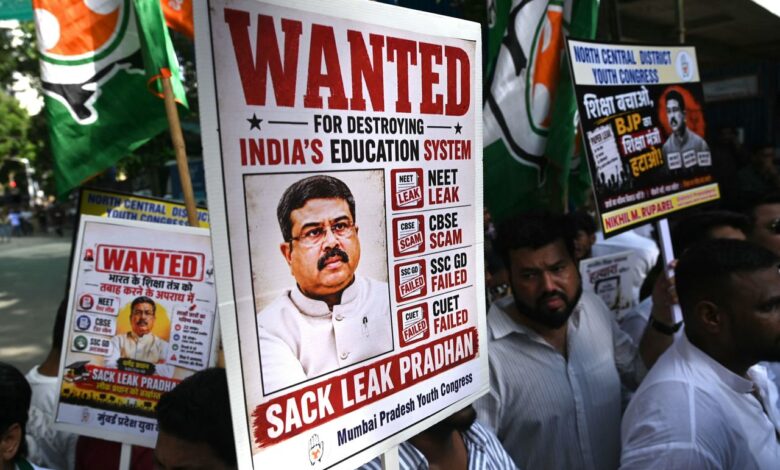
CJP founder Abhijeet Dipke and his supporters began a sit-in last month seeking the resignation of Pradhan. Wangchuk joined them on June 28, launching an indefinite hunger strike at the site.


In a handwritten note from hospital posted on his X account, Wangchuk said he would end his fast if the government took responsibility for recent failures in the education system and for paper leaks, or if CJP protesters were allowed to reach parliament and lawmakers assured them they would take up the issues.
He said he would also end the hunger strike if lawmakers and leaders of various parties met him in the hospital and gave him the same assurances, since his health did not allow him to march on parliament.
The rise of the CJP reflects frustrations among young Indians over issues like high youth unemployment and frequent examination paper leaks, analysts say.
Unemployment in 2025 stood at 3.1 percent among those aged 15 and above, government data shows, but was 9.9 percent for those from 15 to 29. In urban areas it was 13.6 percent, and 8.3 percent in rural regions.
Who is Sonam Wangchuk, the Indian activist rallying Gen Z against Modi?
Sonam Wangchuk may be pushing 60, but he has become the face of a Gen Z movement in India.
Wangchuk, who is widely believed to have inspired the lead character in a Bollywood blockbuster 3 Idiots, is best known for campaigning on issues affecting his Himalayan region of Ladakh, bordering China. But his fast over exam paper leaks has won him a new following among young Indians, helping turn the issue into a broader Gen Z movement and piling pressure on Modi’s government.
Even before police in Delhi moved him to hospital at the weekend after his hunger strike in solidarity with protesting supporters of the youth Cockroach Janta Party, some were comparing Wangchuk to India’s independence hero Mahatma Gandhi.
He has been getting video and text messages of support from across India, including from Bollywood actors.
“It pains me when some say you’re the Gandhi of the 21st century, the modern Gandhi, you’re the real hero,” he said this month from Delhi’s Jantar Mantar protest site.
“I am no Gandhi, no hero. I’m just an ordinary citizen who has not shied away from his responsibilities. Don’t look for a hero in others. Be the hero of your own life and fulfil your responsibilities.”
Lovingly called “Sonam Sir” — Sonam means “merit” or “virtue” in some cultures — by many, including CJP founder Abhijeet Dipke, Wangchuk is one of Ladakh’s most prominent public figures, having built a career around education reform and water-conservation projects in the high-altitude desert.
In 2018, he was awarded the Ramon Magsaysay Award, widely known as Asia’s Nobel Prize, for those efforts.
Born in 1966 in the small, remote village of Ulaytokpo in Ladakh, he was a 19-year-old engineering student at the government-run National Institute of Technology, Srinagar in India-administered Kashmir when he ran a coaching programme in basic subjects such as English and mathematics that helped hundreds of students. He later set up the Students’ Educational and Cultural Movement of Ladakh.
Related


