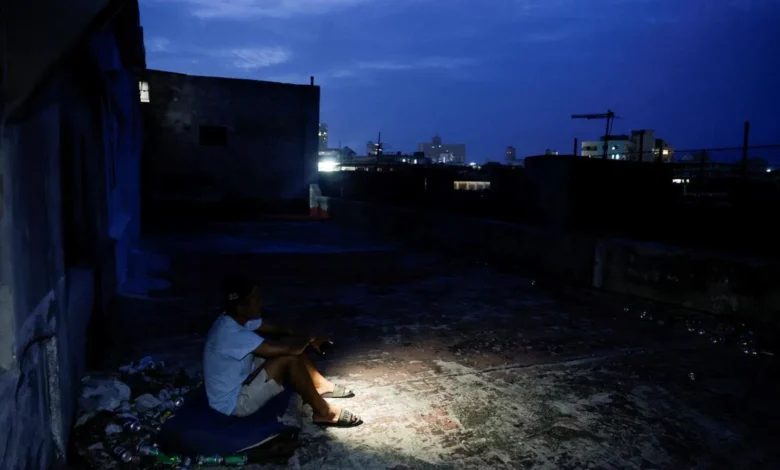
HAVANA, July 13 – Most nights, Frank Alfonso sleeps on the roof to escape the suffocating heat during Havana’s increasingly frequent blackouts. But on Friday afternoon, the rain arrived just as Cuba’s national grid collapsed, leaving him without even that respite from the island’s dire energy crisis.
Alfonso, 39, lives in one of Havana’s thousands of cramped tenements known as “solares,” decades-old buildings that residents have subdivided into tiny living quarters. Six months into the U.S.-imposed oil blockade, many of these complexes routinely suffer extended electricity shortages as Cuba’s aging infrastructure strains to provide power with less and less fuel.
“We didn’t even realize this time that the whole grid had collapsed, because we were already in a blackout,” he said.
Over 24 hours this weekend, as the system failure continued across much of the island, Reuters documented how Alfonso and his neighbors weathered what has become their daily reality: life in the dark.


WITHOUT POWER, RESIDENTS GO DAYS WITHOUT WATER
Next to Alfonso’s apartment, 51-year-old Yunaisi Durruti sat in an armchair late Friday night, the tip of her cigarette the only dot of light. Her main concern: water.
Her tap had been dry for a week because the pump that transports the water from the cistern on the ground level to her apartment’s tank on the second floor requires electricity. During the few hours a day when there is power, she said, the cistern’s often empty due to routine water cuts.
Durruti arrived in Havana in her youth to study gastronomy and then worked for a decade in the kitchen of a beach resort managed by the Spanish hotel group Melia.
Those days of pursuing her culinary passion are gone. She works as a security guard and after work heads to her parents’ house in a neighborhood with less frequent blackouts to shower, cook, and wash her clothes. She keeps her own refrigerator empty as the food would spoil anyway.
Melia said it was exiting Cuba after the U.S. tightened sanctions this spring.
Durruti said that Cuba’s strong culture of neighbors helping neighbors — a sense of solidarity forged over decades on the island — helps blunt the impact of the severe shortages. But there are limits.
“Everyone can share a small bucket of water,” she said. “But in this crisis, more than that is impossible.”
A PROPHECY COME TRUE
The island’s aging infrastructure, including its electrical grid, has been deteriorating for years. But the tenement building’s residents said the occasional energy cuts from years past have grown interminable in recent months, as the U.S.-imposed oil blockade set in.
On Saturday afternoon, Thalía Castillo, 28, nursed her 3-month-old infant, Thayler, as a small rechargeable fan kept the hot air and mosquitoes off his back in their first-floor apartment.
Unlike most of their neighbors, Castillo and her husband, Lazaro Herrera, enjoyed electricity for hours after the grid collapsed, thanks to a power station sent to them by Castillo’s grandmother in the United States.
But that power quickly ran out. A frozen package of meat — another luxury funded by their U.S.-based relatives — was thawing in the freezer. Every few hours, Castillo cleaned the pools of blood seeping into the refrigerator.
Small statues of Yoruba deities decorated their kitchen. Herrera is a priest — known as a babalawo — in the Afro-Cuban-based religion, which is widely practiced on the island. Each year begins with a series of predictions, issued by community elders. This January, the prophecy warned of convulsions and conflict.
“Everything has come true, so far,” he said.
A MOMENT OF LIGHT
Shortly before 9 p.m. on Saturday, Alfonso rushed back to the tenement building. The electricity was still out. But Argentina’s World Cup quarter-final against Switzerland was about to begin.
Since the start of the tournament, he and Herrera had devised a plan to deal with the repeated blackouts: mount Herrera’s television on a rack outside and hook it up to a generator across the street.
By kickoff, a few dozen of the building’s residents and nearby neighbors were already gathered around the screen, standing in the street. An elderly woman who lives on the building’s second floor sat on the doorstep, scolding youngsters who blocked her view. Cheers erupted when Argentina scored its first goal.
The rest of the street, all the way to Havana’s seafront boulevard, was still dark. REUTERS


