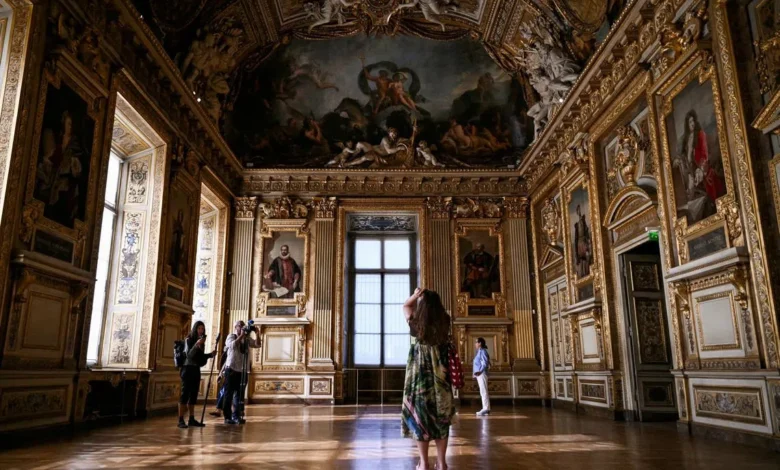
PARIS – The Louvre Museum’s Apollo Gallery reopened to visitors on July 22 without any jewels on display, nine months after a daring robbery of crown jewels worth US$102 million (S$132 million) exposed major security failings at the world’s most-visited museum.
Visitors can once again examine the Apollo Gallery’s richly decorated 17th-century interior, one of the Louvre’s most celebrated historic spaces.
But jewels will instead be exhibited elsewhere in the Paris museum in a more secure location, Louvre director Christophe Leribault said.
The gallery, created under a young King Louis XIV, served as inspiration for the glittering Hall of Mirrors at Versailles. It was designed by architect Louis Le Vau and decorated by painter Charles Le Brun according to the theme of the sun, in honor of Louis XIV.


Culture Minister Catherine Pegard hailed the gallery’s re-opening as the symbol of a new beginning for the museum after what she said had been a “trauma for the whole world”, and she pledged to beef up security at museums nationwide.
In October, two men parked a movers’ lift outside the Louvre in broad daylight, rode up to the second story, smashed a window, cracked open display cases with angle grinders, and then fled on the back of scooters driven by two accomplices in a heist lasting less than seven minutes.
Four people suspected of direct involvement in the heist have been charged and placed in custody.
However, the stolen items remain missing, except for a crown belonging to Empress Eugenie, Napoleon III’s wife, which was found damaged near the museum and is currently undergoing restoration.
In February, Laurence des Cars, who headed the museum at the time of the heist, resigned after facing intense criticism over the robbery and rolling strikes over pay and conditions.
The state auditors’ office and other critics have questioned the museum’s low spending on security and infrastructure maintenance while it made lavish purchases of new artwork, only a quarter of which is open to the public, and spent heavily on post-pandemic relaunch projects. REUTERS


