A house without curtains is not just exposed to wind. In Palestinian speech, it becomes a warning about fragility, about what happens when protection is missing where it is needed most.“بيت بلا ستارة ما بيستحمل ريح”“A house without curtains cannot withstand wind.”This proverb is short, domestic, and deceptively simple. Yet it carries layers of meaning about family life, privacy, social structure, and emotional resilience that continue to resonate far beyond its original setting in everyday Palestinian Arabic.
Meaning and literal imagery
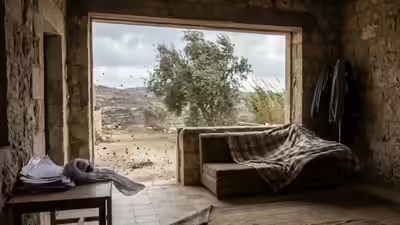
On the surface, the proverb describes a physical reality familiar in older Levantine homes. Curtains were not merely decorative. They served practical purposes: blocking dust, reducing cold drafts, protecting privacy, and softening the harshness of wind and sun entering through windows.A house without curtains is therefore not fully shielded. The wind enters freely, carrying discomfort and disorder.But the proverb is not really about architecture. In Palestinian and broader Levantine oral tradition, household imagery is frequently used to speak about human relationships. Here, the “house” represents the family or social unit, and the “curtains” represent boundaries, protections, and the small but essential systems that keep emotional and social life stable.Without those boundaries, even ordinary pressures become overwhelming.
Cultural and linguistic context

This proverb belongs to the wider tradition of Palestinian Arabic sayings that draw meaning from everyday domestic life. Oral proverbs in the region have long been used as a way to pass down social wisdom in compact, memorable phrases. Scholars of Arabic folklore, including those who have documented Levantine oral traditions such as Ibrahim Muhawi and Sharif Kanaana in their work on Palestinian folktales and cultural expression, note that proverbs often reflect lived realities rather than abstract philosophy.In this case, the imagery of wind is especially significant. In rural and semi-urban Palestinian environments, wind is not just weather. It is a force that carries dust from fields, affects crops, and enters homes easily through simple wooden or stone structures. A well-prepared home is one that manages exposure, not one that tries to eliminate it entirely.The curtain becomes a symbol of managed exposure. Not isolation, but control.
Boundaries and family structure
When used metaphorically, the proverb is often applied to families or households that lack structure, discipline, or emotional boundaries.A “house without curtains” can describe a family where personal limits are unclear, where conflict is unmanaged, or where outside interference easily enters private matters. In traditional usage, it may be directed at situations where gossip, social pressure, or external influence destabilizes the home.The “wind” in this sense becomes anything that disrupts stability. It could be financial stress, interpersonal conflict, or even the opinions of neighbors. In tightly knit communities, social observation is constant, and boundaries are essential for maintaining dignity and cohesion.The proverb does not suggest isolation. Instead, it emphasizes structure. A home must remain open enough for life but protected enough to remain stable.
Philosophical importance
At a deeper level, the proverb reflects a broader philosophical idea common in many folk traditions: vulnerability increases when boundaries are absent.It does not argue for rigidity. Curtains are not walls. They do not block everything. They filter. This distinction is important. The philosophy embedded here is about moderation and balance, not separation.In this way, the proverb aligns with a wider Mediterranean and Arab cultural emphasis on “hurma” (sanctity or protected space), particularly regarding the home. The home is not simply a physical structure but a moral and social space that must be guarded through behavior, discretion, and mutual respect.The proverb also subtly acknowledges inevitability. Wind will come. External pressures are part of life. The question is not whether disruption exists, but whether the structure in place can handle it.
Contemporary relevance
In modern contexts, the proverb extends easily beyond physical homes. It is often used when discussing digital boundaries, workplace dynamics, or emotional health.For example, in an age of social media oversharing, the idea of “a house without curtains” can be applied to individuals who have no privacy settings, no limits on what they share, or no separation between personal life and public exposure. In such cases, “wind” can take the form of criticism, misunderstanding, or digital intrusion.It is also relevant in discussions about relationships. Couples or families without clear communication boundaries often find that minor issues escalate quickly. The proverb suggests that structure prevents amplification of small disturbances into larger crises.Even in organizational contexts, the metaphor works. A workplace without clear roles, expectations, or confidentiality practices becomes vulnerable to internal confusion and external influence.
Why it resonates across generations
One reason this proverb persists in Palestinian Arabic usage is its adaptability. It does not rely on a single historical moment or event. Instead, it emerges from daily life, which makes it portable across time.Older generations may recall it in the literal context of homes built with simple materials, where wind and dust were real, constant challenges. Younger generations encounter it more metaphorically, in discussions about boundaries, privacy, and emotional resilience.Its strength lies in its clarity. There is no abstraction required. The image of a curtainless window in a windy environment is immediately understandable, even to those unfamiliar with its cultural background.
Conclusion
“بيت بلا ستارة ما بيستحمل ريح” survives because it compresses a complex social insight into a single domestic image. A house without curtains is not destroyed by wind, but it is constantly tested by it. Likewise, families, relationships, and communities without boundaries are not necessarily broken, but they are easily unsettled.The proverb does not advocate shutting the world out. It suggests something more practical and more enduring: prepare the space so that what enters does not overwhelm it.In that sense, it remains less a warning about fragility and more a lesson in design. A life, like a home, is not made stronger by exposure alone, but by the quiet structures that decide what is allowed in, and what is kept gently out.