As Russian soldiers refuse to fight, the Kremlin has turned its gaze outward, exploiting Africa’s youth through deceptive recruitment schemes. This desperate strategy reveals both the military and moral bankruptcy of Russia’s war effort.
It was billed as a war that would end in weeks. Four years and counting, Putin’s military is stuck like Macbeth’s fate; to go forward is as hideous as to go backwards. For the first time since the full-scale invasion began in February 2022, Russia is losing soldiers on the battlefield faster than it can sign up new ones to replace them.
This is the single most important development in the manpower story of the war, and it represents a genuine reversal of the arithmetic that sustained Russian operations for the first three years of the fighting.
According to Ukrainian intelligence assessments, for four consecutive months from December 2025 through March 2026, the arrivals-to-departures balance has remained firmly negative, with Russian losses exceeding the number of soldiers Moscow actually managed to mobilise.

The testimony of Alexander Lunin, a decorated Russian veteran, paints a harrowing picture of life within the ranks. In a video shared on X, he describes: Torture and underground prisons: Hundreds, possibly thousands, of soldiers are detained and abused by their superiors.
Lunin offers a vivid, harrowing spectacle of suicidal orders: Soldiers are punished for refusing reckless commands or for demanding their rightful pay. Added to the macabre situation are the executions disguised as combat deaths: Some are killed outright, then falsely reported as casualties of battle.
Lunin’s appeal is clear: soldiers must rise against the Kremlin if the truth continues to be hidden. His words resonate with growing discontent among troops, many of whom now refuse to fight in what they see as a futile and destructive war.
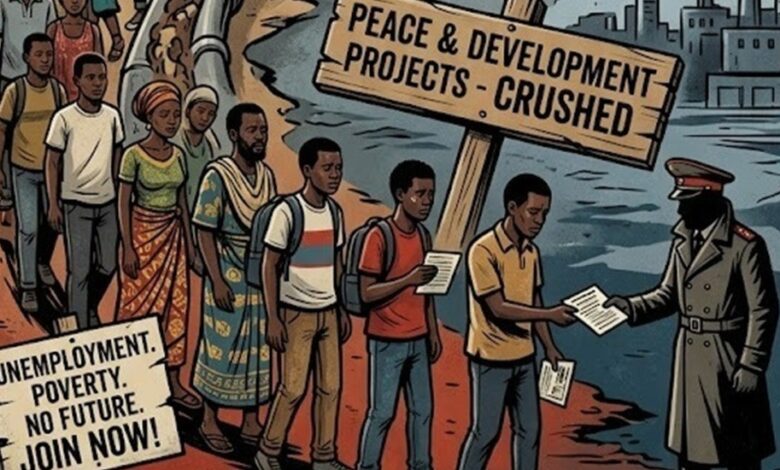
With Western estimates of Russian losses exceeding 1 million since February 2022, Moscow has sought replacements far from home. Africa has become a prime target, with recruiters exploiting economic hardship and youthful aspirations for better opportunities abroad.
But what the Kremlin offers are deceptive pathways couched in fanciful adverts and promises. Take the scholarships and partnership programs with universities like Novosibirsk State University, which masquerade as academic opportunities but often serve as funnels into military service.
For Moscow, the digital space offers a fertile field for recruitment. Social media platforms—VK, Facebook, TikTok, Telegram, YouTube—are flooded with offers promising salaries of $2,500 per month, bonuses up to $37,000, and even Russian citizenship. The military nature of these roles is obscured under terms like “logistics.”
On Facebook and TikTok, youths are lured into encrypted migration, where conversations shift to WhatsApp or Telegram. Here, recruiters finalise arrangements beyond the platform’s oversight.
Central to the devious drive is the Alabuga Start program, which epitomises Russia’s manipulation. Marketed as “positive professional migration,” it integrates over 800 African recruits—many young women—into drone production lines. Instead of education or career advancement, they face surveillance, gruelling hours, and restricted movement.
Recruitment is reinforced by travel agencies, diaspora intermediaries, and pro-Kremlin affiliates who manage visas and logistics, ensuring a steady flow of recruits into Russia’s war machine.
The exposure of these schemes has forced African states to act, though responses remain cautious. In Kenya, intelligence services estimate over 1,000 citizens have been recruited.
In March, Nairobi banned Russian enlistment through its Ministry of Defence and shut down more than 600 travel agencies linked to recruitment. The announcement was made in Moscow by Kenya’s Foreign Affairs Minister, Musalia Mudavadi, following discussions with Russian Foreign Minister Sergei Lavrov.
Mudavadi said the understanding reached with Russia means Kenyans will no longer be able to join the Russian armed forces through the defence ministry. Though Moscow maintains that foreign nationals serving in its military signed contracts willingly and in line with Russian legislation, in Kenya, several accounts have emerged from people who say they travelled abroad believing they had secured well-paid civilian employment, only to discover later they had been signed up for military roles linked to the Ukraine war.
The South African government has taken more forceful action, repatriating 17 of its citizens caught in the scheme. President Cyril Ramaphosa, who confirmed the successful repatriation of the 17 South African men, noted that the initiative involved close cooperation between the South African and Russian governments, following calls for assistance from the distressed individuals, aged 20 to 39. The men were allegedly enticed by South African elements to join the battle lines, raising serious concerns regarding their recruitment into mercenary activities.
In Ghana, Foreign Minister Samuel Okudzeto Ablakwa personally travelled to Kyiv to secure the release of two Ghanaian prisoners of war. At the same time, Cameroonian authorities issued warnings against participation in foreign conflicts. They tightened measures against desertion after the deaths of 16 nationals, though independent monitors suggest the actual toll may be significantly higher. A February 2026 report by the Geneva-based group INPACT (All Eyes on Wagner) documented at least 94 Cameroonians killed while fighting for Russia.
However, in Nigeria, the government’s posture has leaned toward caution and distancing rather than forceful rescue. In mid February 2026, the Ministry of Foreign Affairs voiced grave concern over the rising cases of Nigerians illegally recruited into foreign armed conflicts. Yet, it pointedly avoided naming Russia, warning that several citizens had been misled and coerced into signing military contracts before being deployed to combat zones. That concern followed an All Eyes on Wagner report documenting at least 36 Nigerians drawn into the Russian army, five of them already killed, alongside the reported deaths of Hamzat Kazeem Kolawole and Mbah Stephen Udoka in Luhansk in February, neither of whom had any military training. Even so, Abuja has stopped short of the repatriation drives seen in Pretoria, Nairobi and Accra. The Nigerians in Diaspora Commission, through its spokesman Abdur-Rahman Balogun, insisted that the country’s evacuation exercise ended in 2022 and that any Nigerian enlisting in a foreign army during wartime now does so by personal choice and is, in his words, on his own. Recruitment fronts accused of advertising Russian enlistment on billboards and social media with promises of citizenship and quick money remain a domestic dimension the authorities have yet to confront in full.
These actions highlight both the growing awareness and the delicate balance that African governments must maintain in their relations with Moscow.
Russia’s reliance on African recruits underscores its profound crisis. As Russian soldiers increasingly refuse to fight, the Kremlin forces are forcing innocent people—far removed from the conflict—to shed blood for a cause that is not theirs. This exploitation leaves a gaping wound in Russia’s military body and exposes the hollowness of its victory speeches.
The Ukrainian front reveals a Russian army on the brink of collapse, sustained only by coercion and deception. Alexander Lunin’s testimony exposes the brutality within, while Africa’s recruitment scandal demonstrates the Kremlin’s desperation.
For Russia, the war has become not only a military failure but a moral catastrophe—one in which the voices of betrayed soldiers and exploited recruits speak louder than any official declaration of victory.
-Amajama, a social commentator, writes from Abuja and can be reached via [email protected]
What do you think about this?
Drop your opinion in the comment section.
FOLLOW US & Share this with someone who needs to see this.