Satellite images reveal a massive 5,000-mile seaweed belt stretching thousands of miles across the Atlantic

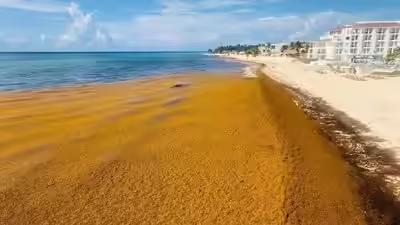
For centuries, sailors crossing the Atlantic occasionally encountered floating mats of brown seaweed drifting far from land. These patches were largely associated with the Sargasso Sea, a region of relatively calm waters in the North Atlantic where free-floating sargassum has long formed part of a unique marine ecosystem. That picture has changed dramatically over the past decade.Satellite observations now reveal an immense band of sargassum stretching across tropical Atlantic waters between West Africa and the Gulf of Mexico. What was once considered a more localised phenomenon has expanded into a recurring ocean-scale feature, covering thousands of kilometres and carrying tens of millions of tonnes of biomass. Scientists are increasingly trying to understand why this transformation occurred, where the nutrients sustaining it come from, and what it could mean for coastal regions on both sides of the Atlantic.
Atlantic seaweed belt reaches record 37.5 million tonnes
The modern story began in 2011 when satellites detected unusually large concentrations of sargassum outside its traditional strongholds. Since then, the floating algae have reappeared almost every year, forming what scientists call the Great Atlantic Sargassum Belt.A landmark study published in the National Library of Medicine, titled “The Great Atlantic Sargassum Belt”, described a continuous belt extending from the coast of West Africa across the Atlantic basin toward the Caribbean and Gulf of Mexico. Researchers estimated that during a particularly intense event in 2018, the belt stretched roughly 8,850 kilometres and contained more than 20 million metric tonnes of sargassum biomass.Recent assessments suggest the phenomenon has continued to grow. According to a study published in ScienceDirect titled “Productivity, growth, and biogeochemistry of pelagic Sargassum in a changing world”, the belt reached a record biomass of approximately 37.5 million tonnes, making it the largest event observed since satellite monitoring began.
Why the Atlantic’s giant seaweed belt keeps growing

Scientists do not point to a single cause. Instead, they describe a combination of ocean circulation patterns and increasing nutrient availability.Ocean currents play an important role in moving sargassum across vast distances. Water flowing through the Gulf of Mexico, the Loop Current and the Gulf Stream can transport seaweed into different parts of the Atlantic. At the same time, currents and winds near the equator help distribute floating mats through tropical waters.Nutrients appear to be equally important. Evidence gathered over several decades suggests that phosphorus and nitrogen help fuel sargassum growth. While natural sources such as coastal upwelling remain significant, researchers have identified growing contributions from river discharge, agricultural runoff, wastewater inputs and atmospheric deposition.The Amazon River has received particular attention. Several studies have linked changes in sargassum abundance to variations in nutrient-rich freshwater entering the Atlantic from the Amazon basin. Years with exceptionally high river discharge have often coincided with stronger blooms offshore.
Atlantic seaweed shows signs of rising nitrogen levels
One of the more striking findings from long-term monitoring is that the chemistry of the seaweed itself has shifted.According to the study, Analysis of hundreds of sargassum samples collected over four decades indicates that nitrogen concentrations within the algae have risen substantially. Researchers reported that tissue nitrogen levels increased by more than 50 per cent compared with measurements from the 1980s, while nitrogen-to-phosphorus ratios also climbed sharply. These changes point toward increasing nutrient enrichment across parts of the Atlantic basin.The pattern suggests that modern sargassum is growing in an environment influenced more heavily by nutrient inputs from land than was previously the case. Scientists view this as evidence that human activities may now be affecting ecological processes across a much larger section of the ocean than once assumed.
How the Atlantic sargassum belt affects marine life and coastlines
Far from shore, floating sargassum serves as an important habitat. Fish, sea turtles, invertebrates and numerous other marine organisms use the drifting algae for shelter, feeding and breeding. Some species spend a significant portion of their lives within these floating ecosystems. The situation changes when massive quantities reach coastlines. As per the study, Large strandings can blanket beaches, alter local habitats and create low-oxygen conditions as the seaweed decomposes. The process may release hydrogen sulfide gas, producing the distinctive odour often reported in affected coastal communities. Tourism-dependent regions throughout the Caribbean and Gulf of Mexico have spent considerable resources clearing beaches during major influxes.Environmental impacts can extend beyond tourism. Thick accumulations have been linked to stress on seagrass beds, coral reef systems and nearshore marine habitats, prompting concern among researchers and coastal managers alike.