The meticulously disorganised 250th anniversary of American independence was branded as the dawn of a new ‘golden age ’, with the largest fireworks and miliary aerial pageantry display in history, along with a presidential address from Mount Rushmore. It was Trump’s ultimate vanity project, a celebration of American exceptionalism designed to dazzle the world. Instead , the world watched Tehran.
The broader ‘Freedom 250’celebration dissolved into a shambolic spectacle on the National Mall, where sweltering heat and power cuts left acres of exhibition fields humiliatingly thin. Reports indicated Trump grew furious after seeing aerial photos of the sparsely populated fields during his separate D.C. campaign-style appearances. The calculatedly designed celebration is a reminder of how quickly spectacle can become farce.
At the same time, millions upon millions flooded the streets of Iran for the funeral of Ayatollah Ali Khamenei and his four family members. The contrast could not have been starker. The date of July 4 was chosen not by accident. It was designed to hijack America’s big day and turn the funeral into a global stage of Iran’s narrative of resilience and defiance. It was a masterstroke of political upstaging.

The Funeral that Eclipsed the News Cycle
By any measure, the funeral -lasting six days ( 4-9 July)-, dominated the global media coverage. Estimates placed mourners between 12 and 20 million across five cities, with delegations from over 100 countries, including Russia, China , Pakistan, and Saudi Arabia. The procession stretched from Tehran to Qom, then to Najaf and Karbala in Iraq, before concluding in Mashhad. It was described as the ‘funeral of the century’, and arguably the largest funeral gathering in human history.
In the meantime, Trump’s birthday celebration struggled to generate headlines, with performers reportedly pulling out citing partisanship. The event was branded less as an American celebration of America and more as a ‘Trump rally’ ; a show of orchestrated narcissism of the first order, complete with new ‘Patriot Passports’ featuring his photo, and bookended by the Treasury’s legally-stalled prototype for a $250 bill with his face. The birthday that was meant to unite the country exposed its deepening divisions, leading one NYTimes writer ( Robin Givhan , 4 July 2026) to confess in her op-ed (Trump Ruined the Fourth of July for Me) that ‘this year, I can barely tolerate the sight of red, white and blue. When combined into a maximalist display of nationalist cheerleading, the colours make my heart ache.’
In the streets of Tehran, the tiny coffin of Zahra Mohammadi Golpayegani, placed beside her grandfather’s , became the most haunting image of the day. A 14-month old toddler, killed by the American-Israeli strike, her small flag-draped casket turned a state funeral into a raw portrait of family loss, stripping the event of political theatre to reveal the human tragedy.
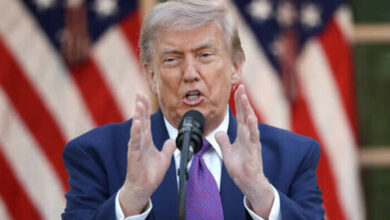
Trump, reportedly aware of the funeral’s scale, remarked that he was ‘surprised by the turnout of Iranians in support of the late Supreme Leader… maybe it’s fake tears,’ he mused. ‘I was shocked to see Iranians crying at the funeral, as I thought people hated him’, he added. Perhaps Trump truly expected to see ordinary Iranians dancing in the streets, assured as much by Benjamin Netanyahu and his hawkish congressional echo chamber, led by Lindsey Graham.
Trump even went so far as to repeat his bizarre complaint ( first revealed on 5 April 2026) that the Kurds hoarded the guns he sent them to spark an armed insurrection inside Iran. This arrogant attitude toward foreign-backed uprisings obscures the lesson of modern US-Iran relations: the 1953 CIA and MI6 orchestrated coup that toppled the democratically elected government of Mohammad Mosaddegh. For a nation whose modern identity is rooted in resistance to foreign-engineered regime change, such clumsy American interventionism does not spark liberation; it triggers deep historical trauma.
Historical Ironies
When America was fighting for independence in 1776, Iran was in ruins. The once-mighty Safavid empire had collapsed in 1736, plunging the country into dynastic chaos. The historical irony is stark: by the time the American colonies declared self-governance, no single ruler controlled all of Iran, leaving a broken landscape caught between rival, warring tribal protectorates.
READ: CENTCOM says it completed another round of strikes on Iran
The juxtaposition of the two events on July 4th 2026 – the funeral and the birthday-, reveals something profound about the two nations. America, the young empire, treats history as something to be marketed. Iran, heir to a civilization thousands of years old, treats history as something to be studied and learned from. The successors of Iran’s political tradition understand something their American counterparts do not: power is not simply about bombs and dollars. As forty-five years of sanctions prove, it is about narrative, patience, and civilizational endurance.
Trump’s birthday celebration was the opposite: it was a display of self-congratulation that the world largely ignored. It was a reminder that American power, for all its military might, is often blind to the forces that actually shape history. The US knows how to destroy, it does not know how to mourn, wait, or to transform loss into strength. This is the definitive lesson America refuses to learn: Iran is not a nation to be bombed into submission, but a civilization that has outlasted empires, invasions and revolutions. Until that lesson is learned, the violence will continue, as evidenced by the fresh hostilities breaking out in the last 24 hours (July 8), a grim reminder that America’s leaders are merely fighting history, oblivious to a foundational law of the global order: empires end, but civilizations endure. Does Washington’s myopic leadership still not understand that while you can assassinate individuals, you cannot assassinate an idea?
The Ghost of the Eight-Year War
Taking the funeral to Najaf and Karbala, the holiest cities in Shii Islam, was a masterstroke. Najaf is home to the shrine of Imam Ali, and Karbala, the shrine of Imam Hussein, the third Imam martyred in 680 AD, whose death is the defining tragedy of Shia identity, making Karbala the ultimate symbol of martyrdom and resistance against tyranny. By visiting both sites, the funeral route directly connects to Khamenei’s death, framed as ‘martyrdom’, to this foundational narrative of righteous sacrifice.
In addition, the procession carries a stunning geopolitical message. Only 40 years ago, Iran and Iraq were locked in an eight year war, (1980-1988) instigated and bankrolled by Washington to crush the nascent Islamic Republic, a war that caused over a million casualties. Today, Khamenei’s body crosses the border with full honours. This signals to the world that Iran’s influence in Iraq is now so deep-rooted that the country can host the funeral of a former enemy’s leader.
The journey to Iraq -completely unprecedented in modern history- is the most eloquent part of entire week, making it a trans-national event, asserting that Khamenei was not just a leader, but a figure of global Shia significance entrenched in the region’s geography. As the late Ayatollah Ali Khamenei’s multi-day funeral procession winds toward its final burial in the holy city of Mashhad, accompanied by a buildup of anti-American fury and symbolic defiance, Washington has already unleashed a renewed wave of air strikes. And as investors rush to the safety of the U.S. dollar and global oil prices spike past $73 a barrel, the world is reminded once more of the steep, cyclical price of commercially minded deception. In the end, the administration did not achieve victory; it merely bought a brief moment of performative theatre, leaving the global economy and the Middle East more dangerously unmoored than before.
There is a farcical asymmetry in Trump’s schoolyard diplomacy. He mused about wiping out Iran’s leadership ‘all in one shot’, oblivious to the fact that the regime he targeted anchors its authority in deep cultural sophistication. Khamenei’s intellectual background was shaped by rigorous seminary training and a deep engagement with both Islamic theology and secular literature. He was also highly regarded as a literary intellectual, a cleric who regularly attended poetry circles, possessed an aptitude for literary criticism, and famously read Western classics, citing Victor Hugo’s Les Misérables as a personal favourite. While he rarely spoke it publicly, he understood English well enough to read western literature, novels, and news reports without the aid of a translator.
In the final analysis, it is becoming all too clear that the highly publicized Memorandum of Understanding with Tehran was not a bridge to enduring peace, but an exercise in mercenary diplomacy.
The MOU ( signed on 17 June) can be discarded now. Was this a diplomatic pause engineered simply to ensure that neither the glitz of the football World Cup nor the hollow vanity of the 250th would be disrupted by the inconvenient realities of war? On July 7th, Trump yet again revoked what he had already agreed on. Was all this deception from the beginning? Perfidious Washington has eclipsed its predecessor.
We did not have to wait long for Trump’s predictable next move: as tensions with Iran slipped back into chaos on July 8th, the U.S. struck nearly 100 targets. During a press briefing from Ankara alongside Nato’s pliant ‘Teflon’ secretary general Mark Rutte, – the alliance chief who notoriously appeased the president as ‘daddy’-, Trump effectively declared the MOU nullified with a characteristic shrug: ‘To me, I think it’s over,’ he announced. ‘I don’t want a deal with them… As far as I’m concerned, it’s just a waste of time dealing with them.’ Then, turning his focus to Iran’s leadership, he concluded with great presidential eloquence: ‘They’re scum. They’re sick people, led by sick people’. He then added: ‘Very, very probably hit them hard again tonight. I’ll give them a little warning. We’re going to hit them hard tonight… You know, we may take over Kharg Island. It’s not a thing they can do about it. But I said, don’t hit the pipes. Just hit everything else’.
This is foreign policy reduced to the beat of an endless reality television monologue. By filtering a volatile regional conflict through a barrage of repetitive ‘maybes’ and juvenile insults, the executive branch has abandoned the gravity of statesmanship for transient transactional hype, the international order completely exhausted by the noise.
OPINION: From Zion Mules in 1915 to a Foreign Legion in 2026: Mercenaries and the IDF
The views expressed in this article belong to the author and do not necessarily reflect the editorial policy of Middle East Monitor.