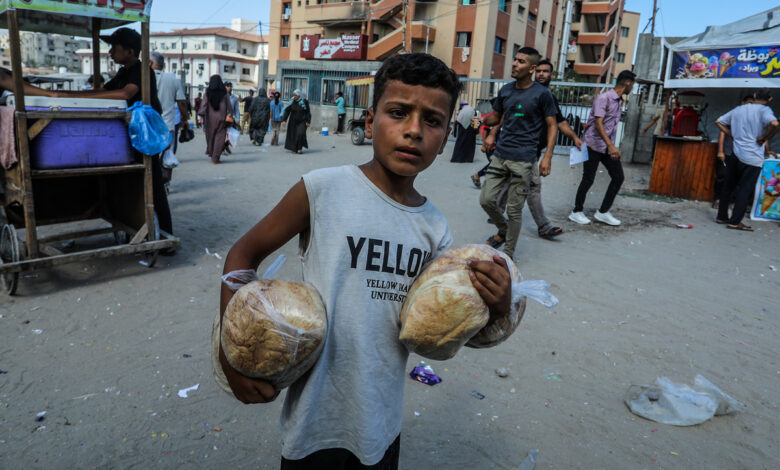
A joint press release by the Food and Agriculture Organisation (FAO), UNICEF and the World Food Programme (WFP) gave an overview of the current food insecurity in Gaza, exacerbated in recent years by Israel’s genocide. “There is progress on food security in Gaza, but it is fragile and can easily be reversed,” the WFP Acting Executive Director Carl Skau stated.
Of course, in the press release, Israel’s genocide was not mentioned. Neither were colonialism and military occupation. Food insecurity in Gaza is a result of various forms of colonial violence.
While the report points out what needs to be done to alleviate the current situation in which 1.4 million people are still experiencing acute food insecurity, international organisations are missing the point when they stipulate recommendations without highlighting the reason why Palestinians in Gaza are in continuous need of humanitarian aid.


The insufficiency of provision is also a direct consequence of colonial violence.
Warnings about food insecurity should encompass the entire trajectory. FAO Director General QU Dongyu noted that “Restrictions on agricultural imports and humanitarian supplies must be lifted.” True, but by who? The ambiguity of such statements only generates more impunity and, as a result, the possibility of perpetual food insecurity, which was already a reality for Palestinians before the genocide.
READ: Israel expands ‘yellow zone’, forcing thousands more Gazans to flee again – Israeli media
UNICEF’s Executive Director Catherine Russell also warned about the long-term consequences of food insecurity when humanitarian aid is fragile due to insufficient funding. Progress, Russell stated, “rests on a supplementary feeding program that doesn’t reach all children, and where funding is running out.” Again, the politics of colonialism and funding are crucial to this understanding. While it can be argued that the point of the press release was to impart the impact of food insecurity, the trend across international organisations is to never tackle the root problem. And incomplete narratives give an incomplete picture of how aid organisations are also embroiled in the politics of colonialism and humanitarian aid.
“FAO, UNICEF, and WFP stress that sustained peace, safety and security are essential to enable people to return to their farms, businesses and communities and to begin rebuilding their lives,” the press release partly states. The politics dictate that sustained peace, safety and security for Gaza will remain unreachable. Almost three years since the start of Israel’s genocide, Palestinians are still forcibly displaced while world leaders are still debating their role and relevance in relation to Gaza. Humanitarian aid is a small fragment of the entire equation, despite efforts to make the paradigm look more significant.
For Palestinians, the significance is the difference between starving and starving less. For the international community however, humanitarian aid makes all the difference between impunity and accountability, as it erases the latter and sustains the former.
Will Palestinians be allowed to return to their land, or will the international community persist in supporting the colonial expansion scheme which the US Board of Peace allowed for Israel? In the context of military occupation and plans for colonial settlements in Gaza, how can food security be achieved? If Israel maintains the Palestinian people’s forced displacement, how can Palestinians enjoy sustainability? Recommendations to prevent food insecurity should not use terminology without context. Colonialism does not allow sustained peace, safety and security, so why is colonialism not mentioned as the reason behind food insecurity for Palestinians?
BLOG: Israel shows there is no limit to the imagination of colonial violence
The views expressed in this article belong to the author and do not necessarily reflect the editorial policy of Middle East Monitor.


