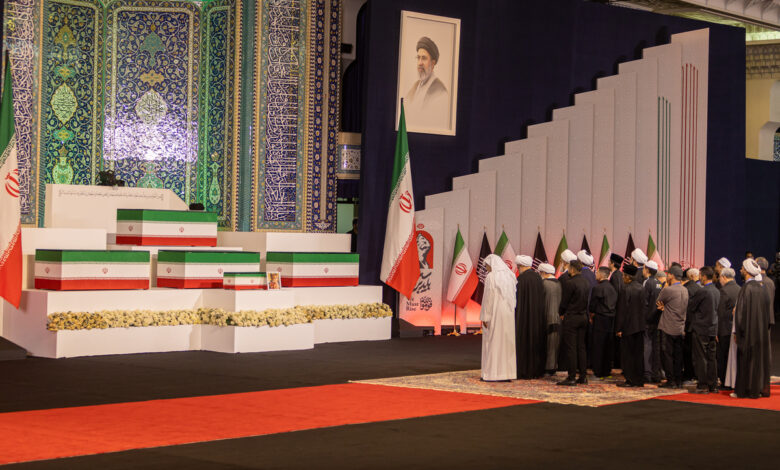
A casket draped in black makes its slow procession through Tehran, past millions of mourners whose chests beat in unison against the late-summer heat. Red fists—the funeral’s symbol—rise above a sea of black-clad bodies, fists clenched not in grief alone but in defiance. The slogan is stark: “We must rise”.
This is the funeral of Ayatollah Ali Khamenei, Iran’s supreme leader for thirty-six turbulent years, killed in the opening salvo of the US-Israeli war on February 28. It is not merely a religious rite. It is a geopolitical manifesto, a metaphysical referendum on empire itself.
Across five cities in two countries, over seven days, Iran expects between fifteen and twenty million mourners. Delegates from more than one hundred countries are in attendance. Pakistan’s prime minister walks alongside Tajikistan’s president. Armenian and Georgian leaders pay their respects. European anti-imperialist activists arrive without official invitations, declaring themselves on “the right side of history”. The body will journey through Qom, then to Najaf and Karbala in Iraq, before final burial in Mashhad, beside the shrine of Imam Reza.


Western capitals observe this spectacle with confusion or contempt. Fox News notes the absence of Western leaders as proof of Iranian isolation. The funeral is dismissed as regime propaganda, as a theocratic state’s desperate grasp at legitimacy.
But this is a catastrophic misreading. For the Global South, Khamenei’s funeral is something else entirely: a collective acknowledgment of a history that the West has chosen to forget. From Operation Ajax in 1953—when the CIA and MI6 toppled Iran’s democratically elected prime minister to restore Western oil control—through the arming of Saddam Hussein in the 1980s, through the 2003 invasion of Iraq on fabricated intelligence, through the destruction of Libya and the devastation of Syria, the pattern is not a series of discrete misadventures. It is a continuous architecture of domination.
A former Iranian deputy speaker captures the Global South’s reading with brutal clarity: Khamenei’s “most important legacy was resistance against the global dominance of the United States and Israel, and the fact that this resistance broke that perceived dominance”.
The West frames the February 28 strike that killed Khamenei as a strategic necessity, as the surgical removal of a hostile regime’s head. The Brookings Institution noted that the Iranian leadership is vast and warned against the assumption that decapitation could rapidly paralyse Iran. But this tactical calculation misses the deeper ontological chasm.
Sovereignty is the formal attribute of states recognised by the international community. Justice is procedural, administered by institutions.
In the Global South’s ontology, violence is structural, historical, continuous. The drone strike is not an isolated defensive measure but a pulse in a rhythm of dispossession that began with the slave ship and the colonial census.
Sovereignty is a substantive capacity to resist external domination, a capacity that must be endlessly performed. Justice is historical and redistributive—a horizon never yet reached.
These are not just different interpretations. They are different realities, built on different archives of memory. The funeral crystallises this epistemic asymmetry: for one side, it is propaganda; for the other, it is truth.
The timing is deliberate. Khamenei’s body lies in state on the 250th anniversary of American independence. The procession unfolds during Muharram, the Islamic month of mourning for Imam Hussein’s martyrdom at Karbala—a death that Shiite tradition casts as the eternal struggle against tyranny.
The symbolism is unmistakable: America’s celebration of freedom is, in this telling, the anniversary of a different kind of empire.
What makes this funeral genuinely novel is its transformation of grief into geopolitical currency. The West’s precision strikes aim to decapitate; the funeral reveals that the social body can regenerate its head in symbolic form. The population becomes the weapon. Fifteen to twenty million bodies assembling in procession constitute a living statement: the will has not been extinguished.
This is biopolitical warfare inverted. The empire administers death to produce docile populations; the resistance administers collective mourning to produce insurgent populations. Each mourner becomes a carrier of the resistance code. The funeral is a bioweapon of solidarity—not a biological pathogen, but a memetic one that spreads through digital and physical networks.
Consider what this means for the rules-based order. A system that requires consensus on what constitutes a breach cannot function when the very perception of breaches is predetermined by epistemic affiliation. When the Global South increasingly perceives the international system as a rigged game, its institutions lose legitimacy. When the West perceives the Global South’s historical memory as paranoid distortion, it becomes incapable of self-correction.
The result is not dialogue but schism. Each bloc inhabits a closed epistemic universe, performing rituals of justification before its own audience. Khamenei’s funeral is a diagnostic event: it reveals that we no longer share a world, but only a planet.
The military-industrial complex, as Eisenhower warned, has a built-in incentive for permanent conflict. The Middle East has been its testing ground and profit centre for decades. The funeral indictment is that empire needs enemies more than it needs peace, and that Iran under Khamenei played the role of necessary enemy—the antagonist that justified the budgets, the bases, the carrier groups.
By mourning him, the Global South mourns not just a man but the hope of breaking out of this cynical cycle. The moral economy of empire is revealed as profoundly immoral: it transforms human suffering into a balance sheet item and masks this transformation with rhetoric about freedom and security.
Pakistan’s attendance is particularly instructive. Islamabad has played a central role mediating between Washington and Tehran, helping secure a ceasefire in April and a memorandum of understanding in June. Yet here is Pakistan’s prime minister, standing in Tehran, honouring a man Washington killed. This is not hypocrisy. It is the geopolitics of a multipolar world in which the Global South refuses to choose sides.
The funeral’s route through Najaf and Karbala is equally significant. At the request of Iraqi politicians, Khamenei’s body will be carried through Iraq’s holiest Shiite cities. This is not merely religious piety. It is a statement that the Axis of Resistance does not rely on a single centre and will not collapse with the elimination of a single leader. The network endures.
What, then, does this funeral portend? For Iran, it affirms the survival of the clerical system under Khamenei’s son Mojtaba—who remains in hiding, severely injured in the same strike that killed his father. For the Global South, it is a rallying cry against a Western military-industrial complex that feeds on perpetual warfare. For the global order, it is a warning: when two civilisations do not agree on what it means to exist legitimately, the “international system” is a fiction sustained by the inertia of power.
The funeral asks a question that no UN resolution can answer: whose reality counts? Khamenei is dead. But the millions who mourn him are very much alive.
They are not mourning a man alone. They are mourning a world that might have been—a world in which the Middle East was not a crucible for war and empire, a world in which sovereignty meant something more than the permission to exist within someone else’s design.
The red fists rise. The chests beat. The casket moves on. And the global order fractures a little more.
The views expressed in this article belong to the author and do not necessarily reflect the editorial policy of Middle East Monitor.