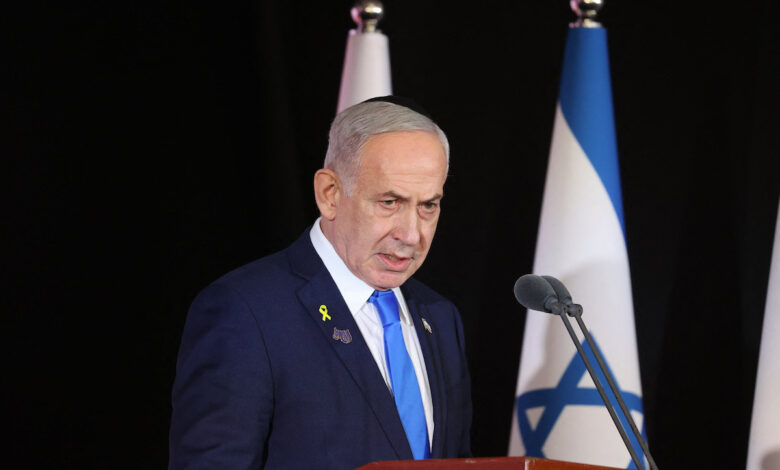
“Another principle of the government, of the broad national government that I intend to lead, is that there is no room for two states. Between the sea and the Jordan River there is no room for two states,” Israeli Prime Minister Benjamin Netanyahu recently asserted. Inverting the Palestinian slogan to emphasise the elimination of the Palestinian people through colonisation is of no concern to the international community, even though Netanyahu is no longer talking about ideology but a process that culminated in genocide.
Netanyahu is basing his statement on what he described as a change in Israeli public opinion after 7 October 2023. However, the refusal to even consider or participate in the two-state diplomacy is not a recent change in Zionist politics. For several years, both colonial expansion and official rhetoric have excluded the two-state paradigm, by now only functioning as a relic in Western diplomacy.
The biggest problem lies in the fact that the UN and world leaders still threat the obsolete paradigm as allegedly the only possible peace framework. That is a contradiction in itself, and one that suits Israel. If the two-state cannot be implemented as a result of colonial expansion, then Netanyahu cannot be faulted for saying that there is no room for two-states. Zionist colonialism left no room, in fact. Meanwhile the international community has been consistent in refusing to create the political the conditions for a two-state possibility to emerge.

READ: Netanyahu claims Israel killed 9,000 Hezbollah members, says group has lost 92% of missile arsenal
If colonialism is not challenged, and the international community refuses to consider decolonial alternatives, Netanyahu will have his way whether or not Israeli settler society is in agreement. So far, the UN holds regular meetings to reiterate the usual two-state rhetoric and further obfuscating the Palestinian people’s political rights. The EU limits its criticism of Israel to settler violence and settlement expansion without considering the entire colonial framework.
What still saves the two-state rhetoric for the international community is that the paradigm is portrayed as a possibility under threat. Therefore, any new settlement plans or construction constitute a singular, immediate threat, rather than a process that started with Zionist colonial expansion before the 1948 Nakba. The international community’s reliance on the two-state politics has nothing to do with Palestinian political rights. Neither does it any longer provide a veneer for Israel’s colonial expansion.
As Netanyahu clearly stated, Israel will continue expanding across what remains of Palestine. The recently renewed concern with the forced transfer of Palestinians is not happening in a vacuum. If Israel is overtly refusing the two-state, the next question is what to do with the Palestinians that remain. It is in this context that Netanyahu’s reference to ‘between the sea and the Jordan River’ should be considered. Israel’s genocide in Gaza showed the entire world that forced displacement for ‘Greater Israel’ is just a matter of time. While Netanyahu threatens Palestinians with further ethnic cleansing, the international community continues to allow the two-state rhetoric to take precedence over Palestinian lives and land. There is no room for two states, according to Netanyahu, and the international community made sure of that by coming up with a paradigm that does not decolonise the land.
BLOG: The EU does not need to clarify its support for Israeli colonialism
The views expressed in this article belong to the author and do not necessarily reflect the editorial policy of Middle East Monitor.