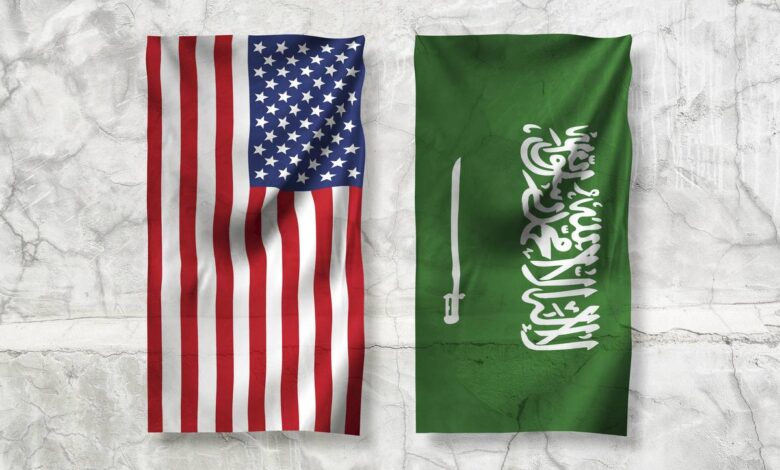
The United States has presented its new nuclear agreement with Saudi Arabia as a gift: reactors, technology, investment, prestige, and the radiant promise of a peaceful atomic future. Washington is forever giving gifts of this kind. Curiously, they tend to arrive fitted with surveillance equipment, political conditions, and a discreetly concealed choke chain.
This is not merely a civil nuclear agreement. It is a disciplinary instrument aimed at Mohammed bin Salman — a strategic summons issued to a crown prince who has recently behaved less like an obedient client and more like the ruler of an indispensable state. Its message is simple:
Saudi Arabia may diversify its economy, its diplomatic partners, and even its wardrobe of alliances, but it may not diversify the source of its ultimate protection. That franchise still belongs to Washington.
The agreement therefore concerns nuclear energy only in the same sense that a prison contract concerns architecture. Its deeper purpose is to
reconstruct American authority over a kingdom that has begun imagining life beyond the imperial security nursery.
Riyadh has committed three increasingly intolerable offenses.
First, it has moved too close to Pakistan. The Saudi–Pakistani relationship is hardly new: money, soldiers, intelligence cooperation, religious patronage, and strategic ambiguity have bound the two states for decades. What has changed is the context. As confidence in American protection has weakened, Pakistan has ceased to look merely like a useful military subcontractor and begun to resemble a possible component of an alternative security architecture.
That possibility is especially sensitive because Pakistan is nuclear-armed. No formal Saudi–Pakistani nuclear arrangement has been acknowledged, and neither capital needs one publicly declared. Strategic ambiguity is useful precisely because it performs deterrence without
submitting an invoice to the International Atomic Energy Agency. A defense pact, carefully suggestive official language, and decades of intimate military cooperation can generate considerable anxiety without anyone having to unveil a warhead in Riyadh.
Washington’s nuclear offer is designed to interrupt that imagination. It tells the Saudis: there will be no Pakistani shortcut to strategic autonomy. If the kingdom wants reactors, fuel-cycle expertise, advanced technology, and the political symbolism of nuclear modernity, those ambitions must pass through American gates. The atomic future may be Saudi, but the key to the laboratory must remain in Washington.
Second, Mohammed bin Salman has shown insufficient enthusiasm for the campaign against Iran. Riyadh has no sentimental attachment to Tehran; states do not exchange friendship bracelets. But it has learned, after years of expensive confrontation, that permanent hostility to Iran is a ruinous American luxury financed by Gulf vulnerability. Saudi–Iranian accommodation is not ideological reconciliation. It is an insurance policy against being drafted into someone else’s war.
This is precisely what makes it objectionable to Washington and Israel. An autonomous Saudi Arabia might decline to become the logistics platform, financier, diplomatic choir, and eventual target of a regional war against Iran. It might decide that oil facilities, desalination plants, investment plans, and glittering megaprojects are poorly served by turning the Gulf into a missile exchange. Such ingratitude cannot be
encouraged.
READ: Israel warns Saudi-US nuclear deal raises stakes as Iran expands nuclear programme
The nuclear deal places Washington back at the center of Saudi strategic planning. Technology creates dependency; dependency creates leverage; leverage restores obedience. The reactor is not merely an energy source. It is a thirty-year listening device embedded in the kingdom’s national-security imagination.
Third, Riyadh has refused to normalize relations with Israel on Washington’s preferred terms. Saudi leaders continue to tie normalization to a credible pathway toward Palestinian statehood — an inconvenient demand in an imperial order that prefers Palestinians as humanitarian statistics rather than political subjects. Trump’s subsequent insistence that the nuclear arrangement depends on Saudi entry into the Abraham Accords merely stripped the agreement of its ceremonial clothing.
The bargain is now indecently clear: Washington will help construct Saudi Arabia’s nuclear future if Riyadh helps rehabilitate Israel’s regional standing. Nuclear cooperation becomes diplomatic blackmail. The kingdom is invited to purchase strategic reassurance with Palestine. This is less a treaty than a geopolitical obedience course: sit beside Israel, distrust Iran, step away from Pakistan, and receive your
reactor.
China and Russia are the other uninvited guests at the signing ceremony. Saudi Arabia is not merely another energy producer; it is the central
Arab power in OPEC, a financial heavyweight, and a pivotal actor in the emerging multipolar order. Its relations with Beijing and Moscow
challenge Washington not because Riyadh has become anti-American, but because it has become insufficiently exclusive.
Empire does not require affection. It requires the absence of alternatives.
A Saudi nuclear program built with Chinese or Russian assistance would deepen technological, financial, and strategic relationships that
Washington can no longer confidently control. American companies want the contracts, certainly, but the larger concern is architectural:
whoever builds the reactors helps shape the dependencies surrounding them. Nuclear cooperation produces decades of training, maintenance, fuel arrangements, regulatory influence, security coordination, and elite access. Washington is not selling machinery. It is purchasing strategic occupancy.
The irony is exquisite. The United States portrays the agreement as evidence of restored strength, yet its generosity reveals its weakness.
A hegemon secure in its position does not need to offer extraordinary concessions to retain an old client. It does so when the client has
discovered competing suppliers, alternative protectors, and the invigorating sensation of being courted.
Nor does the agreement simplify nuclear diplomacy with Iran. Washington has spent years treating Iranian enrichment as uniquely sinister while now constructing a far more permissive vocabulary for Saudi ambitions. The distinction will be explained through the usual theological
machinery of empire: allies possess peaceful atoms; adversaries enrich malicious ones. Centrifuges, apparently, acquire moral character from
the flag hanging above them.
The result is a nonproliferation doctrine so intellectually elastic that it can be folded into a campaign brochure.
Mohammed bin Salman may believe Saudi Arabia has accumulated enough leverage to escape the old hierarchy. Washington’s answer is this
agreement: not quite a reward, not quite a threat, but an elegant combination of both. America will protect the kingdom — from Iran, from
uncertainty, and above all from the dangerous temptation to protect itself through arrangements Washington cannot supervise.
The reactor, then, is the bait. Israel is the condition. Pakistan is the warning. China and Russia are the targets.
And the leash, freshly polished and marketed as partnership, remains unmistakably American.


OPINION: Oslo on the Strait of Hormuz
The views expressed in this article belong to the author and do not necessarily reflect the editorial policy of Middle East Monitor.


