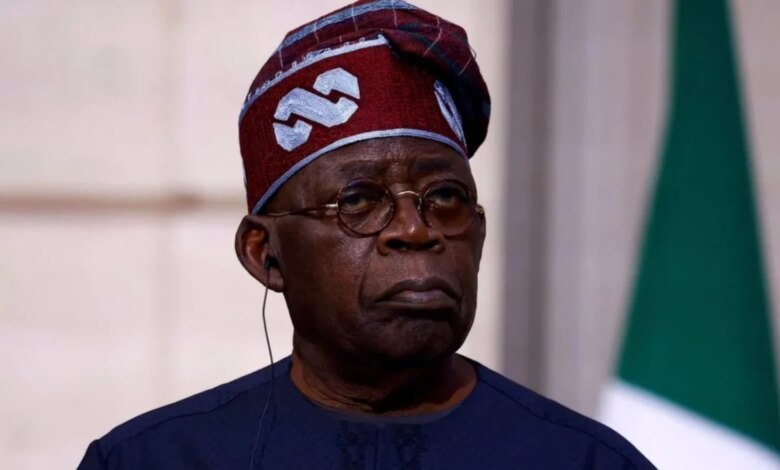
President Bola Tinubu has approved the immediate dissolution of the Presidential Implementation Committee on the Alienation of Federal Government Properties (PIC).
This development ends the operations of the 25-year-old body established during the administration of former President Olusegun Obasanjo to oversee the privatisation and disposal of federal government properties.
The President also directed that all the committee’s responsibilities be transferred to the Attorney-General of the Federation and Minister of Justice, Lateef Fagbemi.
The directive was announced on Thursday in a statement signed by the Special Adviser to the President on Information and Strategy, Bayo Onanuga. According to the Presidency, the dissolution took effect from November 5, 2025.

Tinubu further directed the committee’s Secretary, B. S. Dutsin-Ma, to immediately stop acting on behalf of both the committee and the Federal Government on matters relating to the body’s activities.
Explaining the decision, the Presidency said a review of the committee’s operations showed that it had gone beyond the mandate for which it was originally created and that its continued existence could no longer be justified.
“After careful consideration, the government has noted that the activities of the PIC had extended beyond its original mandate, resulting in multiple litigations across the country, and the continued existence of the committee is no longer justified,” the statement said.
The Presidential Implementation Committee was established in 2000 under the administration of former President Olusegun Obasanjo to supervise the privatisation, sale and lease of Federal Government landed assets as part of the government’s monetisation policy.
The policy was introduced to convert government-owned assets, including official residences, vehicles and other properties, into cash while ending the practice of providing such benefits in kind to public servants.
Notedly, the committee was chaired by the Minister of Housing and included representatives from the Ministries of Transportation, Justice, Health and Agriculture, as well as the Nigeria Police Force. Professor P. T. Ahire, then a Deputy Director in the Office of the Secretary to the Government of the Federation, served as its pioneer secretary.
On March 22, 2001, the Federal Executive Council approved the establishment of a Panel of Inquiry to prepare a White Paper that would guide the implementation of the committee’s recommendations. The panel spent 21 months carrying out its assignment before submitting its report.
Although the monetisation policy became one of the most significant administrative reforms introduced during the Obasanjo administration, its implementation remained controversial for years. Thousands of disputes emerged over the valuation and sale of government properties, with allegations of undervaluation, irregular sales to politically connected individuals and numerous court cases challenging aspects of the exercise.
The latest decision comes only days after President Tinubu criticised the privatisation programme carried out during the Obasanjo administration while taking a swipe at former Vice President Atiku Abubakar, who chaired the National Council on Privatisation between 1999 and 2007.
Speaking last Friday during a meeting with members of the Nigerian Diaspora Medical Association and Northeast stakeholders, Tinubu accused Atiku of leaving behind unpaid pension liabilities following the privatisation of government-owned enterprises.
“The olden age is here now if you can stabilize the economy, Nigerians are not asking for too much, simple stability and social welfare, if I can go political, somebody among my prospective opponents privatized government investment in public entities but forgot to pay the pension. I’m clearing the pensioners now, so clearing the mess they created,” the President had said.