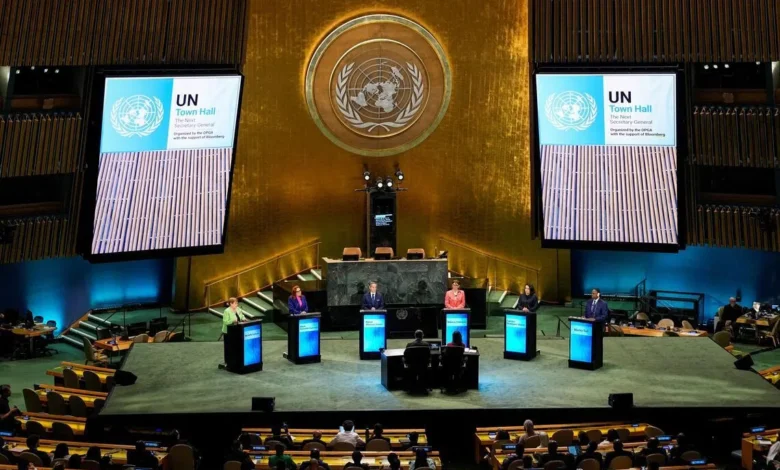
Six contenders vying to be the next United Nations secretary general argued their case to lead the world body at a time when conflicts in Iran, Gaza and Ukraine, as well as divisions among global powers, have deepened concerns about its effectiveness.
“I would like to see a UN that is back at the table on the scenarios of conflict,” Rebeca Grynspan, a former vice-president of Costa Rica, told a town hall event moderated by Bloomberg Television in the UN’s General Assembly chamber.
The candidates are competing to succeed current UN Secretary General António Guterres, whose term ends in 2026. It will be no easy task: Wars in Ukraine, Gaza and Iran have challenged the UN’s credibility as a global peacemaker and exacerbated deadlock among Security Council members including the US, China and Russia.
At the same time, US President Donald Trump has criticised the UN as a bloated bureaucracy too focused on climate and issues that go against his priorities. The US has withdrawn from a number of its agencies and frozen much of its funding for the UN, pushing it toward a financial crunch.


Guterres’s successor will need to secure at least nine of 15 votes in the Security Council without a veto from any of its five permanent members. It is also possible that other candidates will emerge in the months before a final decision is made, likely in October.
Guterres has often been sidelined in the broader geopolitical debate – condemning violence around the world but struggling to influence outcomes from Ukraine to Iran. His decision to challenge Israel – he once lamented the “systematic destruction of Gaza City” – has drawn anger from Prime Minister Benjamin Netanyahu’s government, which later cut off communications with him.
“You have to go in into the field, you have to work with the people there, you have to have presence,” said Michelle Bachelet, the former president of Chile who previously served as UN high commissioner for human rights. She added it was important to sound an alarm “that can help to produce a change”.
The other candidates appearing at the event on July 23 were María Fernanda Espinosa, the former president of the UN General Assembly, Carolyn Rodrigues Birkett, Guyana’s ambassador to the UN, and the former president of Senegal Macky Sall; and Rafael Mariano Grossi, the Argentine head of the International Atomic Energy Agency in Vienna.
“Our responsibility is to make the UN relevant again, to deliver, to touch the hearts and souls of people on the ground, to serve people on the ground and not to confuse activity with impact,” Espinosa said.
With Russia, China, and the US often locked in their own power struggles at the UN, the eventual winner will need to find a way to be palatable to all.
Only after the Security Council makes its recommendation can the broader General Assembly grant final approval, by simple majority. The Security Council is expected to begin closed-door “straw polls” later in July to gauge support.
At the event on July 23, Grossi said “nice words won’t do” if a UN member state started a conflict and that he would re-establish the UN as an influential player in issues on war and peace.
“What we need to do is to restore the credibility of the UN as a valid interlocutor, and then use the tools at hand,” he said. BLOOMBERG


