0
LAGOS – The United States has reaffirmed its commitment to deepening economic, trade and security relations with Nigeria, revealing that two-way trade between both countries climbed to nearly $15 billion in 2025, a 14 percent increase over the previous year.
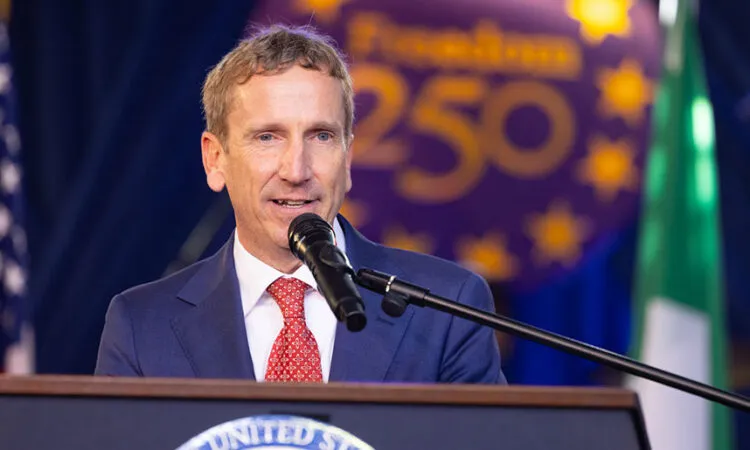
Speaking at the celebration of the 250th Independence Day of the United States, held at the U.S. Consul General’s Residence in Lagos, the Chargé d’Affaires of the U.S. Mission in Nigeria, Keith Heffern, described Nigeria as one of America’s most important strategic partners in Africa, saying Washington is placing trade and investment at the centre of its engagement with the continent.
Addressing diplomats, government officials, business leaders and other guests, Heffern said the anniversary celebration, tagged ‘Freedom 250’, commemorates 250 years of American independence while looking ahead to another 250 years of leadership, innovation and global engagement.
He noted that the diplomatic relationship between Nigeria and the United States, which spans more than six decades, has evolved into one of Washington’s strongest partnerships in Africa.
According to him, Nigeria is now the second-largest trading partner of the United States in sub-Saharan Africa, with bilateral trade rising to almost $15 billion in 2025.
He said the figures represent more than trade statistics, stressing that they reflect investments, employment opportunities and economic transformation benefiting both countries.
Heffern disclosed that more than 100 American companies currently operate in Nigeria, underscoring the country’s growing importance as an investment destination despite prevailing economic challenges.
He said one of the top priorities of the U.S. Mission is to support American businesses seeking opportunities in Nigeria while also encouraging stronger commercial collaboration between both countries.
To achieve this objective, he said the United States has partnered with Nigeria’s Ministry of Industry, Trade and Investment through the U.S.-Nigeria Commercial and Investment Partnership, a five-year memorandum of understanding designed to strengthen bilateral trade.
Now in its second year, the initiative has brought together nearly 50 Nigerian and American companies to identify and remove barriers limiting trade and investment.
He recalled that Lagos hosted the partnership’s first ministerial-level meeting earlier this year, adding that collaboration is currently focused on three strategic sectors—agriculture, the digital economy and infrastructure.
According to him, these sectors are expected to drive long-term economic growth, create jobs and expand prosperity in both countries.
Beyond commerce, Heffern stressed that security cooperation remains a critical pillar of U.S.-Nigeria relations.
He cited the recent collaboration between the National Drug Law Enforcement Agency and the United States Drug Enforcement Administration, which led to the dismantling of a major transnational criminal organisation involved in drug trafficking and money laundering.
He said such operations help disrupt criminal networks that threaten regional security and undermine economic development.
The American envoy also highlighted growing maritime security cooperation, noting that the Vice Commander of U.S. Naval Forces Africa recently participated in celebrations marking the 70th anniversary of the Nigerian Navy, reaffirming Washington’s support for African-led security initiatives.
On cultural relations, Heffern said music continues to serve as one of the strongest bridges between both nations.
Drawing inspiration from the evening’s Motown theme, he described the legendary American music movement as a symbol of creativity and storytelling that continues to influence artists globally.
He also praised the global rise of Afrobeats, noting that Nigerian musicians now dominate international charts and enjoy growing popularity across the United States.
He specifically applauded performances by Rema and Burna Boy during the opening ceremonies of the 2026 FIFA World Cup, describing their appearances as evidence of Nigeria’s expanding cultural influence.
Looking ahead, Heffern said the United States is entering what he described as the country’s “Decade of Sports,” with the hosting of the 2026 FIFA World Cup and the 2028 Summer Olympics expected to create fresh opportunities for cultural and commercial collaboration.
He recalled that the U.S. Mission recently supported the debut of the Professional Fighters League (PFL) in Nigeria under the Freedom 250 initiative, showcasing American expertise in sports management while strengthening people-to-people ties.
He also acknowledged the role of educational and professional exchange programmes in strengthening bilateral relations.
According to him, more than 14,000 Nigerians have participated in U.S. government-sponsored exchange programmes over the years, forming a network of leaders contributing to stronger economic cooperation, innovation and strategic engagement between both countries.
Heffern said the progress recorded in U.S.-Nigeria relations over the years is the product of sustained diplomacy, investment and mutual commitment.
As a demonstration of America’s long-term confidence in Nigeria, he revealed that construction is progressing on the new U.S. Consulate General complex in Eko Atlantic, Lagos, describing it as one of the largest U.S. diplomatic investments anywhere in the world.