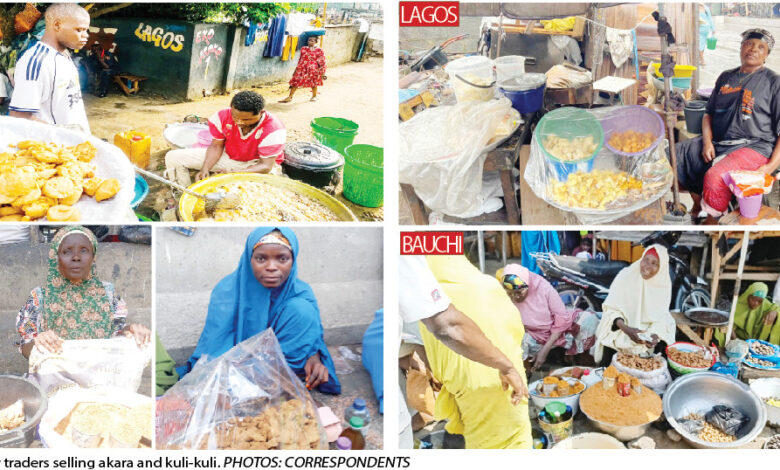
Describe business as lifeline, say they employ workers
By AZA MSUE, Makurdi; ENNA GODWIN, Katsina; NICHOLAS DEKERA; ACHOR ABIMAJE, Jos; ABU NMODU, Minna; AHMED TAHIR, Lafia; and LONGTONG YAKUBU, BUKOLA ARO-LAMBO and BUKOLA ARO-LAMBO, Lagos


The nationwide debate sparked by First Lady, Senator Oluremi Tinubu’s advice that Nigerians should embrace indigenous small-scale businesses such as akara (bean cake), corn, and kuli-kuli (groundnut cake) has continued to generate widespread public conversation across the country.
Her remarks, made against the backdrop of rising food prices, unemployment, and economic hardship, have become more than a political talking point. They have triggered a deeper reflection on informal entrepreneurship and the survival strategies of millions of Nigerians.
While critics and supporters remain sharply divided over the intent and implications of the statement, findings by LEADERSHIP Weekend across seven states reveal a consistent reality: akara and kuli-kuli businesses are not symbolic side hustles, but central survival systems for thousands of households.
Behind the frying pans, grinding stones, and sacks of groundnuts lies an informal economy that has quietly financed education, built houses, sustained families, and provided employment for decades in communities where formal opportunities remain limited.
From Benue to Katsina, Zamfara to Plateau, Niger to Nasarawa and Kano, traders described a common experience shaped by resilience in the face of rising input costs, insecurity, unstable electricity, and limited access to affordable credit.
Across all locations, producers and sellers agreed on one point: if properly supported with soft loans, improved processing equipment, and stable energy supply, kuli-kuli and akara production could become a major job-creation engine in Nigeria’s informal sector.
“Kuli-kuli trained my children through school”
At Katsina-Ala Market in Katsina-Ala Local Government Area of Benue State, Amina Sani, a Jigawa State indigene, has spent the last 10 years in kuli-kuli trading.
She said the business has been her family’s lifeline, funding the secondary education of her two sons, both of whom have completed their SSCE and are awaiting admission into tertiary institutions.
“Kuli-kuli business is for patient people,” she said. “Daily sales depend on location and customers’ demand. I make between N2,000 and N3,000 on a normal day.”
She explained that earnings vary, but consistency keeps the business alive.
“Sometimes I make up to N5,000 in a day, but not regularly. I combine kuli-kuli with selling groundnut oil and vegetables. I use proceeds from all of them to train my children and pay rent.”
For 13-year-old Ibrahim Idris, the business has also become a means of survival and hope.
“I live with my parents in Hausa Quarters. I help them sell kuli-kuli and other items. We feed and pay rent from the business,” he said.
He added that schooling is still part of the family plan. “Sometimes we buy from suppliers, other times my mother produces it.”
Another trader, Mary Onoja, described the trade as steady but slow.
“You cannot make quick millions from kuli-kuli. It is a slow-and-steady business. We use proceeds for feeding and basic needs. Like every business, it has challenges,” she said.