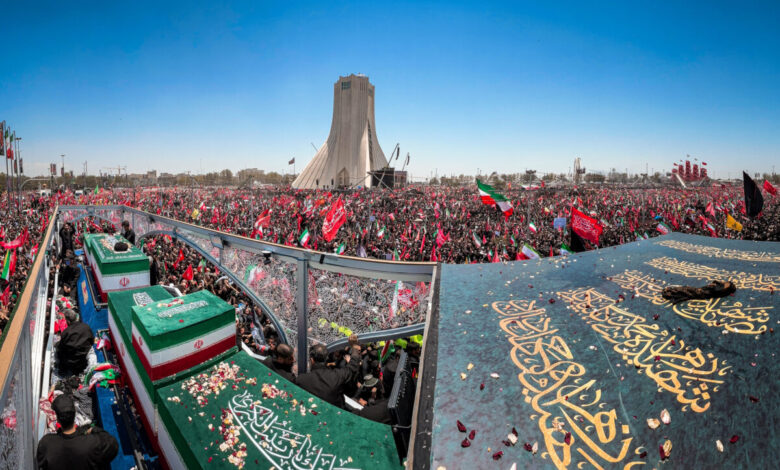
In politics, not everything is measured by the ballot box. Nations sometimes speak in moments when no ballots are cast, no electoral competition is underway, and no official institution has asked for public input. Yet these moments can reveal more about a society’s condition, citizens’ sense of belonging, and their relationship with national identity and authority than many formal elections. The national funeral of Iran’s martyred leader, Ayatollah Seyyed Ali Khamenei, is one such event. Public farewell rites opened in Tehran on July 4, and the capital’s main procession on July 6 brought a million-strong public presence into the streets. The ceremonies are continuing through their final stages and are scheduled to conclude with burial in Mashhad on July 9. Mourning has therefore transcended a personal ritual and become a political, social, and historical occasion.
A common mistake in analyzing these events is to view them solely through the lens of emotion or purely as political organization. Neither perspective alone can fully explain the widespread, million-strong public presence at Ayatollah Khamenei’s funeral. If emotion were sufficient, similar ceremonies elsewhere would reach comparable scale. If organization alone were decisive, the symbolic capital of such events would not endure so strongly in a nation’s historical memory.
What distinguishes this funeral is the profound connection between collective emotion, revolutionary identity, historical memory of resistance, and the public’s perception of the nation’s destiny.
In political science literature, legitimacy is not merely the product of legal institutions. Political systems achieve greater stability when they establish an emotional and identity-based bond with large segments of society. The funeral of Ayatollah Khamenei, after its first major public stages, serves as a real-time test of this social capital. It shows that a significant portion of Iranian society links the existence of the political order and the achievements of the Revolution to its own narrative of independence, resistance, security, and the country’s future. Moments of crisis and transition bring this bond into sharp relief.
For this reason, the funeral of Iran’s leader cannot be seen merely as a farewell to an individual. It has become a stage for competing narratives about the country.
For the state, it symbolizes continuity, cohesion, and the endurance of the Leader’s path. For citizens, it offers an opportunity to express deep attachment, pay respects to a historic figure, and participate in a shared memory of resistance and sacrifice. For outside observers, it provides data to assess levels of social cohesion or division. Thus, the streets filled with crowds in Tehran, followed by ceremonies in Qom, Mashhad, and other cities, are not just an image – they constitute powerful political data that various actors are actively interpreting.
From this perspective, the concept of a “symbolic referendum” gains relevance in the context of Ayatollah Khamenei’s funeral.
This does not mean the public ceremony replaces legal electoral mechanisms, but rather that such events – due to their scale of participation and symbolic weight – become arenas for displaying public perceptions of Iranian-Islamic identity, national cohesion, and revolutionary continuity.
While lacking the legal standing of an election, this display significantly influences both domestic and international perceptions. The scale of the turnout does not merely accompany the political message; it is part of the message itself.
In today’s world, power competition unfolds not only in economics, diplomacy, or military strength, but also in the realm of narratives. The funeral of Iran’s martyred leader has moved beyond a cultural ritual to become part of “the politics of imagery.” The scenes of millions of people filling Tehran’s streets convey a narrative of Iran that goes beyond official statements.
This funeral has emerged as a pivotal moment in reinforcing national identity. It reconstructs citizens’ shared sense of the past (the Revolution and the Sacred Defense), the present (resistance amid pressures), and the future (continuity of the path), while generating a form of social solidarity that transcends everyday divisions.
For political analysts, the central question should not be merely how many people were present, but why this turnout occurred, what meaning it holds for different groups, and what narrative will be constructed around it domestically and internationally. Politics is less a domain of numbers than one of meaning. The image of this collective presence affects public perception more powerfully than dozens of speeches, because images transmit feeling directly – and feeling remains one of the most important drivers of political behavior.
In the age of digital media, this funeral is not confined to the streets; it is simultaneously reproduced across social networks and international outlets. The battle over its interpretation – from “a display of unity” to competing counter-narratives – has itself become part of the political process.
Ultimately, the national funeral of martyred leader Ayatollah Seyyed Ali Khamenei can be viewed as a mirror reflecting an important part of Iran’s social and political reality. It signals the presence of symbolic capital, collective memory, and a deep capacity for social mobilization. Its real significance lies in reminding us that politics in Iran is not solely the product of institutional and party competition, but rests also on a foundation of memory, identity, emotion, and meaning.
History will likely remember this funeral not merely as the end of one leader’s life, but as the beginning of a new chapter in the nation’s narrative. In these moments, the street is no longer just a passageway for crowds; it has become a stage where society seeks to present its understanding of identity, continuity, and the future to the world.
Understanding this message requires looking beyond counting participants to the meaning this collective presence is attempting to convey.
The views expressed in this article belong to the author and do not necessarily reflect the editorial policy of Middle East Monitor.