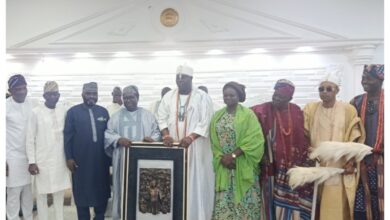
Reuben Abati has spent decades working close to the places where journalism, politics and public policy meet. As a television anchor, newspaper columnist, former presidential spokesman and public intellectual, he has gained access to decision-makers while retaining a regular place in Nigeria’s political debate.
His influence does not come from holding elected office or controlling a state institution. It rests on experience, visibility and the authority to question politicians before a national audience.
Abati currently appears as an anchor on The Morning Show on ARISE News, where he interviews political leaders, public officials, diplomats, business executives and policy experts. He also writes the Tuesday with Reuben Abati column for THISDAY, giving him influence across television, print and digital media.
His career is unusual because he has worked on both sides of the media-government relationship.

Before entering government, he spent more than a decade as chairman of the editorial board and editorial-page editor of The Guardian. From 2011 to 2015, he served as Special Adviser on Media and Publicity and official spokesman to President Goodluck Jonathan.
That experience gave him an insider’s understanding of how governments manage information, respond to crises and defend policy. It also created questions about independence that continue to shape how some viewers judge his work.
Current Power and Institutional Control
Abati does not control a ministry, political party, legislature or regulatory agency. His current authority is editorial rather than constitutional.
On ARISE News, he occupies a position from which he can determine the direction of interviews, select follow-up questions and challenge the claims made by public officials. That gives him indirect power over how political issues are presented to viewers.
His previous role inside the presidency adds weight to his analysis. He has seen how official decisions are communicated and how political leaders respond when placed under pressure.
However, access is not the same as control. Abati cannot compel a minister to change policy or force an agency to investigate wrongdoing. His influence depends on whether the public, other journalists and policymakers treat the questions raised on his programmes as important.
His period as a presidential spokesman also complicates his public image. Supporters may see it as valuable government experience, while critics may question whether a former political appointee can always examine power from a sufficient distance.
Reach and Visibility
Abati’s influence is strengthened by his regular presence on a national television network.
The Morning Show covers politics, security, the economy, foreign affairs and social issues. Interviews and commentary from the programme are distributed through ARISE News’ television service, website, YouTube channel and social-media accounts.
This means an exchange that begins in the studio can quickly reach audiences far beyond the original broadcast. Short clips are often shared on WhatsApp, X, Facebook and other platforms, where they become part of wider political arguments.
Abati also maintains visibility through his newspaper column. His writing allows him to examine issues in greater depth than television usually permits and gives him another route into national discussion. THISDAY has carried the Tuesday with Reuben Abati column for several years.
He does not appear to operate a major independent podcast built around his own name. However, ARISE News interviews are often consumed in podcast-like form through online video and audio clips.
His reach is strongest among politically engaged Nigerians, professionals, officials and members of the diaspora. It is substantial, though not as broad as that of the country’s largest entertainment personalities.
Read related reports:
Tinubu hails Reuben Abati at 60, describes him as a patriotic public intellectual
Wike is rude, Amaechi is his political boss – Reuben Abati
Osun APC accuses NULGE, Reuben Abati of partisanship in LG allocation crisis
Soft Power and Cultural Influence
Abati has become part of Nigeria’s political-media culture.
His measured speaking style, academic background and experience in government give his commentary a different tone from the confrontational approach used by some broadcasters. He often places current events within a wider historical, legal or literary context.
This gives him soft power: the ability to shape opinion through knowledge, language and reputation rather than formal authority.
His influence is also linked to the idea of the journalist as a public intellectual. He does not limit himself to reporting what happened. He interprets events and offers judgments about politics, culture and public conduct.
That approach has earned respect, but it can also attract criticism. Viewers may disagree with his framing, accuse him of favouring particular interests or believe that commentary has moved too close to advocacy.
Public trust in a journalist is never automatic. It must be renewed through fair questions, accurate analysis and a willingness to challenge all sides.
Relevance to 2026
Abati remains relevant in 2026 because Nigeria is moving towards another general election while facing economic pressure, insecurity and arguments over the performance of public institutions.
The approach to the 2027 elections will increase demand for interviews with candidates, party officials and government representatives.
Abati’s experience gives him the background to test campaign promises against previous records. His familiarity with presidential communication also helps him identify when an official answer avoids the central issue.
His relevance extends beyond elections. Inflation, poverty, constitutional disputes, security operations and Nigeria’s foreign relationships all require sustained public questioning.
The danger is that political television can become dominated by personalities, daily disputes and viral exchanges. Abati’s value will depend on whether he keeps attention on policy, evidence and public consequences rather than spectacle.
Generational Influence
Abati’s career spans print journalism, television, government communication and digital media.
For younger journalists, that journey demonstrates that media skills can be applied across several institutions. It also shows the opportunities and ethical risks that arise when journalists move into government and later return to the newsroom.
His newspaper work belongs to an older tradition of long-form political commentary. His television interviews now reach younger viewers through short online clips.
This combination allows him to connect established journalism with changing media habits.
However, his generational influence is not based on a large personal youth movement or a dedicated training institution. It is mainly professional and intellectual.
His legacy will depend partly on whether younger journalists adopt his preparation and range without accepting access to power as a substitute for independence.
National and International Recognition
Abati has received recognition over several decades.
His journalism honours include the Hadj Alade Odunewu/Diamond Award for Media Excellence prize for informed commentary, which he won several times, the Cecil King Memorial Prize for Print Journalist of the Year in 1998 and the Fletcher Challenge Commonwealth Prize for Opinion Writing in 2000.
He also received the Freedom Peace Prize for Journalism in 2010 and the Red Media Africa Living Legends Industry Award in 2015, according to his professional profile.
His 60th birthday in 2025 drew public tributes from President Bola Tinubu and former national leaders. The presidency described him as a journalist, former presidential adviser, public intellectual, author and broadcaster whose writing and television analysis had contributed to public discussion.
His international recognition is respectable but more limited than his national profile. Some of his awards have Commonwealth links, while ARISE News gives his interviews access to international and diaspora audiences.
He is best understood as a major Nigerian media figure with regional reach rather than a globally dominant broadcaster.
Public Trust and Democratic Accountability
Abati contributes to democratic accountability by questioning those who exercise power.
Political interviews give citizens an opportunity to hear officials explain decisions in their own words. A prepared interviewer can expose weak arguments by asking for evidence, dates, costs and responsibility.
Abati’s knowledge of government communication can be an advantage in this role. He understands how official language is used to control a narrative.
Yet public accountability also requires the interviewer to remain independent from the political class. Abati’s past service in the Jonathan administration and his participation as a deputy governorship candidate in Ogun State’s 2019 election mean that audiences may examine his political neutrality more closely than they would that of a journalist without such experience.
That scrutiny is legitimate. A journalist’s past does not automatically disqualify him, but it increases the need for consistent treatment of government and opposition figures.
Trust depends not on claims of neutrality but on visible fairness.
The Limits of His Influence
Abati’s public profile should not be confused with direct political power.
He can ask difficult questions, but he cannot make officials answer fully. He can criticise a policy, but he cannot reverse it.
His audience is also largely made up of people who already follow politics and public affairs. Many Nigerians receive information mainly through entertainment platforms, religious networks, local radio or informal social-media channels.
His association with past government service may also reduce trust among viewers who believe journalists should remain completely outside partisan politics.
Television debates can sometimes reward sharp exchanges more than careful investigation. Abati’s influence would be stronger when interviews are supported by documents, data and sustained follow-up reporting.
He remains influential, but that influence is mediated by the credibility of his platform and the public’s