Xi Unveils Global AI Governance Framework, Pledges 5,000 Training Opportunities for Developing Nations

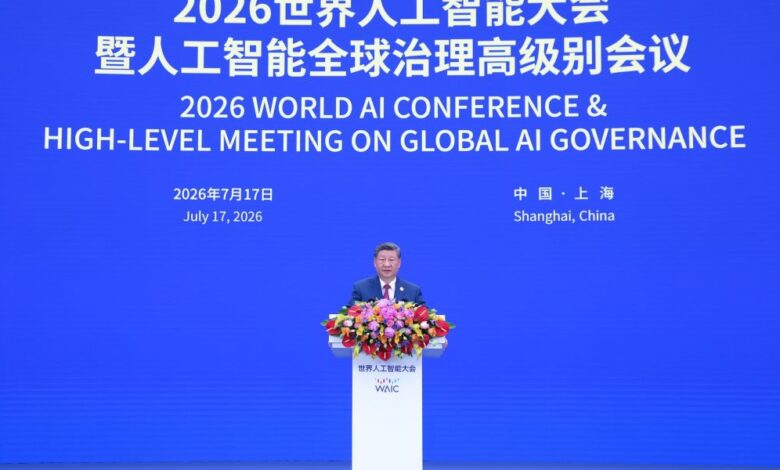
Chinese President Xi Jinping has presented a broad roadmap for international cooperation on artificial intelligence (AI), introducing four guiding principles for global AI governance and announcing a package of initiatives aimed at expanding access to the technology in developing countries.
Speaking at the opening of the World Artificial Intelligence Conference (WAIC) 2026 in Shanghai, Xi said AI is reshaping the global economy and society at an unprecedented pace, making international collaboration essential to harness its benefits while addressing emerging risks.
He urged governments, technology companies and researchers to work together to ensure artificial intelligence contributes to sustainable development, shared prosperity and global security instead of widening inequality or creating new divisions.
Central to his address was a proposal for four principles that should underpin future global AI governance.


The first advocates openness and mutually beneficial cooperation. Xi called for greater collaboration in AI research, innovation and industrial development, encouraging countries to share knowledge and promote wider adoption of AI technologies across different sectors of the economy.
His second principle focused on safety and oversight. While acknowledging AI’s enormous potential, Xi stressed the need for robust legal frameworks, effective regulation and stronger risk management systems to guard against misuse and ensure the technology remains under human control. He also cautioned against using national security concerns to unnecessarily restrict international AI cooperation.
The third principle emphasized inclusiveness and respect for cultural diversity. According to Xi, AI should strengthen dialogue among nations and reflect humanity’s shared values without eroding the unique traditions and identities of different societies.
His fourth proposal called for stronger multilateral cooperation in AI governance. Xi reaffirmed support for the United Nations as the primary platform for developing international AI rules, standards and governance mechanisms, while urging greater assistance for developing countries to narrow the growing AI and digital gaps.
As part of China’s contribution to global AI capacity building, Xi announced that the country will offer 5,000 training and seminar opportunities to participants from developing nations over the next five years.
He also disclosed plans to establish AI application cooperation centres with regional organisations, including the Association of Southeast Asian Nations (ASEAN), the League of Arab States, the African Union (AU), the Community of Latin American and Caribbean States (CELAC), the Shanghai Cooperation Organisation (SCO) and BRICS.
In another major initiative, Xi said China will extend access to its AI-powered MAZU Meteorological Warning System to 30 countries, helping improve disaster preparedness and early warning capabilities.
Highlighting China’s domestic achievements, the President said the country’s AI sector has become a major driver of economic growth, with the value of its core smart economy industries surpassing one trillion yuan. He added that AI technologies are increasingly being deployed in manufacturing, public services and everyday life, while China continues to strengthen legal, regulatory and ethical safeguards for responsible AI development.
Xi also highlighted China’s growing role in shaping global AI governance through initiatives such as the Global AI Governance Initiative, support for the United Nations resolution on strengthening international cooperation in AI capacity building, and the establishment of the World Artificial Intelligence Cooperation Organization (WAICO), headquartered in Shanghai.
He described WAICO as an important platform for promoting inclusive AI development and expanding international cooperation, particularly in response to the needs of developing countries.
Concluding his address, Xi called for closer global partnerships to ensure artificial intelligence advances peace, innovation and human well-being, stressing that the future of AI should be built on cooperation, shared responsibility and common progress.