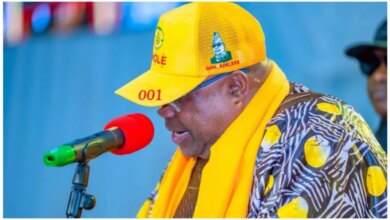
$5bn Abu Dhabi Deal: Oye Worries Over Accountability, Queries ₦11.85tn Borrowing, ₦30.64tn Govt Spending

…says Naira Lost 29% Value in Four Years
The Chairman of the Alliance for Economic Research and Ethics LTD/GTE, Dele Oye, has raised concerns over transparency and accountability in the Federal Government’s approximately $5 billion financing arrangement with First Abu Dhabi Bank, while questioning the composition of the President Bola Ahmed Tinubu-led administration’s reported ₦20.4 trillion in incremental resources and ₦30.64 trillion in additional expenditure.
Oye, in a statement, said the government’s handling of the Abu Dhabi facility required greater public disclosure, particularly because the transaction involves public institutions, sovereign obligations and public collateral.
Oye’s position followed Finance Minister and Coordinating Minister of the Economy, Taiwo Oyedele’s presentation of the Federal Government’s economic reform scorecard on August 19, 2026.


Oyedele had said the government would not publish details of how funds from the Abu Dhabi facility were being spent, arguing that government expenditure was already subject to public reporting and questioning why the particular facility should be treated differently.
But the Oye said the explanation did not adequately address the accountability concerns surrounding the transaction.
He said the government should disclose the material terms of the facility, including the drawdown schedule, purpose of funds, collateral framework, fees, margin-call provisions, early-termination triggers and periodic utilisation reports.
He stressed that legislative approval of the facility was not the same as continuous public accountability.
Beyond the Abu Dhabi facility, the Alliance queried the presentation of the government’s claim that reforms had generated approximately ₦20.4 trillion in incremental Federal Government resources.
The figure, according to the Ministry’s scorecard, comprises ₦5.43 trillion in estimated Federal Government subsidy savings, ₦3.12 trillion in other incremental revenues and ₦11.85 trillion in incremental borrowing.
The organisation noted that borrowing accounted for about 58 per cent of the stated ₦20.4 trillion.
Oye therefore argued that the figure should not be interpreted as ₦20.4 trillion in internally generated or “free” resources, but rather as a combination of fiscal savings, additional revenue and financing.
He also distinguished between the Federal Government’s share of subsidy savings and the total savings generated across the Federation.
It said the Ministry reported approximately ₦15.8 trillion in subsidy savings, comprising ₦5.43 trillion for the Federal Government, ₦6.52 trillion for states and ₦3.88 trillion for local governments.
The organisation also drew attention to the government’s reported ₦30.64 trillion in additional expenditure pressures, describing the figures as evidence of a mixed fiscal picture.
The expenditure pressures include ₦9.39 trillion for wage adjustments, wage awards, allowances and related personnel costs; ₦9.37 trillion from the exchange-rate impact on external debt service; ₦6.47 trillion for strategic infrastructure; and ₦3.14 trillion for electricity support.
The report noted that the ₦9.39 trillion wage-related pressure alone exceeded the Federal Government’s estimated ₦5.43 trillion share of subsidy savings.
However, Oye cautioned against treating the figures as a direct one-to-one transfer of subsidy savings into wages, explaining that the numbers represented different components of a multi-year fiscal adjustment.
According to the organisation, the government’s own presentation showed that additional spending exceeded incremental resources, with about two-thirds of the spending pressures covered by incremental resources and roughly one-third absorbed within the existing revenue base.
The Alliance also questioned whether headline macroeconomic improvements adequately capture the experience of Nigerian households.
It acknowledged that headline inflation had fallen from 22.41 per cent in May 2023 to 15.91 per cent in June 2026, while the National Bureau of Statistics subsequently reported 15.43 per cent headline inflation and 20.31 per cent food inflation in July 2026.
It stressed, however, that falling inflation does not mean prices have returned to previous levels.
The report argued that food inflation, real wages, employment quality and poverty should be considered alongside headline inflation when assessing the impact of the government’s reforms.
It cited an IMF estimate that poverty had reached 63 per cent at Nigeria’s national poverty line, while about 27 million Nigerians faced food insecurity in autumn 2025.
Oye also acknowledged the improvement in Nigeria’s external reserves, noting that the Ministry reported gross reserves above $52 billion, while public reporting based on CBN data put the figure at approximately $52.5 billion in July 2026
He cautioned, however, that reserve figures must be accompanied by clear dates and definitions because different institutions may use different methodologies.
The Alliance said stronger reserves represented a genuine economic gain by improving external resilience, but warned that reserves should not be treated as ordinary budget revenue.
The organisation urged the Federal Government to publish the material terms of the Abu Dhabi facility while protecting genuinely commercially sensitive information.
It called for disclosure of the facility’s amount, tenor, tranche structure, drawdown schedule, pricing, fees, break clauses, collateral arrangements, valuation methodology, margin-call and early-termination triggers, purpose of each drawdown and quarterly utilisation reports.
It also called for complex financing arrangements, including derivative-based and collateralised borrowing, to be incorporated into the government’s economic scorecard.
The report said such disclosures should cover gross exposure, drawn amounts, collateral status, valuation movements, refinancing risks and potential worst-case scenarios.
While raising the concerns, the Alliance acknowledged that the government’s economic reform scorecard represented an important step towards greater fiscal communication and that some of the reported macroeconomic gains were real.
It said the objective should not be to dismiss the reforms but to ensure that their costs, financing sources and consequences are subjected to the same level of scrutiny as their achievements.
The organisation maintained that Nigeria’s economic recovery remained fragile and that sustaining the gains would depend not only on inflation, reserves and growth but also on whether citizens could trust institutions managing public resources.
In another statement, Oye said the naira value held by Nigerians has declined by almost one-third in real terms over four years despite the Central Bank of Nigeria’s (CBN) report that currency-in-circulation rose to a record ₦5.73 trillion in 2025.
Oye said the increase in physical cash in circulation should not be interpreted as evidence of stronger economic activity, arguing that inflation had significantly eroded the purchasing power of Nigerians’ cash holdings.
The CBN’s 2025 Annual Report stated that currency-in-circulation (CIC) stood at ₦5.73 trillion in 2025, compared with ₦5.44 trillion in 2024, attributing the rise to increased economic activity and higher demand for cash.
However, Oye’s analysis of CBN, National Bureau of Statistics (NBS), and World Bank data argued that the headline increase in cash circulation masked a deeper decline in the real value of money in Nigerians’ hands.
According to the report, currency-in-circulation increased from ₦3.325 trillion in 2021 to ₦5.733 trillion in 2025, representing a nominal growth of 72.4 per cent over the period.
But after adjusting for inflation, the report said the picture changed significantly, with the purchasing power of cash held by Nigerians falling by approximately 29 per cent between 2021 and 2025.
What do you think about this?
Drop your opinion in the comment section.
FOLLOW US & Share this with someone who needs to see this.