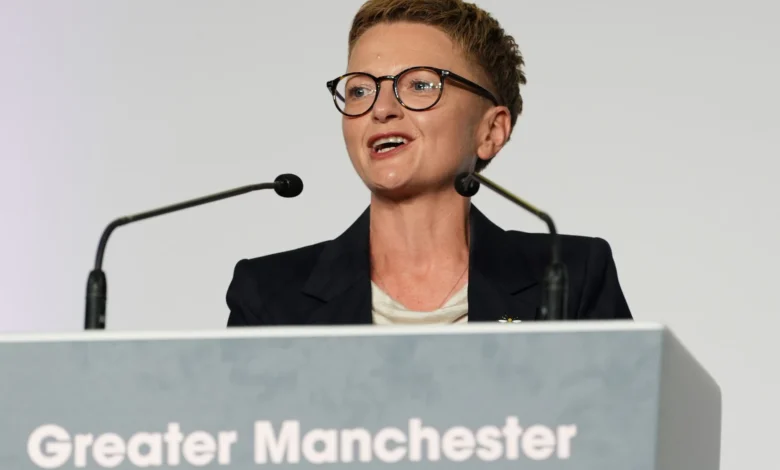
Labour’s Bev Craig has won the Greater Manchester mayoral by-election, defeating Reform UK candidate Sian Astley after the contest moved to a second round. Craig will replace Andy Burnham and become the first woman to hold one of the most influential regional offices in England, although a turnout of just 25 per cent has raised questions about public engagement.
The election was held on Thursday, 30 July, after Burnham stepped down following his return to Parliament and subsequent appointment as Prime Minister.
Craig secured 47.15 per cent of first-preference votes, falling short of the 50 per cent required for an immediate victory. Astley finished second with 20.99 per cent, meaning the contest moved to a final count using voters’ second preferences.
After the additional votes were transferred, Craig finished with 309,525 votes, or 66.3 per cent, while Astley received 157,178, representing 33.7 per cent.

Labour retains control of Greater Manchester
The result allows Labour to maintain its hold on the mayoralty after Burnham led the region for nine years.
Craig previously served as leader of Manchester City Council, a position she had held since 2021. She was also the first woman to lead the council and now becomes Greater Manchester’s first female metro mayor.
The Greater Manchester mayor oversees policies affecting transport, housing, policing, economic development and skills across the region’s 10 boroughs.
Unlike the mayor of Manchester city alone, the metro mayor represents the wider Greater Manchester area, which includes Bolton, Bury, Oldham, Rochdale, Salford, Stockport, Tameside, Trafford and Wigan, as well as Manchester.
Craig had campaigned on promises to support household incomes, build more council and affordable homes, improve town centres and expand the Bee Network, Greater Manchester’s integrated public transport system.
Her Labour campaign said she would seek to freeze public transport fares and create a New High Streets Fund to support local communities. Some of those policies may require additional funding or approval from the combined authority before they can be fully implemented.
Result delivers setback for Reform UK
The victory is a blow to Reform UK, which had hoped to build on its recent gains in local elections and challenge Labour in one of its traditional northern strongholds.
Astley reached the second round but remained well behind Craig once transferred votes were counted.
Labour’s performance will be viewed as an early political boost for Burnham, who entered Downing Street on 20 July after replacing Sir Keir Starmer.
The by-election was widely seen as an important test of whether Burnham’s rise had helped Labour regain support lost to Reform UK, the Greens and other parties.
Craig’s victory suggests that Labour remains the dominant force in Greater Manchester. However, one regional result cannot reliably predict how people will vote in a future general election.
Approval ratings, local contests and national elections measure different political factors. Voters may support one party for a mayoral role but make a different choice when electing an MP or national government.
New Daily Prime previously reported on Starmer’s leadership crisis following Burnham’s Makerfield victory, which accelerated the political events that eventually took Burnham from Greater Manchester to Downing Street.
Despite Craig’s decisive final-round victory, only about 25 per cent of eligible voters participated.
More than 2.1 million people were entitled to vote, but 538,659 ballots were cast. It was the lowest turnout recorded in a Greater Manchester mayoral election since the position was created in 2017.
The low figure means that while Craig won a clear majority among those whose votes remained in the final round, most eligible residents did not take part.
The summer timing of the contest, limited public awareness and voter fatigue may have contributed to the low turnout. However, the available results do not establish a single reason for the lack of participation.
The by-election was required because Burnham left the mayoral office before completing his term. It was described as Britain’s largest by-election because more than two million electors across the city region were eligible to participate.
The supplementary vote system was used for the contest. Under this system, voters could choose a first and second preference.
When no candidate won more than half of the first-preference vote, all candidates except the two leaders were eliminated. Valid second preferences from those eliminated candidates were then added to the totals of Craig and Astley.
This differs from the first-past-the-post system used in UK general elections, where the candidate with the largest number of votes wins even without securing an overall majority.
Craig promises continuity after Burnham era
Craig now faces the task of establishing her own leadership after nearly a decade in which the Greater Manchester mayoralty was closely associated with Burnham.
She has promised to protect residents’ interests, improve access to good-quality housing and reject political division. Her record as Manchester City Council leader formed a central part of her campaign.
Labour said the council increased the delivery of council and affordable housing, reduced homelessness and secured an outstanding Ofsted rating for children’s services during her leadership. Those claims formed part of the party’s campaign case and will now face scrutiny as she begins work at regional level.
Craig will also work alongside Burnham’s government, which has opened a new No 10 North office in Manchester.
The office is intended to bring ministers, regional mayors and business leaders together to discuss investment, housing, transport and economic growth. New Daily Prime has reported on Burnham’s launch of No 10 North and the controversy surrounding his government flight to Manchester.
Her election gives Labour control at local, regional and national levels in Greater Manchester. That alignment could make it easier to negotiate with central government, but it does not guarantee that every promised project will receive funding or approval.
Craig will be judged on whether she can maintain the political influence built during Burnham’s tenure while delivering measurable improvements across all 10 boroughs.
The result is a clear Labour victory and an early setback for Reform UK under the new national government. Yet the low turnout also shows that Craig must persuade many residents who stayed away from the polls that the mayoralty can improve their daily lives.
New Daily Prime: Read the latest UK political reports from New Daily Prime