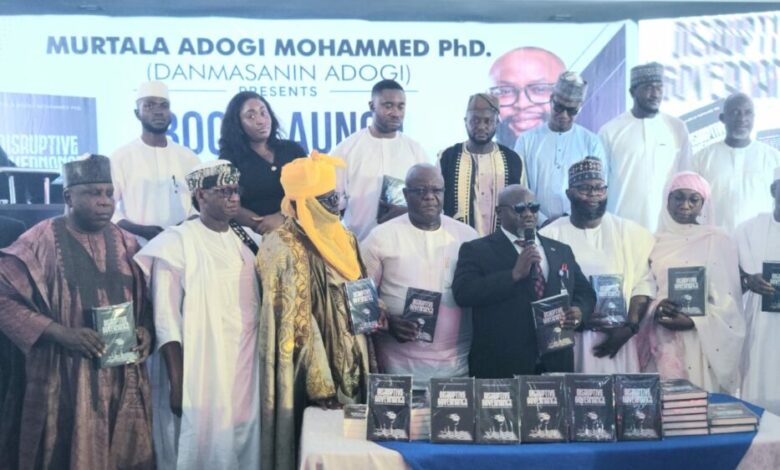
Governments at all levels have been urged to strengthen institutions, move beyond the formulation of policies and development plans and focus on achieving measurable results that directly improve the lives of citizens.
The call was made in Abuja at the unveiling of ‘Disruptive Governance,’ a book by policy entrepreneur and governance strategist, Murtala Adogi Mohammed, which examines leadership, institutional performance, strategic planning and public-sector delivery.

The author, Mohammed who spoke on governance and crisis preparedness, urged state governments to develop strategic plans and make adequate budgetary provisions for emergencies rather than relying on the Federal Government whenever crises occur.
He recalled that the COVID-19 pandemic exposed weaknesses in the emergency preparedness of states, noting that governors approached the federal government for funds to respond to the crisis. “I began to think that if we’re going to have another COVID-19, it means governors may likely run back to the president again,” he said.
Mohammed advised newly elected governors to prioritise strategic planning, budget review and the establishment of competent technical teams at the beginning of their administrations, stressing the need for governments to prepare for crises rather than wait for them to occur.
Chairman of the Organising Committee, Dr Edwin Edeh, said Nigeria and Africa were not short of development plans and strategies, citing Vision 2020, the Nigeria Development Agenda and the African Union’s Agenda 2063. He, however, said the challenge was translating these policies into tangible improvements in the lives of citizens. “An average Nigerian, an average African wants real leadership, not by speeches, but by results,” Edeh said.
He stressed that good ideas could not produce meaningful outcomes without effective institutions, evidence-based decisions and systems for measuring performance. “Good ideas alone cannot produce results. For results to be produced, institutions and systems must work. Decisions must be evidence-based, and every performance must be measured,” he said.
On his part, vice-chancellor of Baze University and lead reviewer of the book, Professor Abiodun Adeniyi, said measurable performance, institutional coordination, leadership and resource mobilisation were essential to closing the implementation gap.
Adeniyi said the book presents disruption as a deliberate leadership strategy for challenging ineffective routines, overcoming institutional inertia and creating conditions for measurable results. “The author’s conception of disruption is fundamentally reformist rather than anarchist,” he said.
He said the approach was particularly relevant to Nigeria, where institutional reforms often face political, administrative, financial and organisational constraints, adding that strategic leaders could identify points of leverage within such systems to initiate meaningful improvements.
Also speaking, Minister of Women Affairs, Hajiya Imaan Sulaiman-Ibrahim, highlighted gaps in the policy framework for protecting women, children and families, saying several policies were outdated and inadequately funded.
She said the situation had made it difficult for the ministry to effectively implement programmes targeting vulnerable groups. “These are policies that are meant to protect our children, our women, the families that are not existing. Most of them are outdated. They spend most of their time with little or no resources,” she said.
Nasarawa State governorship aspirant, Senator Ahmed Wadada, commended Mohammed’s contribution to governance and economic development, urging public officials and aspiring leaders to study the ideas contained in his book.
Wadada, who has declared his intention to contest the 2027 governorship election in Nasarawa State, said the book should be made available in public and educational institutions to ensure that its lessons benefit future generations.