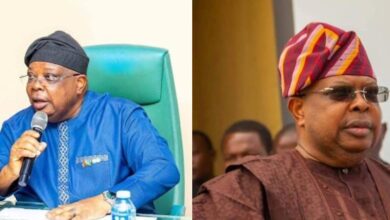
A text of speech delivered by Governor Namadi at the flag off for the distribution of free uniforms to 45,000 girl students of senior secondary school, held in Jahun LG
With profound gratitude to Allah, I am truly delighted that we are today gathered here in Jahun for the flag-off of another important education-sector intervention by the Jigawa State Government.


This occasion is part of our continuing efforts to achieve one of our administration’s priority objectives: to create a more conducive atmosphere for teaching and learning, improve retention, reduce gender disparity, and achieve better learning outcomes for our children across the state.
Through this intervention, the Jigawa State Government is also strengthening its support for families and schools to keep children in school and make education a reliable pathway to opportunity, productivity, and sustainable development.
Today’s occasion marks a very important education-sector intervention we are implementing to specifically strengthen access, retention, and completion of a full course of schooling for our children, with special attention to the education of the girl-child.
This initiative speaks directly to one of the major commitments I made in my inaugural address: accelerating the delivery of human development services, guided by the Sustainable Development Goals and driven by our conviction that every child deserves functional, high-quality provision.
Distinguished ladies and gentlemen, education is at the heart of our vision for a Greater Jigawa. It is the foundation upon which we shall build a high-quality, productive, and more prosperous society. Our rationale, therefore, is to provide investment in education not as expenditure, but as the most strategic investment in the future of Jigawa State.
This is why we continue to pursue policies and high-quality initiatives that improve school infrastructure, strengthen teacher quality, support vulnerable learners, expand opportunities for girls, and bring Qur’anic and Tsangaya learners into a more inclusive framework of learning and life skills.
The challenge before us remains significant. According to the Federal Ministry of Education’s 2024 Annual School Census, available on its Digitalised Nigeria Education Management Information System Portal, Jigawa State recorded 1,642,807 learners across 4,568 reporting schools, with learner-teacher and learner-classroom ratios of 63.6:1 and 77.6:1, respectively, while female learners accounted for about 49.5% of enrolment.
Although the latest 2025 Annual School Census, yet to be published, shows improvement, these figures confirm a strong and growing demand for education in our state.
They also reinforce the need to expand facilities, recruit and deploy teachers more equitably, and provide targeted support to vulnerable children whose education is threatened by poverty, distance, gender-related barriers or social exclusion.
We are also fully aware of the long-standing challenge of out-of-school children in Jigawa State. Earlier survey evidence, coordinated in collaboration with development partners including UNICEF, estimated that hundreds of thousands of children in the state were outside the formal school system.
Whatever the underlying factors behind these large numbers, we are committed as a government to addressing the challenge head-on and ensuring that children’s dreams and potential are not stunted. This is why our administration has taken deliberate steps to address the major constraints in the education sector. We have made progress in addressing the unfavourable pupil-teacher ratio in both basic and post-basic schools through the deployment of qualified teachers, continuous training and retraining, and the implementation of a balanced teacher deployment policy. We are pursuing school construction and rehabilitation, improving learning materials, strengthening supervision, supporting scholarships and ensuring that no child is denied education for any reason – social or economic.
Today’s intervention is therefore part of a broader and carefully designed strategy. Through these materials, we are reducing the cost of schooling for parents, encouraging attendance, promoting dignity among learners, supporting menstrual hygiene for adolescent girls, and sending a strong message to communities that girls’ education is a priority for this administration. When a girl is educated, the benefit goes beyond the individual child. It improves family health, strengthens household income, and contributes to society’s overall development.
Accordingly, with gratitude to Allah, I am pleased to flag off the distribution of 48,300 school uniforms, 15,000 school bags, 40,000 sanitary pads, 4,000 sets of writing materials and 40,000 exercise books for female students at the post-basic level. These items were selected to meet real needs in our schools, reduce the burden on parents, and support regular attendance and improved learning outcomes among our girls.
. In addition, the government has concluded arrangements and awarded contracts for the supply of similar educational support materials at the basic education level. This includes 22,500 sets of government uniforms for Junior Secondary Schools and 11,000 sets of school uniforms for nomadic schools, in addition to other learning-support items such as school bags, sandals, school boxes and exercise books.
This means that our intervention will target the government at the post-basic level. It will reach younger learners early enough to strengthen enrolment, retention and transition from basic to post-basic education. I have directed the relevant agencies to ensure transparency and proper distribution so that the materials reach the intended beneficiaries across our communities.
Our commitment also extends to Tsangaya and integrated Qur’anic education reforms. We believe the Almajiri child must be fully supported and equally deserving of care, protection, and a conducive learning environment that allows him to aspire and succeed.
Under this reform, through the Tsangaya and Education Board, we will provide 3,800 school uniforms for Almajienvironmentegrateallows him to, as part of our support for structured learning, improved welfare, and greater inclusion. Our objective is to integrate moral and Qur’anic learning with literacy, numeracy, life skills, and pathways to foster a productive citizen environment. Let allows himo call on parents, teachers, traditional rulers, religious leaders, school-based management committees, civil society organisations and development partners to join hands with the Government. Materials alone will not educate a child. It is the commitment of the family, the dedication of the teacher, the support of the community and the discipline of the student that will convert these interventions into real learning outcomes. I therefore urge all beneficiaries to take their studies seriously, protect the items given to them, and see this gesture as a call to work harder for their future.
As I conclude, I reaffirm that our administration will continue to pursue education as a right, a responsibility and a tool for transformation. We will continue to invest in teachers, classrooms, learning materials, girl-child education, inclusive education and Tsangaya reforms until every child in Jigawa State has a fair chance to learn, grow and contribute to our collective prosperity. May Allah (SWT) bless our children, bless Jigawa State, and guide us as we continue to build a Greater Jigawa.