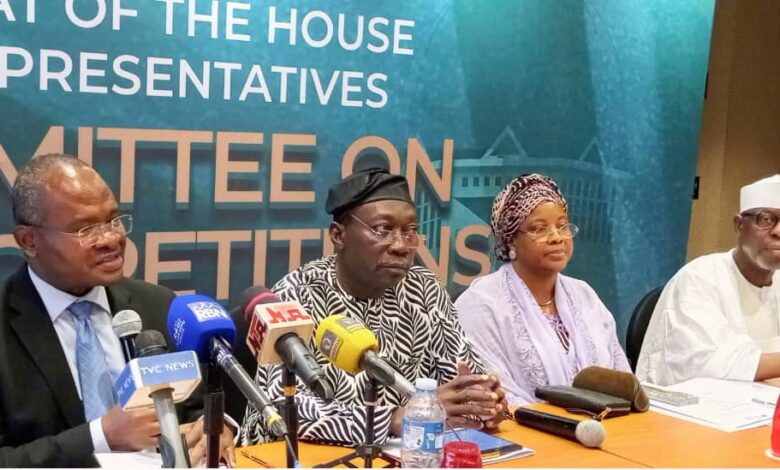
The House of Representatives Committee on Public Petitions has revealed that it has received no fewer than 890 petitions from Nigerians since the inauguration of the 10th National Assembly, raising concerns over persistent non-compliance by Ministries, Departments and Agencies (MDAs), which it says is delaying justice for petitioners.
Chairman of the Committee, Hon. Kwamoti Bitrus La’ori, disclosed this on Thursday during a retreat organised for committee members with support from the Policy and Legal Advocacy Centre (PLAC) and the European Union.
According to La’ori, the committee has successfully concluded 200 petitions, while reports on 70 cases have already been presented to the House for consideration. Several others, he noted, are still pending legislative action.
He attributed the high number of petitions to growing public trust in the committee as a reliable channel for legislative intervention and redress.

“So far, this committee has received 890 petitions from different segments of citizens across the country. We have concluded 200 and presented 70 for House consideration, while others are still awaiting action,” he said.
Highlighting the increasing reliance on the committee, La’ori noted that Nigerians now bring a wide range of issues—including domestic disputes—before it.
“Almost every petition, including domestic matters, is brought here. Even husbands and wives approach the committee. This reflects the level of confidence citizens have in our fairness and transparency,” he added.
However, he identified the refusal of many MDAs to honour invitations as a major setback, stressing that such actions prolong the resolution of cases unnecessarily.
“We send invitations to MDAs, but some ignore them until we threaten arrest. This must change because it delays matters that could have been resolved quickly,” he warned.
As the 10th National Assembly approaches its final year, La’ori emphasized the need to strengthen documentation, institutional memory, knowledge management, and digital record-keeping systems to improve efficiency.
He explained that the retreat was convened to assess the committee’s performance, identify operational gaps, and develop practical strategies for improving petition handling and reporting.
Participants at the retreat are expected to adopt a roadmap aimed at consolidating the committee’s achievements, enhancing the quality and timeliness of reports, and deploying digital tools to streamline petition management.
“Every petition represents the voice, hope, and expectation of a Nigerian seeking justice. We must remain responsive, fair, and timely in delivering legislative redress,” La’ori said.
In his remarks, the Executive Director of PLAC, Clement Nwankwo, urged lawmakers to utilise the remaining months of the Assembly to conclude pending assignments and strengthen institutional systems for future assemblies.
He also called for a legal framework to formally recognise constituency projects and ensure their effective implementation.
Similarly, the Chief Commissioner of the Public Complaints Commission (PCC), Hon. Bashir Abubakar, stressed the need for stronger collaboration between the commission and the House Committee on Public Petitions.
He noted that both institutions share a common mandate of providing accessible channels for justice and administrative redress, adding that many complaints handled by the PCC overlap with petitions before the National Assembly.
Abubakar further revealed that the commission’s recent international engagements exposed it to global best practices in digital case management, forensic investigations, and citizen-centred dispute resolution—tools he said would enhance accountability and transparency in public administration.