
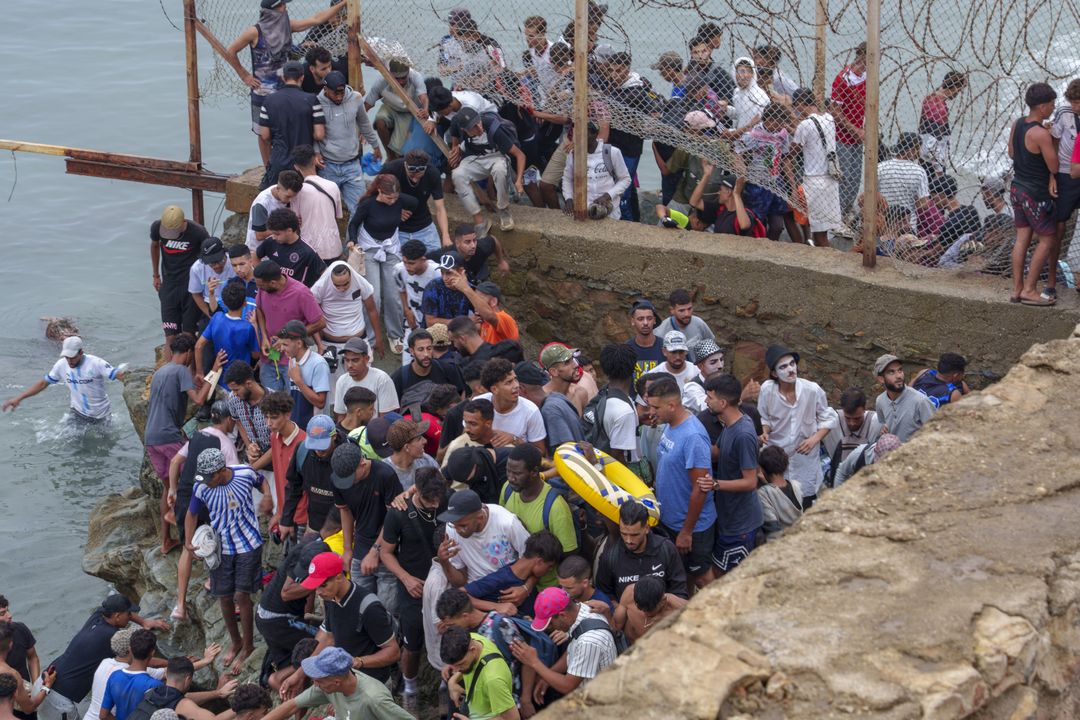
The recent, sudden influx of tens of thousands of Moroccans into Spanish territory has put the spotlight back on irregular migration to Europe, a contentious issue that has roiled the continent in recent times.
However, a broader look at the migrant crisis tells a more complex, multi-dimensional story, one in which history, foreign relations, and global geopolitics intertwine.
In other words, this was not a mere passing of migrants; it was an event that should be viewed through a wider, global lens.
What makes this incident unique when compared with other, usual incidents of migrant passing from Africa to Europe is the fact that it took place on the African mainland – at Ceuta and Melilla, two Spanish-held enclaves in the Moroccan heartland.

Ceuta bore the brunt of the influx, with 50,000 to 60,000 migrants entering the enclave, according to the Reuters news agency. Melilla, though, saw only sporadic clashes between migrants and security personnel.
Related
Spanish takeover
Ceuta and Melilla have long been Spanish-held territories. Unlike other parts of northern Morocco, the two enclaves were claimed by the Spanish crown long before Spain’s land grab of northern Moroccan cities in the late 19th century and early 20th century.
Ceuta, which was initially captured by Portugal in 1415, passed into the Spanish realm as a result of the Iberian Union (1580-1640), when the two then-kingdoms were joined under a Spanish monarch.
The 1668 Treaty of Lisbon reconfirmed Spanish ownership of Ceuta.
Melilla, on the other hand, was conquered by the Spanish as far back as 1497, right after the fall of Granada in 1492 and the completion of the Spanish Reconquista.
Although Spanish administration over the enclaves is recognised by most major global players, a recent change in the US Congress’ legislative phrasing regarding Madrid’s administration of the enclaves points to a wider context that could be tied to the migrant incident.
The US now refers to the enclaves as “Spanish-administered cities located in Moroccan territory”, as opposed to previous documentation referring to the twin cities as Spanish territory.
This shift comes as no surprise, as the US has been no fan of the current Spanish government over the past few years.
In fact, President Trump has been very critical of the Spanish government and Prime Minister over many issues, especially Madrid’s support for the Palestinian cause.
This tumultuous relationship between the two states is what led many to cast doubts over the simplicity of the Ceuta migrant crisis.
Related
Strained relations