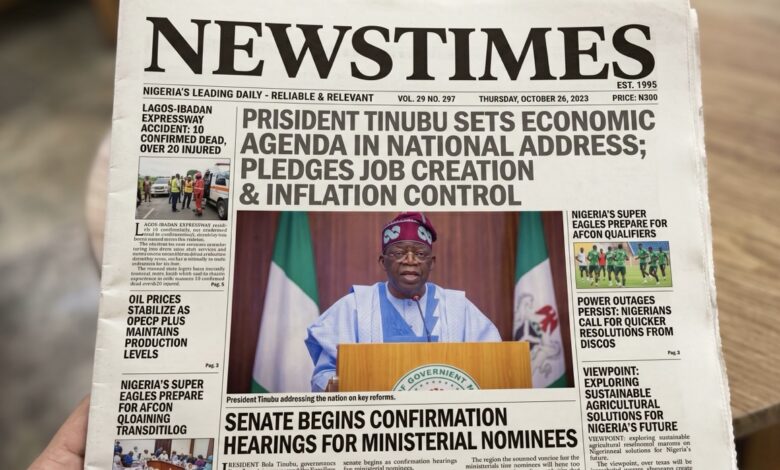
The United States has faulted Nigeria under President Bola Tinubu over fiscal transparency, citing weaknesses in budget execution, financial disclosure, auditing and public procurement. The assessment, released on 11 August, placed Nigeria among governments that failed to meet minimum US fiscal transparency requirements during the 2025 review period, raising fresh concerns about accountability and investor confidence.
The findings are contained in the US Department of State’s 2026 Fiscal Transparency Report, which reviewed 140 governments and entities. Nigeria was among 67 that did not meet the minimum requirements, while 73 were assessed as meeting them. Of the 67 that fell short, 14 were found to have made significant progress, but Nigeria was not placed in that category.
The assessment covered the period from 1 January to 31 December 2025 and examined how governments publish information about revenue, spending, debt, procurement and natural-resource contracts.
US raises concerns over budget performance
The report acknowledged that Nigeria made its enacted budget and end-of-year report widely available, including online. It also recognised that information on government debt obligations, including major state-owned enterprise debt, was publicly accessible.

However, the US said the executive budget proposal was not published within what it considered a reasonable period.
It also found that Nigeria’s budget documents did not provide a sufficiently complete picture of government revenue and expenditure, including detailed spending linked to executive offices.
A major concern was the difference between what was approved in the budget and what was eventually collected and spent. According to the assessment, actual revenue and expenditure did not reasonably correspond with figures contained in the enacted budget.
The finding adds to wider debate about Nigeria’s public finances. New Daily Prime recently reported calls for more detailed economic and public-finance data to allow citizens, investors and researchers to better judge government performance.
Audit independence and procurement questioned
The US assessment also raised concerns about Nigeria’s supreme audit institution. It said the institution had access to the executed federal budget but did not meet international standards for independence and did not publish substantive audit reports during the period examined.
Public procurement was another area highlighted.
The report said Nigeria had not made basic information on public procurement contracts sufficiently accessible to the public. This issue is particularly important because procurement records allow citizens to see which companies receive government contracts, how much they are paid and whether due process was followed.
Questions about public procurement and accountability have also featured in recent Nigerian political debate. Former Vice-President Atiku Abubakar recently demanded disclosure of procurement records relating to billions of dollars in government projects reportedly linked to companies associated with businessman Gilbert Chagoury. The allegations have not been established as fact.
The US report nevertheless gave Nigeria credit in some areas. It said the country had an appropriate legal framework for its sovereign wealth fund and provided information about its funding and general withdrawal arrangements. Nigeria was also credited for having legal procedures governing natural-resource extraction contracts and licences.
That comes as the Tinubu administration introduces new investment rules for Nigeria’s deep offshore oil sector, replacing project-by-project negotiations with a broader framework intended to give investors greater certainty.
Economists warn over investor confidence
Nigerian economists who reacted to the assessment broadly agreed that weaknesses in fiscal management deserve attention.
Professor Franklin Ngwu of the Lagos Business School Public Sector Initiative said repeated extensions and overlaps in Nigeria’s budget cycle had created uncertainty about the country’s financial management. He warned that foreign investors could become more cautious when transparency and governance indicators are weak.
Professor Akpan Ekpo of the University of Uyo also backed the broad findings, calling for greater transparency in government borrowing, procurement, revenue and expenditure. He said stronger scrutiny of the budget process was needed.
Economic Associates chief executive Ayo Teriba argued that the government should regularly publish reports showing how budgets are actually performing before presenting new spending plans.
However, Centre for the Promotion of Private Enterprise chief executive Muda Yusuf offered a more qualified assessment. He noted that Nigeria already publishes detailed budget documents, while agreeing that budget implementation remains an area requiring reform.
The US report is not a corruption ranking. The State Department made clear that failing its fiscal transparency test does not automatically mean a government is significantly corrupt. The assessment focuses instead on whether citizens can obtain reliable and timely information about how public money is raised, allocated and spent.
The State Department recommended that Nigeria publish its executive budget proposal promptly, provide more complete information on revenue and expenditure, bring actual spending closer to approved budgets, strengthen the independence of its audit institution and publish accessible information about public procurement contracts.
Related news