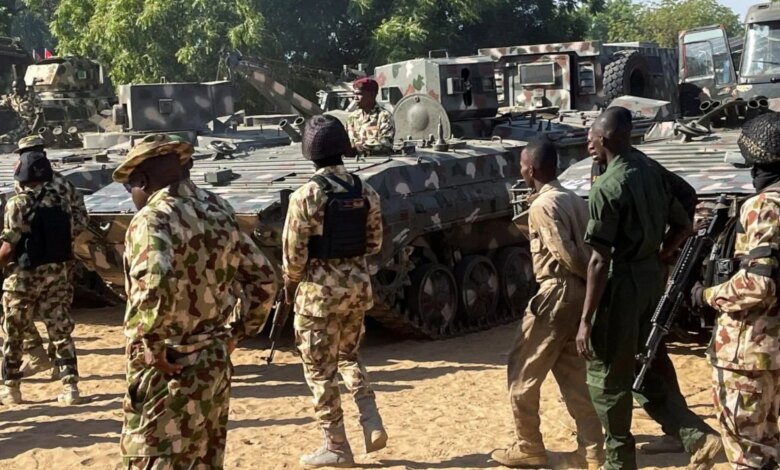
The United States military has stepped up its security cooperation with Nigeria through a new round of specialised training for Nigerian forces in Bauchi State.
The training is focused on improving the ability of Nigerian personnel to handle combat situations, use unmanned aircraft systems and respond to security threats.
It is also aimed at improving cooperation between the armed forces of both countries.
The development was disclosed by the United States Africa Command (AFRICOM) in a report published on Monday, August 24, 2026.

The training is being conducted at Operating Location Bauchi as part of a wider US-Nigeria security cooperation programme.
According to AFRICOM, the activities are designed to share military knowledge, strengthen the capacity of Nigerian forces and improve coordination between American and Nigerian personnel.
The training covers several areas considered important to battlefield operations.
These include Combat Lifesaver and Tactical Combat Casualty Care, weapons familiarisation, camouflage, water treatment and testing, explosive ordnance disposal, small-unit tactics and unmanned aircraft system training.
“U.S. and Nigerian forces are conducting a series of training events at Operating Location Bauchi, Nigeria, aimed at sharing military expertise, strengthening partner capacity and building relationships between service members from both nations.”
The US command said the training programme was not based on a fixed curriculum.
Instead, the areas covered are determined by the capabilities available among the US personnel and the needs identified by their Nigerian counterparts.
Capt. Gabriel Feingold, a logistics officer assigned to the US Army Southern European Task Force, Africa, and the operations officer at Operating Location Bauchi, explained how the programme is structured.
“We bring them a list of several different training topics, and they select what they think would be most beneficial for them,” Feingold said.
This approach allows Nigerian forces to identify areas where they require additional support while making use of the skills available among the US personnel stationed at the location.
One of the areas that has attracted particular interest is the use of unmanned aircraft systems.
The technology is increasingly important in modern military operations because it can provide troops with information from the air and help them understand activities in difficult or dangerous locations without immediately putting personnel at risk.
AFRICOM said Sgt. Mark Murphy, an intelligence analyst with the 13th Combat Sustainment Support Battalion, led training for about 10 members of the Nigerian Air Force Special Forces Regiment.
The session started with about 45 minutes of classroom instruction. The Nigerian personnel later moved to practical exercises where they were given the opportunity to operate the aircraft themselves.
Murphy explained how the system could be used and also showed the Nigerian personnel how information gathered through the unmanned aircraft could be incorporated into military operations.
“They were really excited with being able to get hands-on time with it,” Murphy said.
He added that the Nigerian personnel showed interest in receiving more training on the system.
The US has continued to support Nigeria through military cooperation, intelligence sharing and specialised assistance rather than relying only on the deployment of American troops.
The training in Bauchi also highlights the continuing relationship between both countries despite changes in the nature of the US military presence in Nigeria.
In July, AFRICOM disclosed that most of the US military personnel deployed to Nigeria for a specific counterterrorism operation had been withdrawn after the mission was completed.
Washington, however, maintained that security cooperation with Abuja would continue, particularly through intelligence sharing and other capabilities that can support Nigerian-led operations.
The US had deployed about 200 military personnel to Nigeria in February 2026 to support intelligence, surveillance and counterterrorism activities in the Lake Chad Basin.
The deployment was part of increased cooperation between Washington and Abuja over threats posed by terrorist groups operating in northern Nigeria and the wider region.
The Bauchi training therefore represents a continuation of that broader partnership, with greater emphasis on building the capabilities of Nigerian personnel.
AFRICOM said the programme is not limited to military techniques. It also provides an opportunity for personnel from both countries to work directly with one another and develop stronger relationships.
Feingold said the interaction was particularly useful at the lower levels of the two forces.
“It helps build relationships between Soldiers and the partner force, especially at the lower levels,” he said.
According to the US military, some of the Nigerian personnel involved in the exercises already work around American service members at the Bauchi location.
However, the training has created more opportunities for direct interaction between them.
Murphy said the relationship became easier after the UAS training.
“Now it’s a lot easier to interact with them,” Murphy said. “They come up, they say hi to me, they talk about the training that we did.”
The relationship-building efforts also extend beyond formal military exercises.
US and Nigerian personnel reportedly take part in basketball and volleyball when weather conditions and operational duties permit.
AFRICOM said such activities provide additional opportunities for the two sides to interact outside their normal military responsibilities.
The US military said further training opportunities are being developed at Operating Location Bauchi.
“Additional training opportunities are being developed at OL Bauchi as U.S. and Nigerian forces continue identifying areas where their personnel can share expertise and train together,” AFRICOM said.