Who is Jacob Tsimerman: Fields Medal-winning mathematics professor who was once one of AI's biggest critics, now joining OpenAI to tackle AI safety

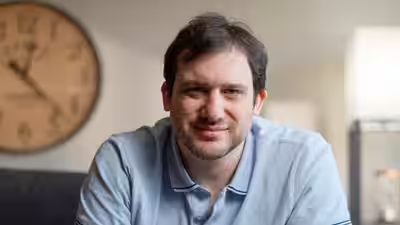
Jacob Tsimerman is widely regarded as one of the world’s leading mathematicians, earning the prestigious Fields Medal in 2026 for his groundbreaking contributions to number theory. Yet, shortly after receiving mathematics’ highest honour, the Canadian professor made headlines for an unexpected career move. Despite previously warning about the potential dangers posed by advanced artificial intelligence, Tsimerman announced that he would join OpenAI to focus on AI safety research. His decision reflects a growing belief among many scientists that the best way to address the risks of powerful AI systems is to work directly on making them safer, more reliable and better aligned with human interests.
How Jacob Tsimerman became a Fields Medal-winning mathematician
Jacob Tsimerman is a professor of mathematics at the University of Toronto and is internationally recognised for his work in number theory and arithmetic geometry. In 2026, he was awarded the Fields Medal, often described as the highest honour in mathematics, for his pioneering contributions to the André–Oort Conjecture and related areas involving Shimura varieties. His research has significantly advanced modern mathematics and established him as one of the leading figures in the discipline before the age of 40.Long before joining OpenAI, Tsimerman had publicly expressed concern about the rapid development of artificial intelligence. He argued that increasingly capable AI systems could pose serious long-term risks if developed without sufficient safeguards. In 2025, he co-authored research examining hypothetical pathways through which advanced AI could threaten humanity, emphasising the importance of preparing for such risks before they become reality. His views made him one of the prominent academic voices calling for greater attention to AI safety.
Why did he decide to join OpenAI?
Tsimerman’s decision surprised many because of his earlier warnings about AI. However, he has explained that his concerns are precisely why he chose to join OpenAI. Rather than stepping away from AI research, he believes the most effective way to reduce potential risks is to contribute directly to developing safer systems. At OpenAI, he is expected to apply his expertise in rigorous mathematical reasoning to problems involving AI alignment, formal verification and system reliability.
What role will mathematics play in AI safety?
Much of modern AI safety depends on understanding how increasingly complex systems behave and ensuring they operate as intended. Tsimerman believes mathematics can provide the theoretical foundations needed to verify AI models, improve interpretability and develop stronger guarantees for safe behaviour. His background in solving highly abstract mathematical problems is expected to contribute to building more dependable AI systems capable of operating within clearly defined limits.
He believes AI could transform mathematics itself
Tsimerman has also spoken about the growing influence of AI on mathematical research. He believes advanced AI systems could eventually outperform human mathematicians in several areas, including discovering proofs, identifying patterns and reviewing mathematical literature. Rather than viewing this as a reason to abandon mathematics, he sees it as a sign that researchers must learn to work alongside AI while ensuring the technology develops responsibly.
Looking beyond academia
Alongside his work in mathematics, Tsimerman has increasingly focused on one of the defining scientific challenges of the 21st century. His move from academia to OpenAI reflects a broader trend of leading researchers applying their expertise to AI safety, where theoretical knowledge is becoming just as valuable as engineering skills. By bringing world-class mathematical thinking into AI research, he hopes to help ensure that future artificial intelligence remains beneficial, transparent and aligned with human values.