By Sunday Olanrewaju, Abuja
The African Network for Environment and Economic Justice (ANEEJ) has demanded an independent investigation into the payment of over ₦14 billion to Atlanta Company for the Summit Junction–Obishi road project, amid a Federal Government disclosure that only about 40 per cent of the contracted work has been completed.
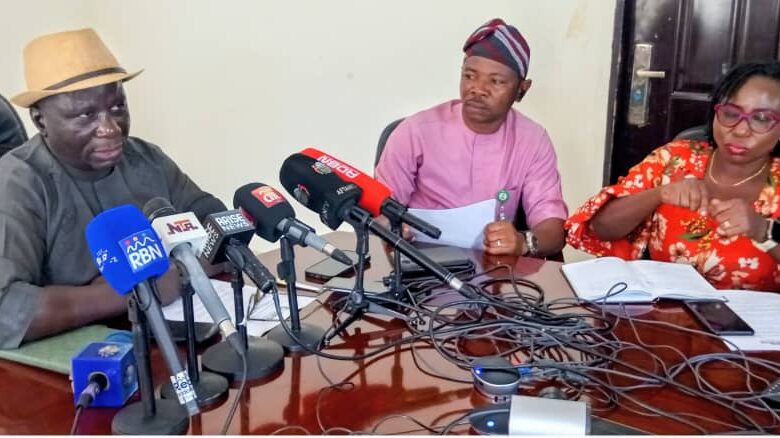
ANEEJ Executive Director, Rev. David Ugolor, made the demand in a statement issued to journalists in Abuja on Monday, insisting that Nigerians deserve a full account of how the public funds were approved, certified, paid and utilised.
Ugolor said the concern followed a public statement by the Minister of Works, Senator Jimwari, on August 28, in which the minister reportedly disclosed that the Federal Government had paid Atlanta Company about ₦14 billion for work covering approximately 11 kilometres from Summit Junction to the Ed Bridge, including channelisation and other structures.
According to him, the minister also disclosed that only about 40 per cent of the agreed work had been executed, leaving roughly 60 per cent outstanding despite the contractor having received the reported payment.

“The minister further stated that only about 40 percent of the agreed work has been completed, which means about 60 percent is yet to be completed, and the N14 billion has been collected,” Ugolor said.
The development, ANEEJ said, raises serious questions about the project’s procurement, certification, payment and supervision processes.
Ugolor said the minister had subsequently directed the ministry’s controller to locate the managing director of Atlanta Company and initiate recovery of funds paid to the contractor.
The minister also reportedly directed officials to call up the contractor’s Advance Payment Guarantee (APG) and update payment records and certificates relating to the project.
But ANEEJ said recovery efforts must be accompanied by a transparent investigation into the entire payment and project execution process.
“We are not saying that N14 billion was stolen. We are saying that Nigerians are entitled to know exactly how N14 billion was committed, certified, paid, and accounted for,” Ugolor said.
ANEEJ challenged the Ministry of Works to publish the complete contract documents, including the original contract, letter of award, contract sum, scope of work, completion period and all approved variations.
Ugolor alleged that the contract is not publicly accessible through the minister’s official channels, despite the enormous public funds reportedly committed to the project.
“Go to the minister of works website, you cannot find the contract. Journalists have not been able to have access. The people of Nigeria have not been able to have access to this contract, and over N14 billion, according to the minister, has been paid out,” he said.
The organisation also demanded a complete payment trail showing the dates and amounts paid, the certificates against which payments were made, officials who certified the work, authorities that approved the payments and the financial institutions through which the funds were transferred.
“This money was not flying in the air. It went through banks. How much was mobilisation? How much was subsequently certified? How much, if any, remains to be recovered?” Ugolor asked.
ANEEJ further demanded an independent technical verification of the reported 40 per cent completion rate.
It wants qualified engineers to independently determine what was contracted, what was actually executed, what was certified and paid for, and the value of the outstanding work.
“We therefore call for the independent technical verification of the projects. Let qualified engineers independently establish what was contracted, what was paid, what was certified, what was delivered, what remains,” Ugolor said.
The civil society organisation also raised questions over the Advance Payment Guarantee reportedly ordered by the minister to be called up.
ANEEJ wants the government to disclose the financial institution that issued the guarantee, its value, expiry date, whether the issuing bank has acknowledged the claim and whether any money has so far been recovered.
Beyond the contractor, the organisation said accountability must extend to government officials involved in the project’s approval, certification, supervision and payment processes.
“A contractor does not normally pay himself. Public officials recommend, certify, approve, and process payment. Therefore, if there has been failure of performance, accountability cannot stop at the contractor,” Ugolor said.
While welcoming the minister’s decision to audit the project, ANEEJ urged the Bureau of Public Procurement (BPP), Federal Ministry of Justice and other relevant oversight institutions to independently establish the facts surrounding the contract.
The group also asked the BPP and Ministry of Works to disclose whether Atlanta Company’s previous performance record on federal road projects was considered before the contract was awarded, particularly in light of provisions of the Public Procurement Act concerning contractors with records of non-performance.
Ugolor stressed that locating or arresting a contractor would not, on its own, resolve the questions surrounding the reported ₦14 billion expenditure.
“Arrest alone will not answer the N14 billion question. An arrest is not an audit. An arrest is not a payment reconciliation. What Nigeria needs is evidence, recovery, accountability, and delivery,” he said.