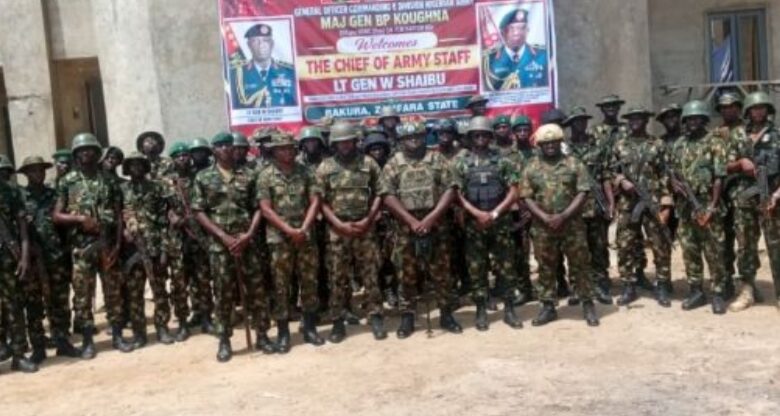
The Nigerian Army has activated three new infantry battalions in Zamfara State, expanding its presence across Bakura, Anka and Kaura Namoda as security forces intensify operations against armed groups in the North-West.
The newly operational units are the 12 Infantry Battalion in Bakura, 23 Infantry Battalion in Kaura Namoda and 28 Infantry Battalion in Anka. The Army said their deployment is designed to increase operational coverage, shorten response time and strengthen security within their respective areas of responsibility.
The development places additional military formations in three locations that have featured prominently in recent security operations.
In July, troops rescued 13 kidnapped victims during separate operations in Anka and Kaura Namoda. Five captives were recovered from a makeshift camp in Bagega, Anka, while eight others were rescued at Ungwan Rogo in Kaura Namoda. Two vehicles were also recovered during the operations.


Days later, soldiers responding to an attack in Magami, Kaura Namoda, rescued 48 kidnapped victims, according to the military. One civilian was killed while two others sustained gunshot injuries during the incident.
The area also recorded another attempted abduction in July when troops responded to a distress call in Shiyan Abiyola, Kaura Namoda. The intervention forced the attackers to abandon the operation and flee.
These incidents help explain the significance of the new formations. A battalion positioned closer to vulnerable communities can give commanders a permanent troop presence rather than relying solely on forces moving from distant bases when distress calls arrive.
READ RELATED NEWS UPDATES:
At the activation ceremonies, Colonel Joseph Umaru, Acting Commander of 1 Brigade, represented Maj
or General B.P. Koughna, the General Officer Commanding 8 Division and Commander of Sector 2, Operation FANSAN YAMMA.
Umaru said the military would continue operations aimed at protecting law-abiding residents. He also stressed that security agencies could not work in isolation, calling for cooperation among the military, other security organisations, traditional institutions and residents.
He asked communities to provide timely and credible intelligence while charging the newly deployed soldiers to maintain discipline, professionalism and operational vigilance in accordance with established rules of engagement.
The traditional institutions in the three affected areas have also been drawn into the security effort.
The Emirs of Bakura, Anka and Kaura Namoda welcomed the additional battalions and pledged to support the security agencies through community mobilisation and information sharing.
That partnership could prove important because military intelligence does not come only from surveillance equipment or patrols. Residents often possess information about unfamiliar movements, hideouts, trafficking routes and suspicious activities before such details reach formal security channels.
Zamfara has already witnessed an intensified military campaign this year. In May, Operation FANSAN YAMMA reported an operation around Kaura Namoda and Birnin Magaji in which three suspected terrorist leaders were killed and weapons and ammunition recovered. The state government also reported continued military activity against armed groups across the state.
The need for additional deployments also comes against a backdrop of continued attacks in the North-West. In August, terrorists attempted to infiltrate a military base at Kasuwan Daji in Kaura Namoda. The Army said the attack was repelled, although an Army officer and a police officer were killed, while nine abducted civilians were rescued.
The three battalions therefore represent more than an increase in troop numbers. Their effectiveness will depend on how quickly they can respond to threats, how well intelligence moves between communities and security agencies, and whether the formations receive sufficient logistics, equipment and personnel.
From the end of Bakura, Anka and Kaura Namoda, the immediate question is practical: whether the new military footprint will translate into faster intervention when communities come under attack.
That will be the real measure of the deployment as the Army deepens its security operations across Zamfara.