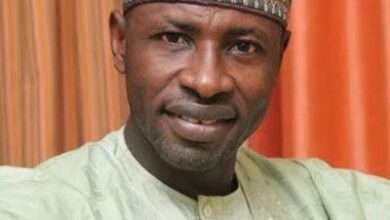
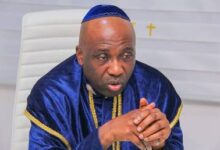
Daniel Onjeh, the Nigeria Democratic Congress (NDC) senatorial hopeful for Benue South, has rejected claims that Benue youths attacked the convoy of the party’s presidential candidate, Peter Obi.
Onjeh, who was beside Obi when the incident occurred, said the men who barricaded the convoy during the former Anambra State governor’s attempted humanitarian visit to Yelwata were predominantly middle-aged men.
In a statement issued on Friday, Onjeh, urged the public not to mistake their actions for the position of Benue youths, who he said had demonstrated strong support for Obi during the 2023 presidential election.
Obi polled 308,372 votes in Benue State in the 2023 election, narrowly trailing the APC candidate, who scored 310,468 votes, according to figures cited by Onjeh.
In Benue South, Onjeh said Obi secured more than 95,000 votes, while the APC and PDP presidential candidates recorded about 40,000 votes each or less.
“Young people constituted a potent part of that voting force. So, how can the same young people who came out in their numbers and voted overwhelmingly for Peter Obi suddenly be presented as the people who mobilised with sticks and stones to prevent him from entering Makurdi? It simply does not add up,” Onjeh said.
“Peter Obi was not rejected by Benue, and he was certainly not rejected by Benue youths. His support in Benue is organic. It cannot be manufactured by government, and it cannot be extinguished by thuggery. Let nobody mistake the actions of a handful of thugs for the voice of Benue,” he added.
Onjeh said he had received several calls and messages from young people in the state who expressed disappointment over the incident and rejected being collectively blamed for it.
He said some of them had asked Obi to return to Benue so they could receive him and demonstrate that the incident did not represent the position of the state’s youths.
The former President of the National Association of Nigerian Students (NANS) said footage of the incident also supported his claim that the attackers were not youths.
“Take a very close look at the footage and photographs that have circulated since the incident. Look carefully at the thugs carrying sticks and stones and those barricading the road. What you see substantially supports what these young people have been telling me: those men should not simply be labelled Benue youths.
“It also corresponds with what I saw with my own eyes. I was standing right beside Mr Peter Obi and saw these men at close range. They were predominantly middle-aged men, many visibly in their 40s and 50s,” he added.
Onjeh said Obi’s visit to Benue was humanitarian and not a campaign trip.
According to him, Obi planned to visit Yelwata, pay tribute to victims of violence, sympathise with bereaved families, meet survivors and internally displaced persons and offer support before leaving the state.
“This was not a campaign visit. Peter Obi did not want noise. He did not want fanfare. If we wanted a political reception, we would have announced his coming, mobilised our members and supporters, and Makurdi would have known that he was coming,” he said.
Onjeh further alleged that the location of the barricade, shortly after Obi’s convoy left the airport, prevented the presidential candidate from reaching the wider population in Makurdi.
He said Obi could have attracted a large crowd if he had reached areas such as Wurukum Roundabout, where residents would have learnt of his presence.
“He was stopped before he could get to the people. A barricade mounted by a handful of thugs at the exit from the airport cannot therefore be presented as the verdict of the people of Benue State,” Onjeh said.
He urged journalists and political actors to stop describing the attackers collectively as “Benue youths”, insisting that responsibility should be placed on those who committed the act.
“Do not speak for Benue youths with stones. Do not speak for them with sticks. Do not speak for them with a barricade. Allow them to speak for themselves,” he said.
Onjeh also warned against normalising political violence, saying attacks on political opponents could eventually threaten politicians and supporters across party lines.
“Today it is Peter Obi. Tomorrow it could be the candidate of another political party. If we normalise thuggery simply because its immediate target is somebody we do not support, eventually nobody will be safe from the monster we have created.
“The answer to a candidate you do not support is not a stone. It is your vote,” he said.
Onjeh said Benue youths would have another opportunity to express their political choices during the 2027 elections.
“A barricade is not a ballot. Thuggery is not democracy. And the men who attacked Peter Obi’s convoy must never be allowed to become the face of the courageous youths of Benue State,” he added.