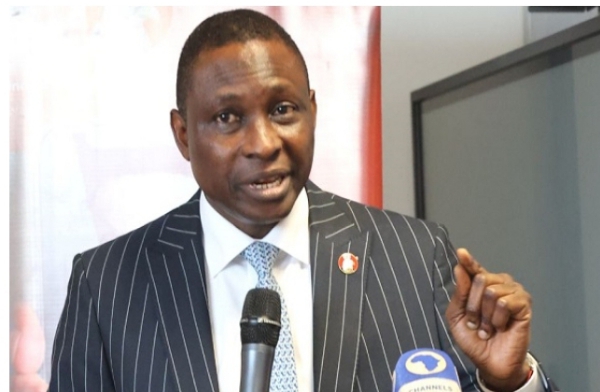
The Economic and Financial Crimes Commission (EFCC) receives more than 20,000 petitions relating to public-sector corruption every year, its chairman, Ola Olukoyede, has disclosed.
Olukoyede made the disclosure in Abuja during the 80th birthday celebration of former Attorney-General of the Federation and Minister of Justice, Chief Kanu Agabi.


He said the volume and nature of the petitions reflected the scale of the corruption challenge in the country, adding that some of the cases investigated by the Commission involved public officials whose financial positions changed significantly after assuming office.
“I receive over 20,000 petitions in a year in respect of public corruption, all terrible. What is going on? Every minute, public officers take money, and if you go through some of our case files, you will weep,” he said.
The EFCC chairman said the alleged diversion of public resources should not be viewed solely as a law-enforcement issue, stressing that Nigerians collectively bear the consequences of corruption.
“The way people take national resources, as Nigerians, we’re victims of these fraudulent activities. And we must come together for once in our lifetime and say no to the activities of some of our leaders,” Olukoyede said.
He further disclosed that EFCC investigations had in some cases traced substantial naira and dollar assets to public servants who had comparatively modest financial positions before assuming office.
According to him, some officials were allegedly linked to millions of dollars and naira accumulated within three or four years in public office, while others were allegedly connected to the ownership of dozens or even hundreds of houses.
“Somebody will spend three to four years as a public servant, but before he got to office, he had less than N100,000 in his account. By the time he’s leaving, we were able to trace several millions of dollars and naira to him,” he said.
“Some build 50-something houses, sometimes 200 houses. There’s no way a nation will develop with those kinds of people in power, no way,” Olukoyede added.
He said public office holders must be prepared to account for their stewardship, stressing that transparency and accountability should remain central to the management of public resources.
Also speaking at the event, the chairman of the Independent Corrupt Practices and Other Related Offences Commission (ICPC), Musa Adamu Aliyu, identified societal tolerance of corrupt practices and weaknesses in public institutions as major factors sustaining corruption.
“The major challenge of corruption in this country is that we tolerate the culture of corruption; that is why it is thriving. Secondly, we have systemic errors; our systems are weak,” Aliyu said.
The ICPC chairman called for integrity education to begin early, particularly in primary and secondary schools, arguing that young Nigerians should be deliberately exposed to values that discourage corruption.
He also urged stakeholders to engage members of Generation Z and Generation Alpha on integrity and responsible citizenship.
“We need to tell them that we want them to imbibe the culture of integrity,” he said.