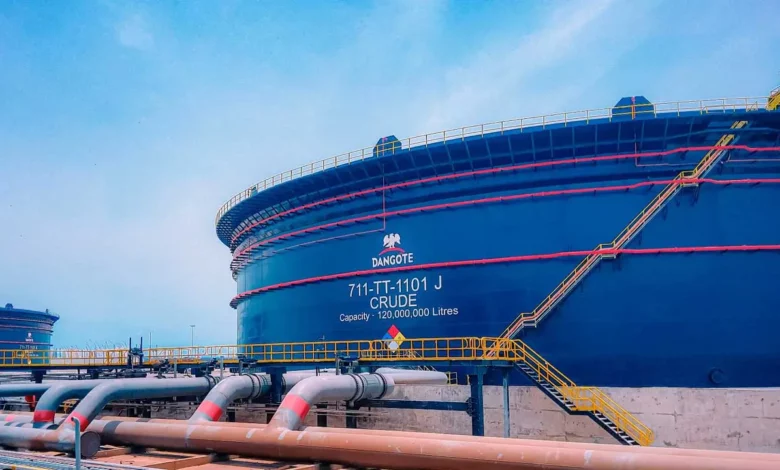
Dangote Petroleum Refinery processed 736,470 barrels of crude oil daily in August 2026, reaching an average capacity utilisation of 105.21 per cent, as the Dangote Group announced a fresh $50 billion investment across Africa.
The regulatory agency, Nigerian Midstream and Downstream Petroleum Regulatory Authority (NMDPRA), released the performance figures showing that the 700,000 barrels per day Lagos plant processed more crude oil than its nameplate capacity.
The President of Dangote Group, Aliko Dangote, announced the new $50 billion funding commitment during an investor event in Nairobi, Kenya.
The meeting occurred before the ground-breaking ceremony for the new Dangote East Africa Petroleum Refinery and Petrochemicals project in Lamu, Kenya.


Local crude deliveries push processing beyond capacity
The Lagos refinery raised its crude oil processing volume from 497,000 barrels daily in July 2026 to 736,470 barrels daily in August 2026. This increase brought the plant’s capacity utilization up from 71 per cent in July to 105.21 per cent in August.
A 16.75 per cent rise in domestic crude oil supply supported this operational growth. Local crude deliveries to the facility climbed to 683,000 barrels per day throughout August.
READ RELATED NEWS
Dangote opens ownership to global investors with $2.5bn equity deal
Why Aliko Dangote remains one of Nigeria’s most influential figures
Dangote IPO demand surges as investment platforms struggle
The facility produced an average of 84.43 million litres of white products daily during the period. These refined items include Premium Motor Spirit (PMS or petrol), Automotive Gas Oil (AGO or diesel), and Aviation Turbine Kerosene (ATK or jet fuel).
The Dangote Group stated that this operational performance supports national energy security, saves foreign exchange, and advances industrial growth.
Industrial footprint expands to east Africa
Aliko Dangote spoke during a fireside chat with Frank Mwiti, the Chief Executive Officer of the Nairobi Securities Exchange (NSE). The exchange hosted the event, titled ‘Dangote Petroleum Refinery IPO High Level Investor Engagement’.
Dangote stated that his group has invested over $25 billion in existing operations and will now spend an additional $50 billion. He explained that large-scale industrial projects are necessary to defend African markets and generate local wealth.
“We have already invested more than $25 billion, but right now, we’re going ahead to invest an additional $50 billion,” Dangote said. “We want to create and generate wealth for Africans, to make sure that we defend our markets. And the only way to defend the market is not to do baby steps. It is better we do big scale.”
The planned Lamu refinery will mirror the operational design of the Lagos facility. David Ndii, the Chief Economic Adviser to Kenyan President William Ruto, stated that an April meeting of regional leaders evaluated the East African refined petroleum market. The assessment placed annual demand between 20 million and 30 million metric tonnes.
Ndii said President Ruto approved the project after confirming the existence of product demand, available regional capital, and execution capacity.
Public ownership and revenue targets under vision 2030
The Dangote Group plans to open its corporate assets to public ownership through African stock markets.
Dangote said the upcoming Lamu refinery will list its shares directly on the Nairobi Securities Exchange when ready for public equity trading. He stated that this public offering strategy aligns with the company’s Vision 2030 corporate plan.
Under Vision 2030, the group targets over $100 billion in annual revenue.
“We want to make sure that, for the first time, an African company will actually be out there with over $100 billion of revenue,” Dangote said. “This thing is possible.”
What readers should know about the refining figures
The capacity utilisation figure measures actual refinery output against its official designed limits. Operating at 105.21 per cent means the facility processed more crude oil daily in August than its official 700,000-barrel daily design capacity.
The primary outputs driving these statistics are refined white products, which refer to light petroleum fuels including petrol, diesel, and aviation jet fuel.
All operational metrics and production volumes were documented and released by the Nigerian Midstream and Downstream Petroleum Regulatory Authority, the federal agency regulating midstream and downstream oil operations.
The factory’s daily output bump depended directly on changes in local raw material availability. Increased domestic crude oil deliveries, which reached 683,000 barrels daily after a 16.75 per cent surge, provided the raw crude required for the processing plant to exceed its nameplate capacity.
For More News Details, Visit New Daily Prime.