Every week, Naijaonpoint spotlights the unfiltered stories of women navigating life, love, identity and everything in between.
What She Said will give women the mic to speak freely, honestly and openly, without shame, about sex, politics, family, survival, and everything else life throws our way.
The subject of today’s #WhatSheSaid is Amara Ogara, a 32-year-old Nigerian businesswoman, storyteller, content creator and filmmaker known online as Amara the Lesbian. She talks about growing up Igbo in the North, the complicated love she carries for parents who hurt her and shaped her, meeting the woman who became her wife, and reclaiming a word people once used to silence her.
My name is Amara Ogara. A lot of people call me Glory now because it is my first name and my work name, but Amara is what I respond to instinctively. Sometimes I forget I am Glory.

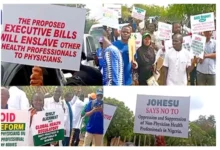
I am a businesswoman. I am a storyteller. Many people found me and connected with me through my stories. I believe in using stories as a medium to raise social awareness and drive impactful change in society, because what people see, they believe. What they believe, they can become.
I am a multidimensional creative, although I am currently working inside the corporate system in America. I recently completed a master’s programme and am now in the workforce, but I still identify as a creative. A storyteller. A filmmaker, because I know that at the end of everything, I will be making films. I still share my stories through my social media platforms.
And I am a lesbian. A married one. My wife is Nigerian, too. We have been together for eleven years and counting.
I am the second-born and first daughter of an Igbo man and an Igbo woman, and I always mention that because being Igbo adds a specific layer of context to your Nigerian experience.
My parents met in Kano. I was born in the North. My dad was born in 1960, which means he was seven years old when the Biafran War started. My mum was born in 1970, the year the war ended. They were babies during that time. I never really understood what that meant until I became an adult and started reading and understanding my Igbo history, and what war leaves behind in the hearts of children, fathers and mothers who survive it. I feel like I was touched by that war even though I was not born during it. In some ways, because of my father. That trickle-down is real.
Complex. My father struggled enormously with his anger, his temper, and his temperament, and I was a huge recipient of that struggle. He believed in spare the rod, spoil the child, so my dad would not spare the rod. He would spoil the rod, and so many rods were spoiled on me. I went to school with scars on my back. There was one time there was a scar on my face from the rod. I had so much anger toward my dad growing up. So much.
But I also want to say this, because it is the truth: my dad is a beautiful man, too. He was an artist. He would make our hair, plait it, relax it, and massage my mum’s feet. He created artworks. He taught us how to soak paper in water, let it soften, pound it, and then use the pounded pieces to make sculptures. He was a fantastic artist with a fantastic mind. He has had a stroke for the past fourteen years or so, and he is different now, but the person I grew up with was both. Both things are true at the same time.
A pendulum. Going from one end of rebellion to one end of people-pleasing.
When I was in people-pleasing mode, I would not wait to be told to make the bed. If I knew Mummy liked the bed made, before she came back from the market, I would have already done it. I wanted her to feel good when she walked in. I wanted her to laugh. I wanted her to be happy.
But I was also the kind of child who would steal money from my parents. Because you beat me yesterday or last weekend, I am going to school now, and I want to buy minerals for my friends and eat shortbread, but I do not have the money for that, so I will take it. I cannot talk about my childhood without talking about how much I stole from them, and I say it honestly because I remember that child. That child struggled deeply with powerlessness and hated it. My mum had a restaurant and was bringing in cash daily, so I would take 200, 100, or 50 naira. Just enough for Coke and shortbread for my friend and me. That was the whole deal.
Underneath all of that, though, I was carrying a deep sadness. I was very depressed growing up. Some days, I would be crippled in bed and just crying, or wake up in tears like I had been running in my dreams, running from my father and his cane. I struggled with intense darkness for years. There was a period where I genuinely did not think I was going to make it to 30. Not that I was going to act on it, but it lived as a quiet background thought: “I am not going to live long anyway. Let me just experience what I can and then go.” It took growing up and fully understanding myself to realise where all of that was actually coming from.
But I was also a loving child. I loved my siblings. Something about experiencing my father’s anger made me want to be everything he wasn’t. I learned very early to communicate my frustration without raising my hand because I had experienced what it felt like to be on the receiving end, and I never wanted to pass it on to anyone smaller than me. My siblings called me a crybaby. Every small thing, Amara is crying again. But funny enough, they would do anything to avoid seeing me cry.
What She Said: I Left a Safe Marriage with a Man for a Woman Living a Double Life
Hard work, above everything. We would wake as early as 4:30 am to handle our responsibilities. My elder brother and I were in charge of opening the Santana leather, the ones used to roll eba and semo, getting them ready before the cooking started. Food was leaving for the shop by 6 or 7 am, so everyone was already in the process before the sun was properly up.
My parents also raised us to understand money very early. If the mai ruwa would normally be paid to fetch water, my mum would offer to pay us instead. So even as small children, we were calculating: let me go and fetch this water and make this money.
I had my own farm at eight years old. My father had unused land around the house. He said I could farm whatever I wanted, so I bought aleho (the Hausa name for a fast-growing leafy vegetable widely known as African spinach) seeds, planted them, harvested them, tied them into bunches, and hawked them. I had my own system for making money while also earning from my parents’ system.
Everywhere I go, I introduce myself as a businesswoman because I am constantly looking for money-making opportunities. When I walk into a room, trust that I have already found the demand and the supply chain. That comes entirely from that childhood.
A storyteller. If you ran a public poll and asked people who knew me from secondary school what they remember, I guarantee you would find someone saying, “That senior who would always tell us stories.”
After prep class, I would ask, “Who wants to hear a story?” And junior students would gather around my bunk, scatter into corners around me, someone calling from the top bunk, “Senior Amara, talk louder so we can hear from here.” I would make up stories on the spot. I still do this with my wife. When she is feeling a certain way, I say, “Should I tell you a story?” and I just create something right there.
I was also known for generosity. I am a big believer that nobody should starve around you. If there is food, share it. I was known for that, stories and trouble. I was mischievous and goofy. Still am. Just slightly more reserved now, if I do say so myself.
Not until my early twenties, genuinely. Growing up, I was not exposed to anything that gave me that awareness. My siblings and I watched Diego and Paloma, When You Are Mine, Esmeralda, Super Story, and Nigerian movies my mother rented from the shop. Nothing that explored same-sex relationships. It was completely outside my radar until I was about 19 and I watched Blue Is the Warmest Colour.
That movie stayed in my mind, both conscious and subconscious, for almost a year. The character Adèle had so much of me in it. I had always gotten along well with boys, had good friendships, and had good banter. But once it came to romance, it always felt like I was giving them an upgraded friendship. I did not understand the disconnect.
I started learning about boy-girl relationships around 13 or 14. I even set a rule for myself that I would not date until I was 18. On my 18th birthday, there were boys waiting, and I had to pick one. Even after I did, it always felt like a weird chore. Every time I thought about the future, I did not even know what to think. Looking back, that depression was wrapped up in everything I had not yet understood about myself. I was carrying so much that I could not yet name until I got into university.
I went to Eastern Mediterranean University. That distance from my family and from Nigerian culture genuinely helped. It created space for things I would not have had space for back home.
In the first semester, I was out with a friend. We went dancing, drank, and on the way back in the Uber, we were cuddling into each other, and it felt so natural to look at her and ask if I could kiss her. She said yes. I asked if she wanted to come back to my dorm. She said yes. That was my first physical, sexual experience with a woman.
The next morning, she woke up, and we went straight back into friend mode. We never spoke about it. Not once. Not until thirteen years later did we finally have a proper conversation about what had happened between us. In the moment, it was just something that lived between us in silence. What we do in the darkness we do not talk about in the light. During the day, I was her friend, she knew my boyfriend, I knew her boyfriend, and that was that.
He was actually one of my closest friends. We were like best friends. We talked about everything, including non-monogamy and my feelings for women. It was not like I was hiding things from him. He knew me in ways that most people did not.
When I met my wife for the first time while still with him, I came home and told him I had met this person and I really, really liked her. He understood. Our relationship ended because of how much I liked her. I eventually lost that friendship because he couldn’t just be my friend anymore, but I have never regretted the choice.
She punched me on the school bus by accident. Every time we ran into each other after that, she would say, “Oh my God, I am so sorry about the other day!” This went on for about a year. One afternoon, she came to find me while I was sitting outside the department and said she just wanted to say sorry again. I told her, “Girl, you need to find something new to say to me. You cannot keep saying the same thing all the time.” We laughed. We talked.
She had grown up queer in Nigeria. She had dated women since she was a teenager. She was the first real-life lesbian that I ever actually experienced, and I was completely mind-blown. She had so many stories, so many experiences.
And then one day, we were taking a walk, and I asked her what she thought about marrying a woman. She stopped walking, looked at me, and said something about how some things are sacred and should stay sacred, that marriage is not for people like us.
And I stood there thinking, wait. I understand the world is against you, but why are you not on your own side?
That conversation changed everything for me. I walked back to my dorm with this conviction in my heart that I wanted to shift the world for this person. Even if I could not change everything that was wrong with it, I wanted to change the way she saw herself in it. The next day, I started talking about her. I told my friends. I talked about her on YouTube. I made a video about kissing a girl. I just started talking, and I did not have a game plan. All I wanted was for the idea of being with a woman to feel as normal as being with a man. Years later, I started going by Amara the Lesbian.
Before I met Yinka, my wife, I had been telling myself I was pansexual. I like people. I am attracted to people. That is what I kept saying while I was still dating boys.
Then I remember the first time Yinka and I were intimate, and I thought, yo, this is exactly what it should feel like. That was also, coincidentally, the very first time I had an orgasm in my life. And I lay there thinking, my body is not actually broken. I can feel things. I can actually feel things. Because before that, I had genuinely wondered: Is something wrong with me? Is my body broken? Did my father break my body with all those canes? It had always felt like a chore with boys. Something I would do to reward someone, or run away from when I could.
With Yinka, I understood. I stopped saying pansexual and started saying what I actually was. You like women. You like women, women, women.
What do you think about this?
Drop your opinion in the comment section.
FOLLOW US & Share this with someone who needs to see this.